My Turn: The Tongass needs a legislative exemption from the Roadless Rule
Published 10:30 pm Sunday, August 3, 2025
When one mentions the application of the 2001 Roadless Rule to the Tongass National Forest in Southeast Alaska the listener thinks of large-scale timber cutting. But the Tongass was created near ancient volcanoes and consequently is one of the richest volcanogenic massive sulfide (VMS) districts in North America.
As pointed out in Patricia Roppel’s books “Fortunes from the Earth” and “Striking it Rich! – Gold Mining in Southern Southeast Alaska” the Tongass contains numerous areas mined in the 1900s for copper, zinc and gold. At the turn of the 20th century the AJ and Treadwell mines in Juneau were the largest in the state. Douglas, adjacent to the Treadwell Mine, was then the largest town in Alaska. Today, Greens Creek, Kensington and Dawson Mines are now operating mines on the Tongass.
The 2008 Tongass Land Management Plan (TLMP) Amendment estimated the values of discovered (page 3-356) and undiscovered minerals (page 3-358 – 3-359) on the Tongass as follows:
A. Discovered Minerals: $37.1 billion (expressed as 1988 dollars) in the U.S. Bureau of Mines study (Caldwell 1990).
B. Undiscovered Minerals: In 1990, this value was $28.3 billion (expressed as 1988 dollars). Highest among the individual minerals were copper ($6.8 billion), iron ($4.6 billion), molybdenum ($4.9 billion), and tin ($3.4 billion).
The value of these critical and precious metals is far higher today and the technical ability to recover more minerals from the same amount of ore has vastly improved.
This should make the Tongass the most immediately accessible mining district in Alaska.
But access for drill rigs and other large equipment needed for exploration is uncertain because road access has been prohibited and other forms of access restricted. While the Preamble to the 2001 Roadless Rule recognizes the right of access to locatable mining claims, it reserves the right to approve access:
In some cases, access other than roads may be adequate for mineral activities. This access may include, but is not limited to, helicopter, road construction or reconstruction, or nonmotorized transport. Determination of access requirements for exploration or development of locatable minerals is governed by the provisions of 36 CFR part 228. Fed. Reg. Vol. 66 January 12, 2001, 3244 at 3253 (middle column).
In other words, what is “reasonable” access is up to the district ranger or forest supervisor. That in turn will depend on whether the federal administration supports or does not support development in Alaska. In short, there are no guidelines for determining what form of access is “reasonable.”
For example, in 1977 the Forest Service denied a Special Use Permit to U.S. Borax to construct a road for a bulk sample of 5,000 tons of ore at the Quartz Hill Project, requiring access by helicopter. SEACC v. Watson, 697 F.2d 1305 (9th Cir. 1983). As the opinion shows, six years later Borax still did not have a permit to build the road needed to move that volume of ore.
Larger core and underground drilling equipment requires roads to move across beaches to the mining exploration area. Expensive helicopters are incapable of slinging such loads. If road access is denied it means that access may be completely denied to large mining equipment that cannot be “slung” to a mining exploration site by helicopter.
Another hindrance is the prohibition on the cutting of trees in mineralized Inventoried Roadless Areas (IRAs). Mining exploration requires the drilling of multiple exploratory holes to determine the subsurface characteristics and extent of the mineral resource. If exploration establishes there are viable deposits, mine development normally requires the substantial cutting of trees for site clearing for buildings, tailings piles, mills, and other facilities.
While “reasonable access” is technically permitted in IRAs, cutting trees associated with mining exploration and development does not appear to be allowed. 36 C.F.R. § 294.13 (b) (2) authorizes the cutting of timber “incidental to implementation of a management activity not otherwise prohibited by this subpart.” However, there is no mention of mining in the examples of what this section authorizes provided in the 2001 Rule and ROD. Moreover, in describing this section the 2001 Rule and ROD provides: “Such management activities are expected to be rare and to focus on small diameter trees.”
A permanent exemption of the Tongass from the 2001 Roadless Rule is necessary to assure road access to locatable minerals for operators that can meet the rigorous environmental standards of 36 C.F.R. Part 228 and the associated National Environmental Policy Act review. An exemption is also needed in the Tongass to authorize the cutting of trees needed to support mineral exploration and development.
In sum, this exemption must be by legislation to eliminate the uncertainty created by the “ping-pong” effect of exemption followed by recission of the exemption we have recently witnessed. Exemption of the Tongass by rulemaking is insufficient as evidenced by recent history.
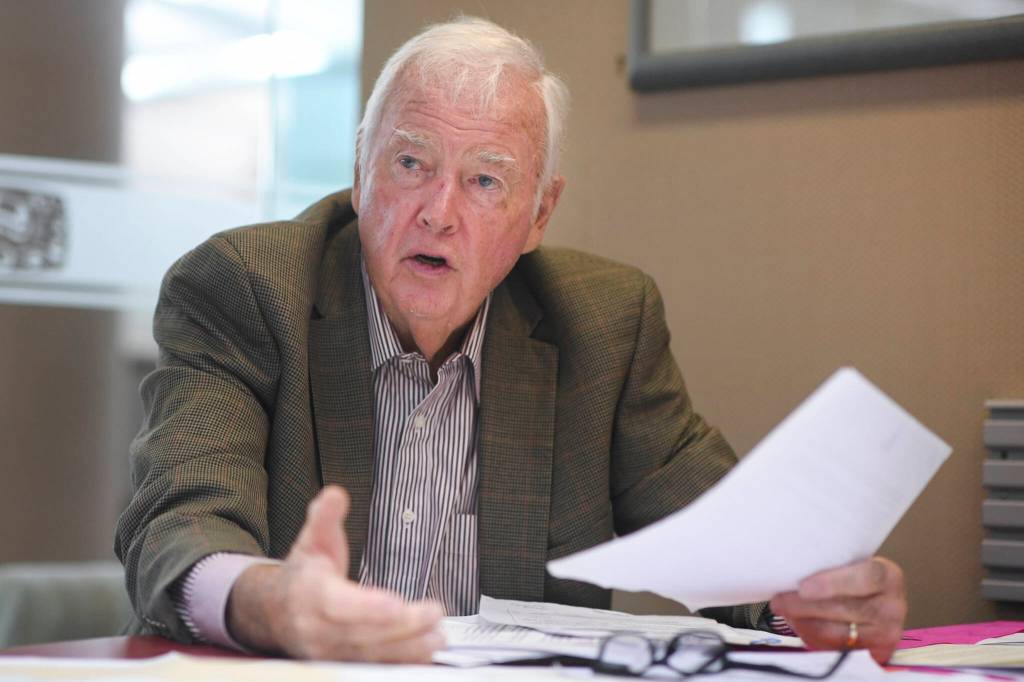
Frank H. Murkowski is a former U.S. senator and the eighth governor of Alaska.