When Alaska salmon ‘go viral’
Published 3:00 am Friday, February 15, 2019

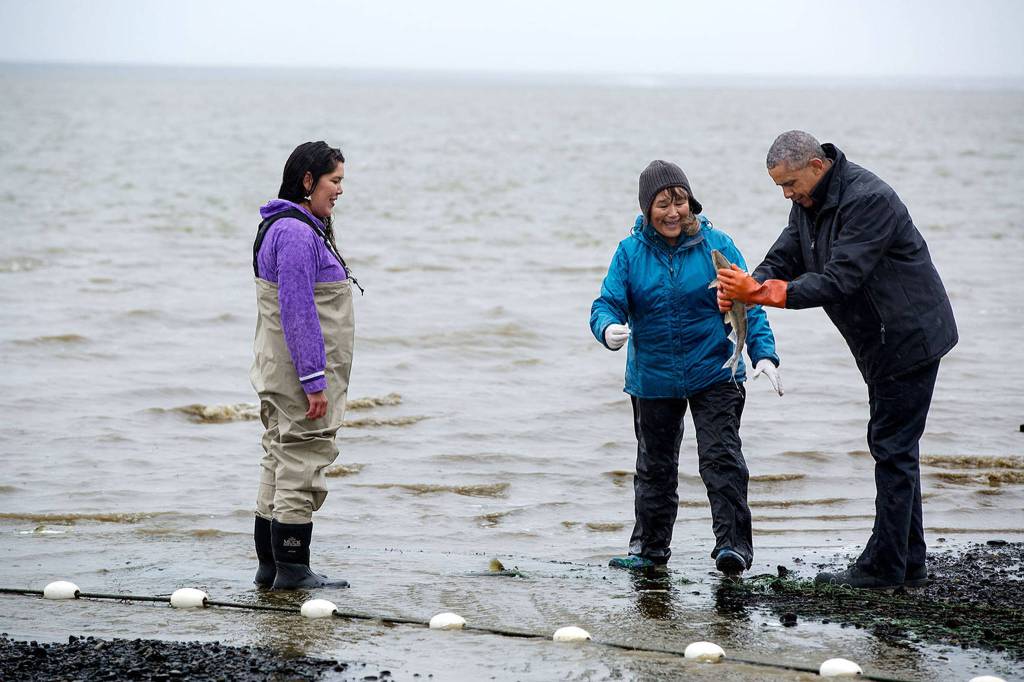
The sitting president of the United States visited Dillingham in 2015 and picked fish, ate traditional foods and joined local kids for Yup’ik dancing. On Kanakanak beach, President Barack Obama picked a humpy out of the net with local residents, Mae Olson and Alannah Hurley, when it spawned on his shoe.
Despite historic events of that trip, including that the president called Bristol Bay one of the United States’ “most important natural resources,” within days, that humpy became the nationwide story of Obama’s visit to Alaska. Featured from KDLG (Bristol Bay’s public radio) to The Guardian, coverage of the presidential trip to the north quickly spread far and wide, and always included a picture of him with that spawning humpy.
Such is the nature of viral internet content. What “goes viral,” when internet content is shared rapidly from one user to the next, is highly unpredictable. But it’s easy to recognize once it’s happened. Though Alaska has its fair share of viral-worthy content created almost daily, it’s the infamous salmon-related content that never seems to die.
Few would consider a humpy spawning on Obama a highlight, nor do many Alaskans celebrate the regrettably viral stories concerning Alaska tapeworms, which we’re all still trying to forget.
Last fall however, an annual tradition at Katmai National Park became viral, which may more closely reflect the type of salmon-related content that Alaskans might join in sharing.
Starting back in 2014, in order to bring attention to hyperphagia, the phase when brown bears gorge themselves on sockeye to prepare for hibernating over winter, a visual media specialist ranger in the park created “Fat Bear Week.” The ranger posted pictures of the largest bears in the park feasting at Brooks Falls and had the internet vote to crown the fattest.
[Wild Shots: Photos of Mother Nature in Alaska]
In 2018, a tweet paired with a meme depicting the future-winner, Bear 409, with the caption “THICC” set off a tweet-storm and media frenzy that induced calls to the park from The New York Times and Washington Post. By the time it was all said and done, 2018’s Fat Bear Week had a combined reach of over 823 million people.
“Fat Bear Week is really fun, but it is about bear survival,” said Katmai Conservancy Project Manager and former Katmai National Park Ranger Sara Wolman. “They are surviving because of all the salmon that are there. That’s what people should think about.”
Other Alaska viral content makes the salmon connection much more directly. “So Apparently There Is Something Called A Salmon And It’s Freaking Adorable,” is an internet article that has reappeared regularly since it was first published in 2015.
“Say hi to your new favorite thing ever,” the article says, now with over 17,000 shares on the Facebook platform alone. And later, “’Hello, I’m a salmon, and I’m incredible. I live in the river. Did I mention I’m THE ABSOLUTE CUTEST?’”
[Applications open for commercial fishing apprenticeship]
Though some content leaves us scratching our heads, others make perfect sense.
Like the viral entrepreneurial sensations Emma Teal Laukitis and Claire Neaton, better known as the Salmon Sisters, who together design their own clothing including women’s and men’s garments, salmon-leather accessories and kitchenware, while selling their own fish and donating canned Alaska salmon to Food Bank of Alaska.
The Salmon Sisters, hailing from the Aleutian Islands with a flagship store in Homer, were recently featured in Forbes’ “30 under 30” list for 2019.
In other less productive or philanthropic corners of the internet, some recall the time pop-mogul, Taylor Swift, dressed like the bottom of a salmon fillet, which could have easily gone viral, but luckily, didn’t.
This isn’t an exhaustive list, nor the end of salmon-related viral content in Alaska. Whether the media makes Alaskans beam with pride, laugh, or grimace, salmon are an integral part of our culture and economy. As Americans’ love for gawking at their notoriously entertaining northern neighbors lives on, our salmon-based viral stories won’t likely end anytime soon, either.
• Jenny Weis is the Alaska communications director of Trout Unlimited, a nonprofit that works to conserve, protect, reconnect and restore North America’s coldwater salmon and trout fisheries and their watersheds.