Voters face $15M question in upcoming election
Published 10:30 pm Monday, September 7, 2020
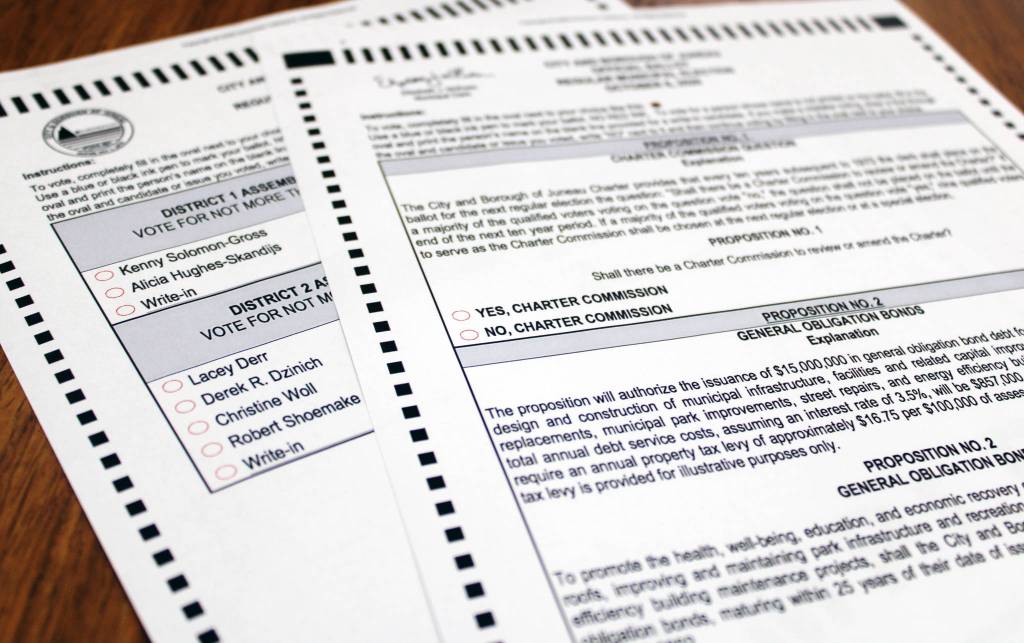
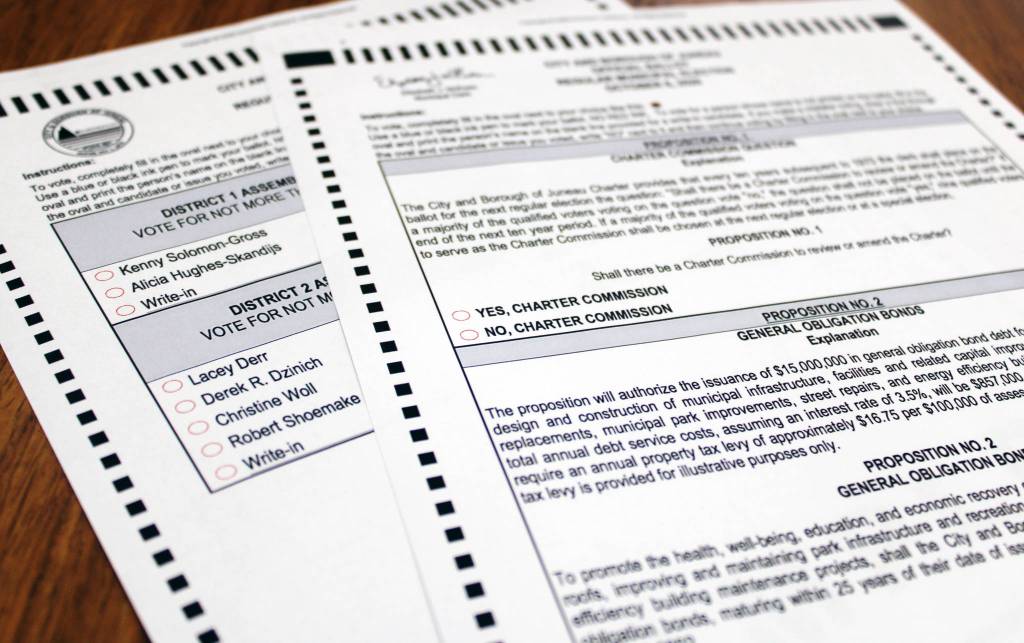


Editor’s note: Ahead of the Oct. 6 municipal election, the Empire is publishing articles on how the vote-by-mail election will work, the propositions that will appear on ballots and races for Assembly and Board of Education seats. The Empire is also partnering with the League of Women Voters, a nonpartisan organization that does not endorse parties nor candidates. On Thursday, Friday and Sunday, you’ll find candidate bios and answers to six questions that the League developed. In cooperation with the Empire and KTOO, the League will hold a virtual candidate forum at 7 p.m. on Sept. 16.
School board and Assembly members won’t be the only things decided by City and Borough of Juneau voters in October.
They’ll also be asked to consider two ballot propositions. The first asks whether the city should establish a commission to review the city’s charter, the second, which has attracted much more public interest, asks voters to approve $15 million in bonds for infrastructure projects.
[Read about how this year’s municipal election will work and what will appear on ballots here]
The Economic Stabilization Task Force, established by Mayor Beth Weldon to help guide the city through the economic consequences of the coronavirus pandemic, suggested in June the city consider issuing general obligation bonds to pay for already needed infrastructure projects.
“The benefits of infrastructure investment are two‐fold,” stated a June 25, letter from the task force to the Assembly. “(1) the immediate infusion of capital and consequent workforce mobilization, and (2) the long‐term—multi‐generational—facilities that are constructed.”
The task force didn’t suggest how much should be issued, or what projects should be given priority. The city manager’s office and the Assembly came up with a list of projects that could be funded and eventually landed on parks, roads and schools as the three key areas to be addressed by the bonds. On Aug. 4, the Assembly voted to send a $15 million bond package to the voters.
The package would ostensibly distribute the $15 million evenly, with $5 million each going to parks, schools and roads. But the big-ticket item in the package is repairs to school roofs, which city officials speculate will cost more than $5 million. Funding in the bonds is being kept open specifically so extra funds can be added to certain projects as needed.
But bonds have to be paid for, and exactly how much this package is going to cost Juneau taxpayers isn’t an easy question to answer.
That’s because there are a lot of factors influencing city taxes that are outside of city control, namely school bond debt reimbursement from the state.
“This is one of these things where people would like a simple picture and like a simple answer but it’s not,” Watt told the Chamber. School bond debt reimbursement was “really, the gorilla in the debt service room.”
[Assembly sends $15 million bond package to voters]
Going into the pandemic, the city had healthy cash reserves and was getting ready to “retire” or end payments on another set of debt payments. That means the city has the ability to take on more debt or it could lower the mil rate, the percentage of tax on assessed property.
But without knowing how much the state is going to reimburse the city, its hard to say if taxes will go up or down even without the bond package, said City Finance Director Jeff Rogers.
Under the original school bond debt agreement between the state and municipalities, the state would pay 70% of the total cost of the project. But as the state’s finances have decreased, Gov. Mike Dunleavy has cut state payments to cities as a way of reducing overall state expenditure. For Fiscal Year 2020, Dunleavy tried to cut school bond reimbursements entirely but the Legislature restored those payments, though at a lower rate, only 50% of the state’s portion. This year, however, those payments were cut entirely after Dunleavy said federal relief money would cover the “vast majority” of vetoed funds.
“I cannot tell you with perfect accuracy (whether taxes will go up or down) because there are these factors out of our control,” Rogers said in an interview. “It is no longer very rational to think the state is going reimburse 100% of what they owe us.”
Issuing the bonds will of course cost Juneau taxpayers money, Rogers said, “the question is, is the rest of our debt trending downwards?” And the answer to that is bound up with the school bond debt reimbursement question.”
City officials have been assuming a reimbursement rate of 50%, Rogers said, but it is likely the state’s financial circumstances are likely to be worse off next year. Currently, federal relief money has to be spent by the end of the year. There are bills in Congress to extend that date and issue additional relief, but it’s not clear if and when those bills might pass.
Rogers said the city has a healthy general fund balance but payments to old school bonds have to be made, even without the state paying its portion. That means the Assembly will have to find a way to make those payments likely through a combination of general fund money and some amount of property tax, he said.
Rogers said many people have asked him if voting for the bonds means property taxes will go up, but the answer just isn’t that simple.
“It’s a little bit un-finance-Director-like, but what I’ve told people, my friends and family, if you think the projects are meritorious, then go vote yes. If not, then go vote no.”
Chartering familiar territory
Proposition 1 asks Juneau voters if a nine-person Charter Commission should be elected to review or amend the city charter, CBJ’s foundational document. It’s a question that, according to the charter itself, must be put to the voters every 10 years.
According to a history of Juneau’s charter prepared by former City Clerk Laurie Sica, voters have repeatedly voted against a charter commission by a strong majority. The proposition says the commission would review or amend the charter but that’s not the only way the charter can be changed. An Assembly vote of at least six can send an amendment to the ballot at any time, but the question must ultimately be approved by voters. The charter’s history provides vote tallies for all the amendment votes from 1970-2010, including ones that failed.
Speaking to the Greater Juneau Chamber of Commerce on Sept. 3, City Manager Rorie Watt called the charter, which turned 50 in June, “essentially our Juneau constitution. It covers everything from how many Assembly members we have to our procurement practices.”
According to Article XIV of Juneau’s charter, the commission would be made up of “nine qualified voters…chosen at the next regular election or at a special election” and elected on the same basis of representation as assembly members. The commission will have to vote to adopt rules and procedures and with a vote of five of its members can propose an amendment to the charter.
Once an amendment is proposed either by the Assembly or a charter commission, the election process is the same. According to the charter, a special election would be held between 60 and 120 days after the vote or at the next regularly scheduled election to fall within that time period.
The charter’s guidelines for the commission are fairly lax, other than the commission has to vote on rules and guidelines, meetings must be open to the public and “costs, fees and other expenses…shall be paid by the municipality. The Assembly shall provide compensation for commission members.”
[School repairs get priority in bond package]
• Contact reporter Peter Segall at psegall@juneauempire.com. Follow him on Twitter at @SegallJnoEmpire.