Toxic mining talks linger between Alaska, Canada
Published 9:30 pm Wednesday, March 8, 2023


Visiting Canadian officials said the appropriate things and listened respectfully during a three-day visit with political and Alaska Native leaders in Juneau this week, but the bottom line for many of the people they met with is the long-abandoned Tulsequah Chief Mine is still a toxic nightmare that’s taking far too long to clean up.
There’s also concerns the Dunleavy administration isn’t going all out to protect affected areas of Southeast Alaska from contamination across the border, which is why a coalition of stakeholders is reiterating their call to elevate the issue to the national level between the U.S. and Canadian governments. Seven Southeast tribes, nine Southeast municipalities and state lawmakers in the region are calling for a temporary pause on all new mine permits in British Columbia pending further permanent restrictive action.
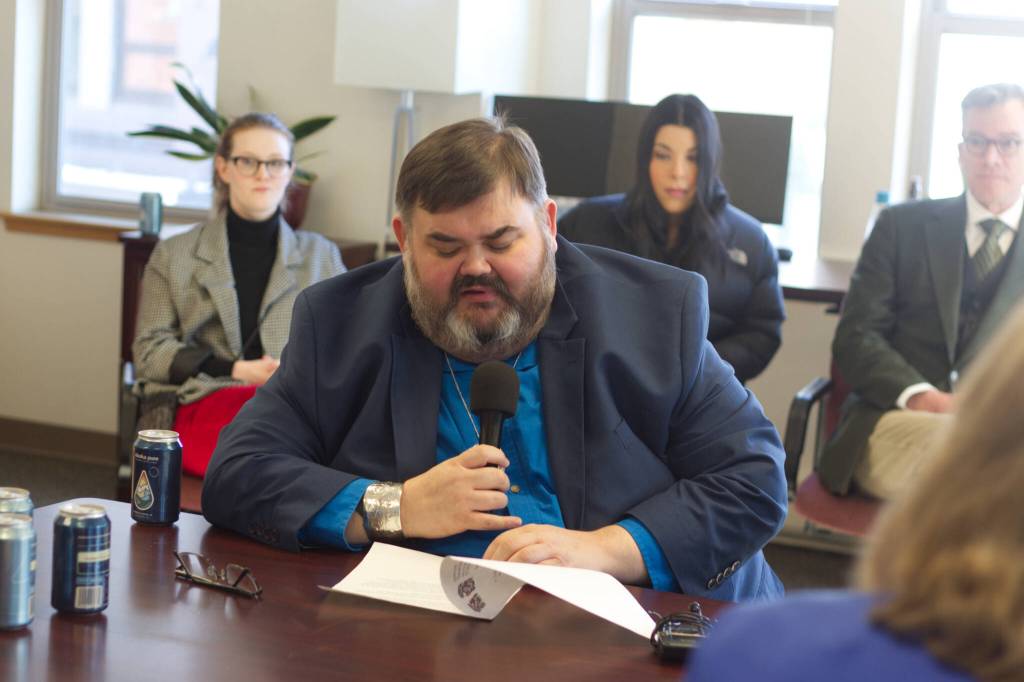
“We want a binding international agreement, and one that considers First Nations and tribal voices as well as our municipal voices, “said Richard Chalyee Éesh Peterson, president of the Central Council of the Tlingit and Haida Indian Tribes of Alaska, during a news conference of coalition members Wednesday following meetings with the Canadian representatives.
The Tulsequah Chief Mine, roughly 20 miles from the Alaska border and 40 miles from Juneau, was a source of zinc, copper and lead during the 1950s. Since its closure in 1957 toxins have been seeping into the Tulsequah River, a main tributary of the Taku river and a prime Alaska salmon habitat, and the cleanup estimated to cost $100 million has been largely held by court proceedings since 2016 when then-owner Chieftain Metals filed for bankruptcy.
A supposed breakthrough occurred last August when the company’s receivership period ended and allowed the B.C. government to step in and act. But there seems to be no definitive cleanup plan, according to participants at Wednesday’s press conference.
The concerns go far beyond the Tulsequah cleanup, as coalition members said there are more than two dozen large-scale mine sites near the border ranging from abandoned to under development that pose risks to three major rivers that are critical salmon habitats in Southeast Alaska. Federal-level intervention is being sought via the authority of the International Joint Commission which was established under the U.S.-Canada Boundary Waters Treaty of 1909.
Peterson credited the two visiting Canadian ministry officials, stating “I felt seen, I felt heard” during this week’s discussions. But he also noted he’s been involved in such discussions for many years and a truly meaningful timeline would include immediate action.
“Tomorrow there should be crews starting to stage, and go out and clean the Tulsequah Chief Mine,” he said. “These promises have been made for years, and nothing’s happened and they’re still contaminated.”
But the visiting Canadians and Alaska Department of Environmental Conservation Commissioner Jason Brune also made their case during the week, arguing they’re doing everything that’s realistically possible in terms of Tulsequah cleanup and responsibly acting on other projects. They also rejected the call to elevate the issue to the national level, asserting regional-level interactions between Alaska, British Columbia and Alaska Native tribes are making progress.
“As many people in this room are aware I’m not a big fan of the federal government,” Brune said. “I’m a big fan of the state having control of our processes.”
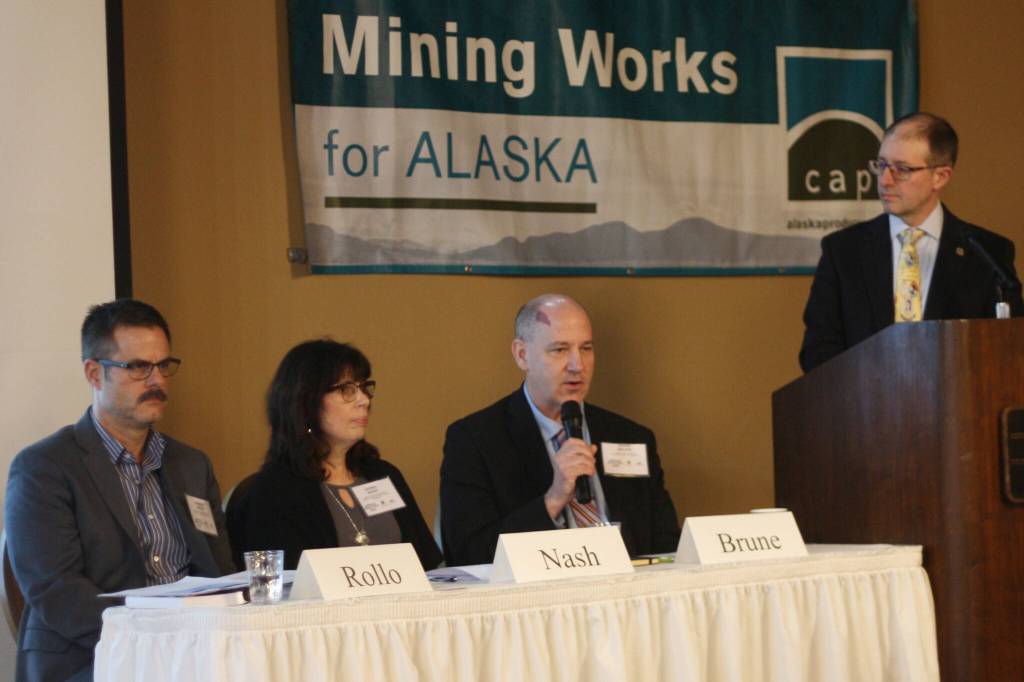
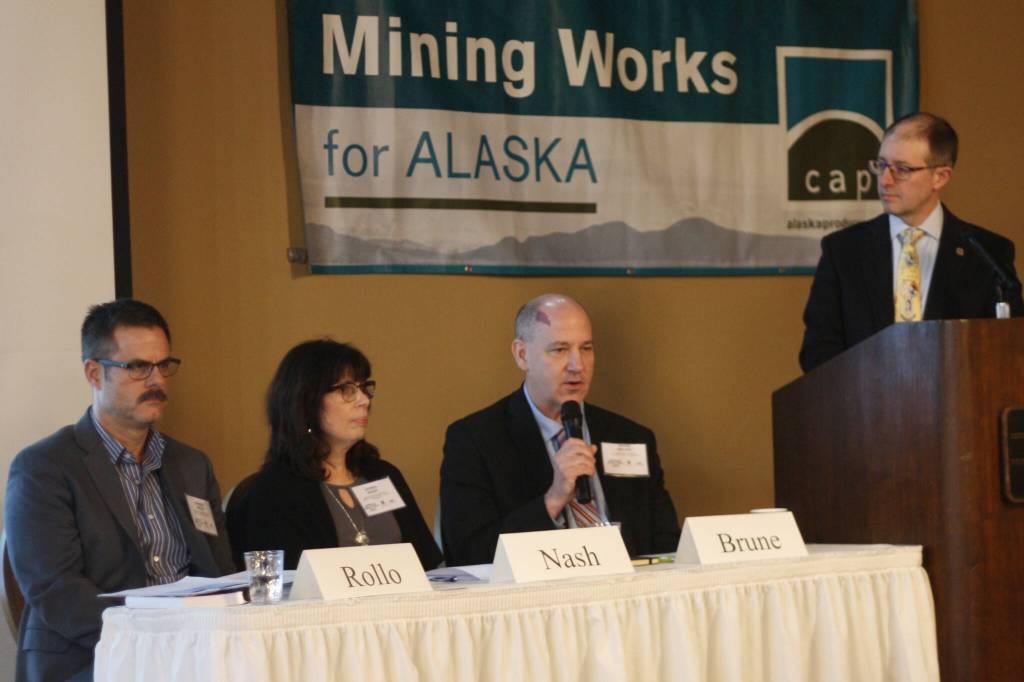
Brune’s comments, as well as those of the Canadian officials, were made during a panel discussion at the first-ever Juneau Mining Forum on Tuesday at the Baranof Hotel, sponsored by the Alaska Miners Association and the Council of Alaska Producers. The commissioner emphasized that, even if environmental issues are set aside, getting Canadian officials to clean up Tulsequah as quickly as possible is in the best interests of mining industry advocates.
“We ask them at every meeting about that, and we are constantly pushing, and the timeline for that historic mine to be cleaned up can’t be soon enough,” Brune said. “There is a public affairs impact. This thing will continue to be used as a reason for other mines not to be developed.”
Cleanup actions may not be happening as quickly as some other sites in British Columbia due to issues such as difficult access and complications involving multiple past and current owners, said Andrew Rollo, assistant deputy minister for Energy Mines and Low Carbon Innovation in British Columbia. He said current or recent actions include bridge upgrades, sediment erosion control and improved water quality monitoring.
“It is important that we hold past and current owners accountable to the site, and make sure it is cleaned up properly,” he said.
Such assurances aren’t convincing, Peterson said, when asked about the comments by Brune and Rollo.
“The contamination of the Tulsequah should not be used as a political football,” Peterson said. “When I hear those kinds of responses that’s politics. That’s the wrong answer. The answer should be we’re doing everything we can and we’re going to be out there cleaning this season. That’s the only acceptable answer.”
The panel discussion featured repeated references to a March 4 opinion piece in the Juneau Empire by Mary Catharine Martin, a former Juneau Empire reporter and current communications director for SalmonState and Salmon Beyond Borders, who decried “broken promises and stonewalling since (the) last B.C. mining ministry visit. She claimed Dunleavy “has basically disbanded” a transboundary working group established under former Gov. Bill Walker, and suggested the visit by ministry officials this week was “to forestall the binding, federal action Alaskans and tribes have long requested.”
Brune said such claims “couldn’t be further from the truth” since the working group meets three to four times a year, and tribal entities are among those invited. He suggested there is a lack of public awareness of such activity, and “that’s my fault for not telling our story and we need to do a better job of that.”
“This is an absolutely a priority of the Dunleavy administration and mine to make sure we are having regular interaction with our counterparts,” he said. “It is a keen emphasis of ours. It is both formal and informal.”
The claims of inclusiveness got a strong pushback from state Rep. Sara Hannan, a Juneau Democrat, who said while some administration officials might be aware of any meetings taking place, the people most affected by the situation are not.
“They’ve not invited our tribes to the table,” she said. “They’ve not included us in their dialogues. They’ve not shared their minutes of their meetings publicly, so although they contend they have very regular working group meetings making progress, that progress is in isolation from the fishermen and the communities that are the most active and most concerned.”
Also, while many of the stakeholders seeking federal intervention are unhappy with the inaction by British Columbia’s governor, Hannan said Alaska’s current government is neglectful as well.
“I’m also very disappointed when our state agencies say ‘What we know is when water reaches the U.S. border it meets our clean water standards,’” she said. “The border is not where fish are raised or reared. They pass through the border and a mixing zone quality standard for clean water may pass an EPA standard, but it does not pass a habitat standard for rearing fish in perpetuity.”
• Contact reporter Mark Sabbatini at mark.sabbatini@juneauempire.com