TMHS grad Elizabeth Djajalie among 30 global contenders in $400,000 Khan Academy Challenge
Published 9:30 pm Saturday, September 14, 2024
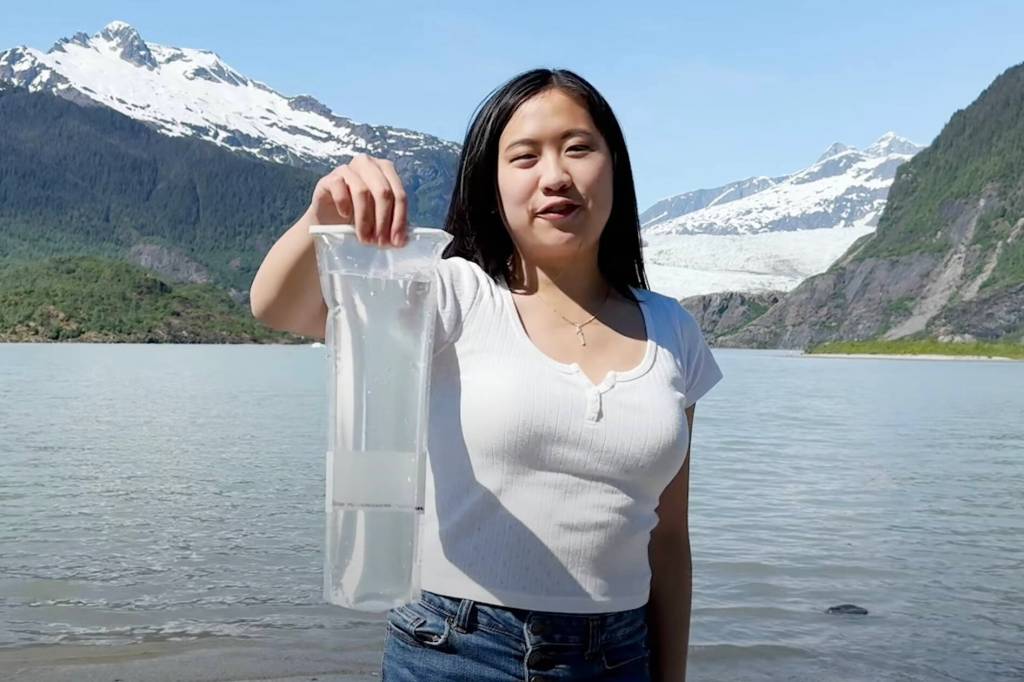
Elizabeth Djajalie is hoping a two-minute video about something known as DNA metabarcoding will pay for the rest of her education at Harvard, plus a new state-of-the-art high school science lab in Juneau.
Djajalie, who graduated from Thunder Mountain High School earlier this year with a slew of national awards and achievements, is among the 30 international semifinalists in the 2024 Khan Academy Breakthrough Junior Challenge. The person whose video gets the most likes on YouTube and Facebook wins a $250,000 scholarship, a $50,000 for a high school teacher of theirs and a $100,000 STEM (science, technology, engineering, art, and math) lab for their high school.
In Djajalie’s competition video, filmed at the Mendenhall Glacier, she holds up a plastic one-liter bag of water she says may contain DNA from hundreds of species and it’s possible to “figure out what species are in an area without ever seeing them” through that process called metabarcoding.
The concept that allows simultaneous identification of many organisms within a sample instead of just one originated about 20 years ago. Djajalie, in an interview Wednesday, said she is focusing on that methodology because of the widespread environmental changes now occurring affecting a wide range of species.
“In the modern times it has such a big implication right now because we’re now going to the sixth mass extinction,” she said. “So I really wanted to shed light on the issue in addition to the technology itself.”
More specifically, she has recently been studying ways to detect, quantify and conserve Pacific salmon species using DNA metabarcoding as well as a laboratory technique known as quantitative polymerase chain reaction (qPCR). While such labels might be way over the heads of many folks, Djajalie said her video aims to make the process of identifying species in that plastic bag of water easy for general viewers to grasp.
“Anyone who has taken a basic biology class,” she said.
The video was a learning process for her since digital drawings by hand and other animated explainers were firsts, Djajalie said. The narration of the science involved and motivations for her research came more naturally.
“Right now we are living through the sixth mass extinction,” she says toward the end of the video. “By 2050 an estimated 30% to 50% of today’s species may be extinct. Breakthroughs like DNA metabarcoding can help us conserve the incredible diversity of life we coexist with, reminding us that we are just one out of millions of species we share this planet with.”
Djajalie said she recorded the video on her phone and it was the last project she did in Juneau before departing for college.
“This has been one of my favorite things I’ve ever worked on, just because if you watch the video you see how much it’s very representative of Alaska, and of Juneau especially,” she said. “My favorite scene in the whole video is the last 15 seconds because of all those scenes of wildlife stuff I shot in Juneau.”
Public voting for the competition ended Friday, which was done with “likes” to the videos posted on Facebook and YouTube. The competition’s website is https://breakthroughjuniorchallenge.org.
Djajalie’s previous honors and activities include attending the National Honor Society (NHS) Trailblazing Leadership Weekend in Washington, D.C., for the top 25 students in the country in April. She was a top-five NHS Pillar Awardee for the Scholarship category, receiving $10,625.
On Wednesday she was also announced as a winner of the 2024 Gloria Barron Prize for Young Heroes, which gives $10,000 to 15 top youths for studies or similar purposes, for her research on salmon species and other science activities.
Djajalie said that while she is finishing her second week of classes at Harvard “and am loving it here so far” — among other things she’s learning to sail as part of the university’s varsity team — winning the Khan Academy challenge would be a major milestone in more than one way.
For starters, the scholarship money would likely cover her three remaining years at Harvard after this one, she said. In addition, her choice for the $50,000 teacher prize is Carol May, a 28-year school district employee who in addition to teaching math and science is a robotics coach at Juneau-Douglas High School: Yadaa.at Kalé.
More significantly to a larger number of people, would be the $100,000 STEM lab at the newly consolidated Juneau-Douglas High School: Yadaa.at Kalé.
“It just would be such a huge thing I think, especially right now in this time when our school just got closed out because of a shortage in education funding,” said Djajalie, who was part of the final graduating class at TMHS before consolidation took effect this school year. “Winning the challenge and showing that a small-town girl born and raised in a rural place like Juneau, Alaska, can still get to the international level like this, and still go anywhere and do anything that you want to do if you just find the resources and have the will do it.”
• Contact Mark Sabbatini at mark.sabbatini@juneauempire.com or (907) 957-2306.