State: ‘Modest’ job growth likely in Southeast in ‘24, but shrinking workforce a long-term concern
Published 9:30 pm Tuesday, January 2, 2024

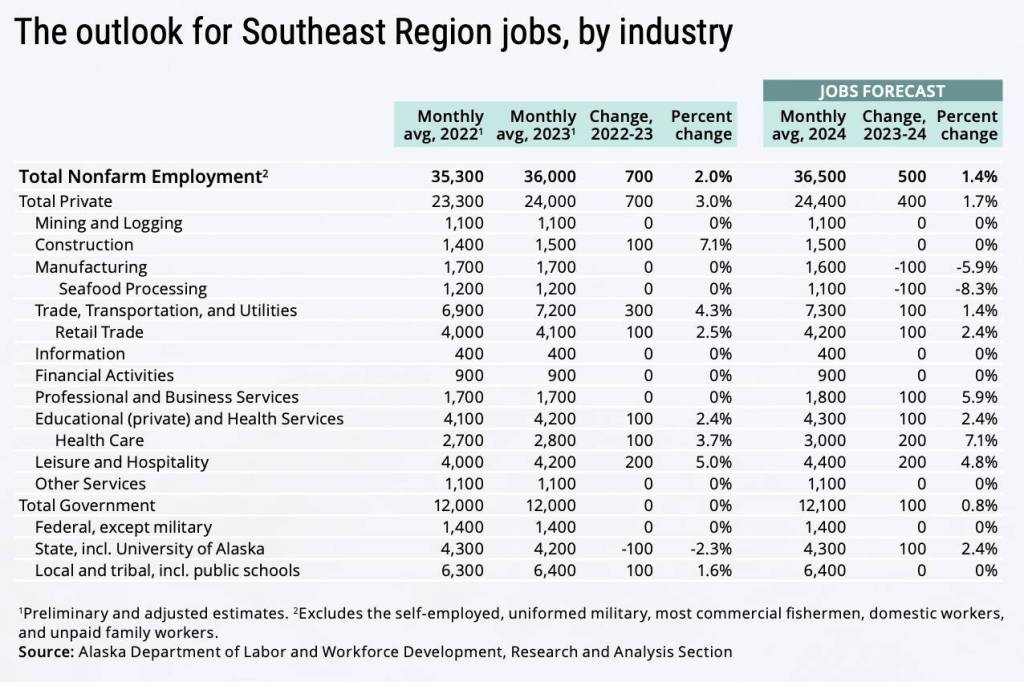


Southeast Alaska is expected to see a “modest” 1.4% job growth in 2024, compared to a statewide 1.7% increase “which for many industries will mark a full recovery from the pandemic,” according to a report released Tuesday by the Alaska Department of Labor and Workforce Development.
The Southeast forecast for the coming year follows a 2% increase in “total nonfarm employment” for the region in 2023, according to the January issue of Alaska Economic Trends, the department’s in-house publication. The report cites the region’s “initially strong rebound from pandemic lows,” while also noting there were significant differences among industries that is likely to continue.
“Four sectors of Southeast’s economy are disproportionately influential in determining whether it will grow or decline in 2024 and beyond: tourism, fishing and seafood, mining, and the combination of state and federal government,” the report states.
Much of the data about Juneau’s employment, health of various economic sectors and demographics is similar to findings in the Juneau Economic Development Council’s annual report presented in November. That study, among its primary findings, stated that while the city’s short-term economic health is good, an aging population and low birth rate are among significant long-term concerns.
[Juneau’s aging population and low fertility rates raise concerns about declining future]
The state’s report found private employment growth significantly exceeded government employment in both 2022 (3% and 0%, respectively) and 2023 (1.7% and 0.8%). Federal employment in Southeast was unchanged both years, while state jobs declined 2.3% in 2022 and then rose 2.4% in 2023, while local government jobs rose 1.6% in 2022 and remained steady in 2023.
“Thinking of government as an economic driver is less intuitive, but the 5,600 state and federal civilian government jobs plus the significant numbers of U.S. Coast Guard personnel in Sitka and Juneau (uniformed military are not counted in standard government employment numbers) are funded by federal and state revenue, and the services they provide benefit the entire state or nation,” the report states.
However, the report notes state government jobs in Southeast Alaska have dropped 23% since 2012.
The changes in private industry in Southeast Alaska during the past two years are stark in their contrasts.
Manufacturing jobs dropped 5.9% in 2023, including an 8.3% decline in seafood processing, after both showed no change in 2022.
“After high prices and big harvests in 2022, prices for salmon fell hard in 2023, making it a tough year for fish harvesters in the region,” the report states. “The latest news is that Trident Seafoods, Alaska’s largest processor, plans to sell a third of its Alaska plants, including facilities in Ketchikan and Petersburg. It’s too soon to tell what the attempts to sell the plants will mean for the 2024 salmon season, but the market for salmon has been up and down dramatically in recent years. Although harvests are generally strong — boding well for the longer term — the next few years will probably be chaotic for prices and processing capacity.”
At the other end of the spectrum, regional healthcare jobs rose 7.1% in 2023 (on top of 3.7% in 2022), professional and business services 5.9% (unchanged in 2022), and leisure and hospitality jobs 4.8% (up 5% in 2022).
Mining, while showing no change in jobs for either year, was singled out in the report as a significant economic contributor
“Mining’s nearly 1,000 jobs — almost all at the two Juneau-area mines, Greens Creek and Kensington — pay well over $100 million a year in wages, and are often the largest sources of property tax revenue for the City and Borough of Juneau,” the report states. Employment has been stable at that level for a decade now and no big changes are expected in 2024.”
However, a major red flag for Southeast is a 10.7% drop in the working-age population between 2013 and 2022, and indicators it “will likely continue to decrease for at least a few more years.”
“It’s difficult to produce job growth without growth in the working-age population,” the report states. “Negative net migration — more people moving out of the region than moving into it — over the last decade or so is the main reason for those losses. That mirrors the pattern in most of the state, with the Matanuska-Susitna Borough being the most notable exception. The other major driver is that baby boomers — the especially large cohort born from 1946 to 1964 — are aging out of their prime working years.”
The JEDC report presented in November found the number of people in Juneau over age 60 exceeds those under 20 for the first time in recorded history, and the current 1.3 fertility rate is far below the 2.1 being considered necessary to maintain the current population.
The labor department’s statewide forecast for 2024 envisions growth that is “widespread as all industries either grow or hold steady, bringing Alaska’s total job count and many industries above their pre-pandemic levels. Industries that remain significantly below their 2019 levels have either faced big changes in recent years or were already on long-term declines.”
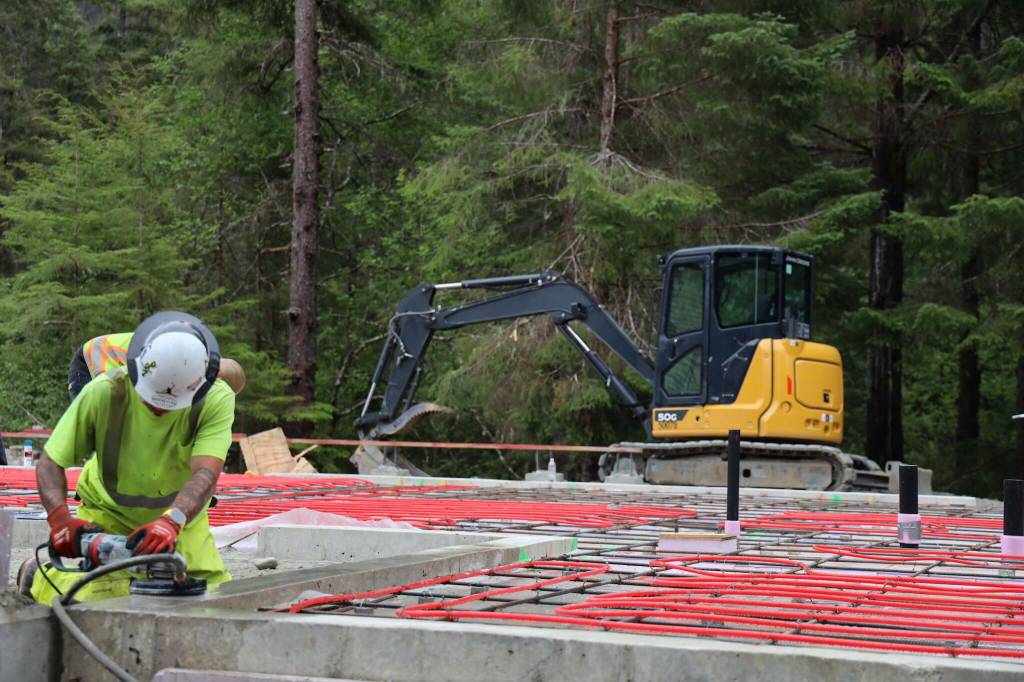
“Unlike the last few years’ growth, which came from parts of the economy normalizing after COVID disruptions, big projects will be this year’s major catalyst,” the report adds. “Federal infrastructure projects will start to materialize in 2024, and mining and oil and gas also have big investments on the horizon.”
The 2021 Infrastructure Investment and Jobs Act, plus the Inflation Reduction Act of 2022, “will route billions of dollars to the state over the next decade. Funds for roads, bridges, ferries, water and sewer facilities, broadband, and other longstanding priorities will make lasting and sometimes overdue improvements. Many of these projects are still in the planning phase, so we might not see significant job growth this year, but they have begun.”
Alaska is receiving more money per-capita than any other state from the infrastructure bill, which in Southeast Alaska will involve hundreds of millions of dollars for the Alaska Marine Highway System, according to the state’s report.
“The system has struggled with declining service levels for years for a variety of reasons, including significant budget cuts,” the report adds. “As recently as 2012, the ferries transported about 263,000 Southeast riders a year, but ridership has steadily fallen over the last decade and totaled just 152,000 by 2019. For context, ferry traffic declined 57 percent in the region over a period when the region’s population fell about 3 percent.”
Traffic, which dropped off drastically during the COVID-19 pandemic, made a big jump from 2021 with 114,000 passengers in 2022, but that was still less than half the ridership of a decade earlier, according to the report.
• Contact Mark Sabbatini at mark.sabbatini@juneauempire.com or (907) 957-2306.