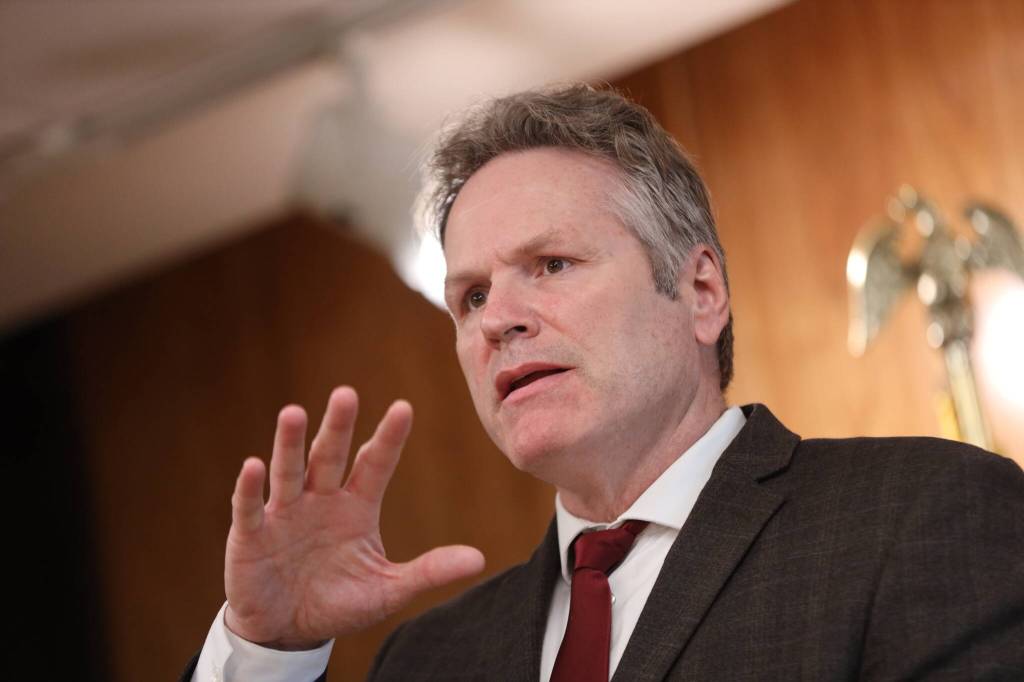
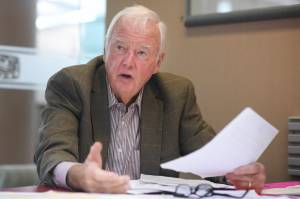
Gov. Mike Dunleavy speaks during a news conference in which options for a long-range fiscal plan were discussed. Dunleavy said in the coming days, he expects a sales tax proposal to be drafted and that a special session to create long-term plan is possible. (Clarise Larson / Juneau Empire)

Gov. Mike Dunleavy speaks during a news conference in which options for a long-range fiscal plan were discussed. Dunleavy said in the coming days, he expects a sales tax proposal to be drafted and that a special session to create long-term plan is possible. (Clarise Larson / Juneau Empire)

Show we the money: Governor, legislators stage news conference vowing again to work together on long-range fiscal plan

Sales tax and special session loom as possibilities.

Gov. Mike Dunleavy, during a news conference in a room packed with state legislators on Thursday, said it’s likely he will introduce a bill for a statewide sales tax — citing 1% as a possible amount — within days and a special session focusing on a long-term fiscal plan is possible in the coming months.

Dunleavy and legislative leaders offered few specifics during the 47-minute gathering, instead emphasizing they agree that a long-range plan is a priority and it will need a multitude of parts. Such pledges to seek a sustainable solution have been expressed by state lawmakers many times over the years, but Dunleavy said he believes the state’s long-term decline in oil revenue and other factors have reached a point where policymakers are ready to make concessions to resolve the situation.

“We wouldn’t be wasting your time with a press conference if we didn’t think there’s a good chance of this happening,” he said.

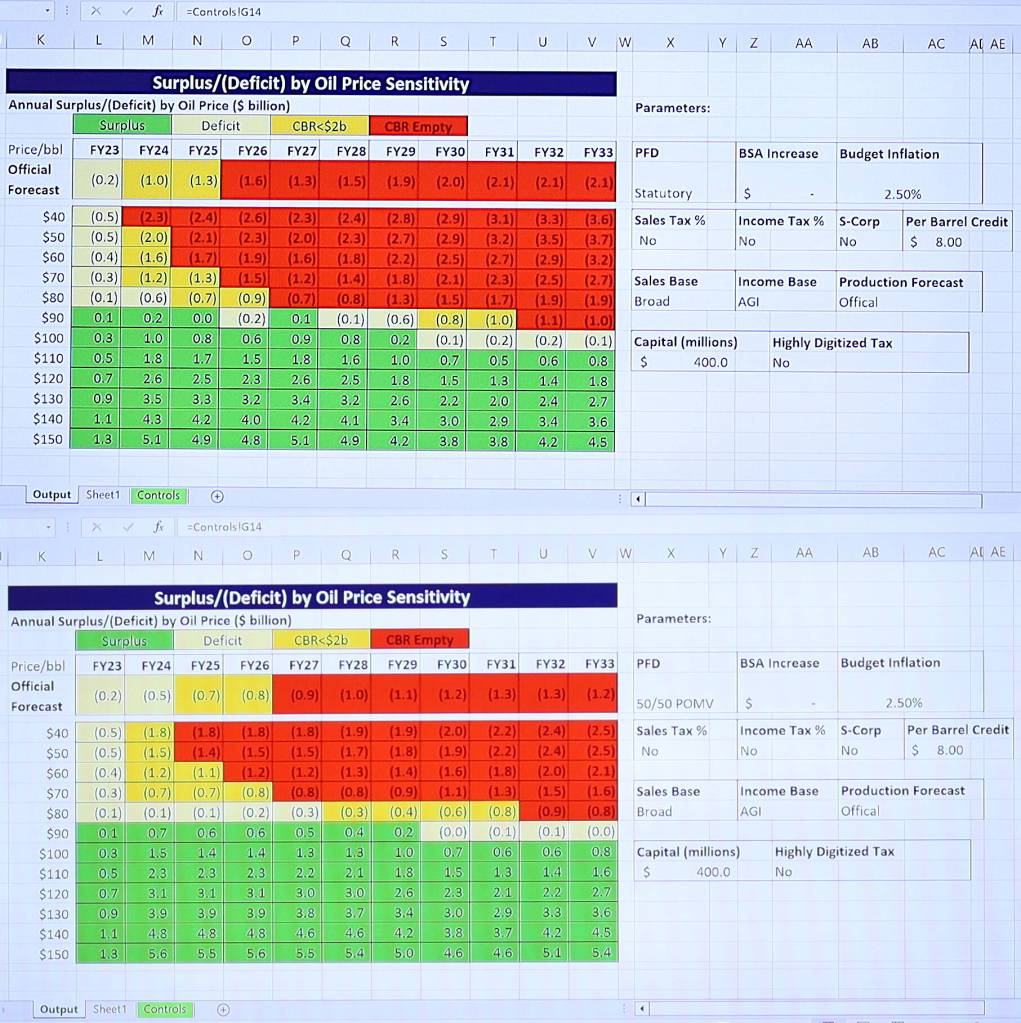
Two spreadsheets generated by the state Office of Management and Budget show the potential long-range financial outlook for the state based on various scenarios, in this instance by varying the amount of the Permanent Fund dividend. The top spreadsheet shows a “statutory” dividend that this year would be about $3,500 while the bottom shows a so-called “50-50” dividend of about $2,700. The yellow-shaded areas indicate years the state would incur a deficit and the red areas represent years when the state would deplete the reserve fund that has been used in past years to cover shortfalls. The spreadsheet model allows users to see scenarios at different oil price levels and inflation rates, as well as by implementing various taxes, and adjusting education and capital projects spending. (Mark Sabbatini / Juneau Empire)

Two spreadsheets generated by the state Office of Management and Budget show the potential long-range financial outlook for the state based on various scenarios, in this instance by varying the amount of the Permanent Fund dividend. The top spreadsheet shows a “statutory” dividend that this year would be about $3,500 while the bottom shows a so-called “50-50” dividend of about $2,700. The yellow-shaded areas indicate years the state would incur a deficit and the red areas represent years when the state would deplete the reserve fund that has been used in past years to cover shortfalls. The spreadsheet model allows users to see scenarios at different oil price levels and inflation rates, as well as by implementing various taxes, and adjusting education and capital projects spending. (Mark Sabbatini / Juneau Empire)

The news conference was staged with fewer than 20 days left in the legislative session, with Dunleavy and the Senate still nearly $1 billion apart on a budget for the fiscal year starting July 1 — the House’s version occupies a middle ground — that needs to be passed before they adjourn — unless a special session is subsequently called.

The biggest disagreement is the size of the Permanent Fund dividend, with Dunleavy’s budget containing a roughly $3,500 PFD and a deficit of more than $900 million, the House a $2,700 PFD and $600 million deficit and the Senate a $1,300 PFD and a surplus of $90 million.

Dunleavy, when asked what movement he and the Senate in particular have made recently toward resolving that gap, said he’s confident differences will get worked out as they have in past years and their goal at this point is to look beyond the short term.

“We’ll get a budget done, but what we want to do is get beyond the one or two components we fight on every year,” he said.

House Speaker Cathy Tilton, a Wasilla Republican, said a focus by lawmakers and the public on a single item such as PFDs doesn’t work if the goal is a longer-range strategy.

“The real picture here is everything we do in a fiscal plan needs to run together and it needs to be something the entire Legislature agrees upon along with the executive,” she said.

That doesn’t mean all lawmakers agreeing on individual aspects of the plan, according to those speaking during the news conference.

“I think what you’re seeing is people are saying we need to compromise, nobody will get everything they want,” said Sen. Bill Wielechowski, an Anchorage Democrat who’s introduced a bill increasing taxes on oil companies that’s already had some of its provisions stripped down.

Dunleavy’s sales tax bill, which he said should be drafted by Friday, along with other comments he made during the news conference such as not flat-out rejecting an income tax are shifts from statements he and his spokespeople have made as recently as a week ago. He’s met numerous times with legislators in recent weeks, including a session with House and Senate members last Thursday when his sales tax proposal was brought up.

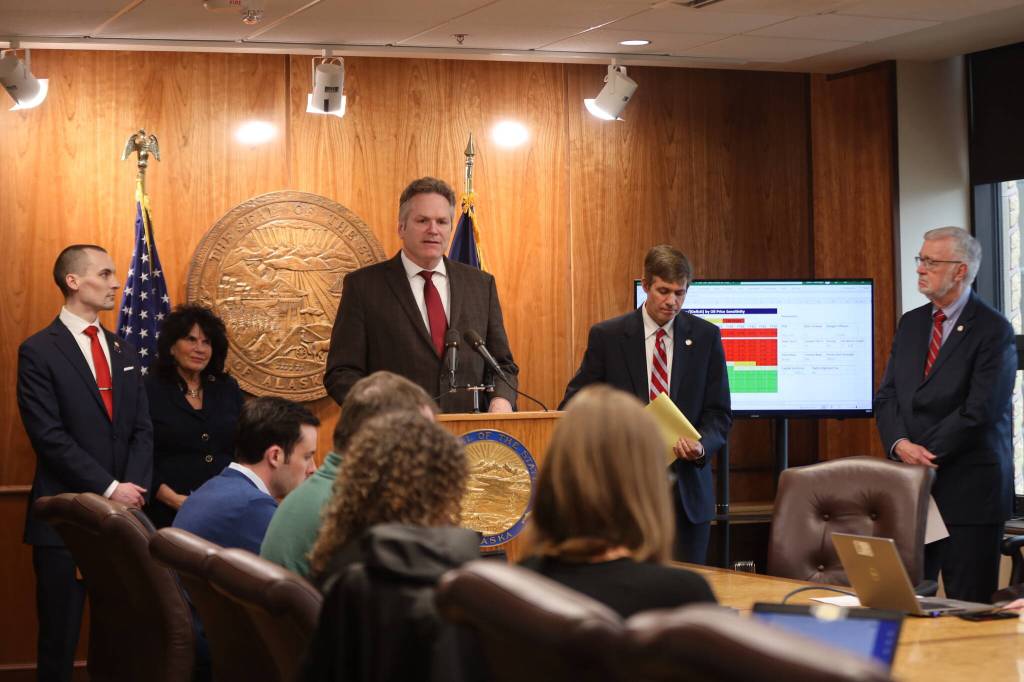
An interactive spreadsheet showing a variety adjustable revenue and expenditure categories — including oil prices, inflation, various types of taxes, education spending and PFDs — was displayed during the press conference. Neil Steininger, the governor’s budget director, showed how the fiscal picture looks during the next decade under several scenarios — although it took the minimal PFDs sought by the Senate along with some new low-level tax to clearly put the state in the green throughout those years even at less-than-optimal oil prices.

While lawmakers talked about the willingness for a special session focusing on a long-range plan if one isn’t developed during the session, the timing is uncertain. Among the possibilities mentioned by lawmakers recently are immediately after the regular session if the various sides appear near to an agreement, or during the fall when policymakers have a better sense of how oil prices are likely to fare during the coming fiscal year.

“Don’t be surprised if there’s some quick movement to put together a fiscal plan,” Dunleavy said, adding “it may not happen in this (session’s) time frame.”

• Contact Mark Sabbatini at mark.sabbatini@juneauempire.com
Gov. Mike Dunleavy, accompanied by state House and Senate leaders, discuss options for a long-range fiscal plan during a press conference Thursday at the Alaska State Capitol. (Clarise Larson / Juneau Empire)

Gov. Mike Dunleavy, accompanied by state House and Senate leaders, discuss options for a long-range fiscal plan during a press conference Thursday at the Alaska State Capitol. (Clarise Larson / Juneau Empire)

More in News

Capital City Fire/Rescue completes last season’s ice break rescue training at the float pond near Juneau International Airport. (photo courtesy of Capital City Fire/Rescue)
On thin ice: Fire department responds to season’s first rescue at Mendenhall Lake

This week’s single digit temperatures have prompted dangerous ice ventures.

Brenda Schwartz-Yeager gestures to her artwork on display at Annie Kaill’s Gallery Gifts and Framing during the 2025 Gallery Walk on Friday, Dec. 5. (Mari Kanagy / Juneau Empire)
Alaska artist splashes nautical charts with sea life

Gallery Walk draws crowds to downtown studios and shops.

A totem pole, one of 13 on downtown’s Totem Pole Trail in Juneau, Alaska, Nov. 27, 2024. (Christopher S. Miller/The New York Times)
Downtown Juneau experiences its first significant city-level snow fall of the season as pictured on Saturday, Dec. 6, 2025. (Mari Kanagy / Juneau Empire)
Sub-zero temperatures to follow record snowfall in Juneau

The National Weather Service warns of dangerous wind chills as low as -15 degrees early this week.

A truck rumbles down a road at the Greens Creek mine. The mining industry offers some of Juneau’s highest paying jobs, according to Juneau Economic Development’s 2025 Economic Indicator’s Report. (Hecla Greens Creek Mine photo)
Juneau’s economic picture: Strong industries, shrinking population

JEDC’s 2025 Economic Indicators Report is out.

Map showing approximate location of a 7.0-magnitude earthquake on Saturday, Dec. 6, 2025. (Courtesy/Earthquakes Canada)
7.0-magnitude earthquake hits Yukon/Alaska border

Earthquake occurred about 55 miles from Yakutat

A commercial bowpicker is seen headed out of the Cordova harbor for a salmon fishing opener in June 2024 (Photo by Corinne Smith)
Planned fiber-optic cable will add backup for Alaska’s phone and high-speed internet network

The project is expected to bring more reliable connection to some isolated coastal communities.

Gustavus author Kim Heacox talked about the role of storytelling in communicating climate change to a group of about 100 people at <strong>Ḵ</strong>unéix<strong>̱</strong> Hídi Northern Light United Church on Wednesday, Dec. 3, 2025. (Mari Kanagy / Juneau Empire)
Author calls for climate storytelling in Juneau talk

Kim Heacox reflects on what we’ve long known and how we speak of it.

Most Read