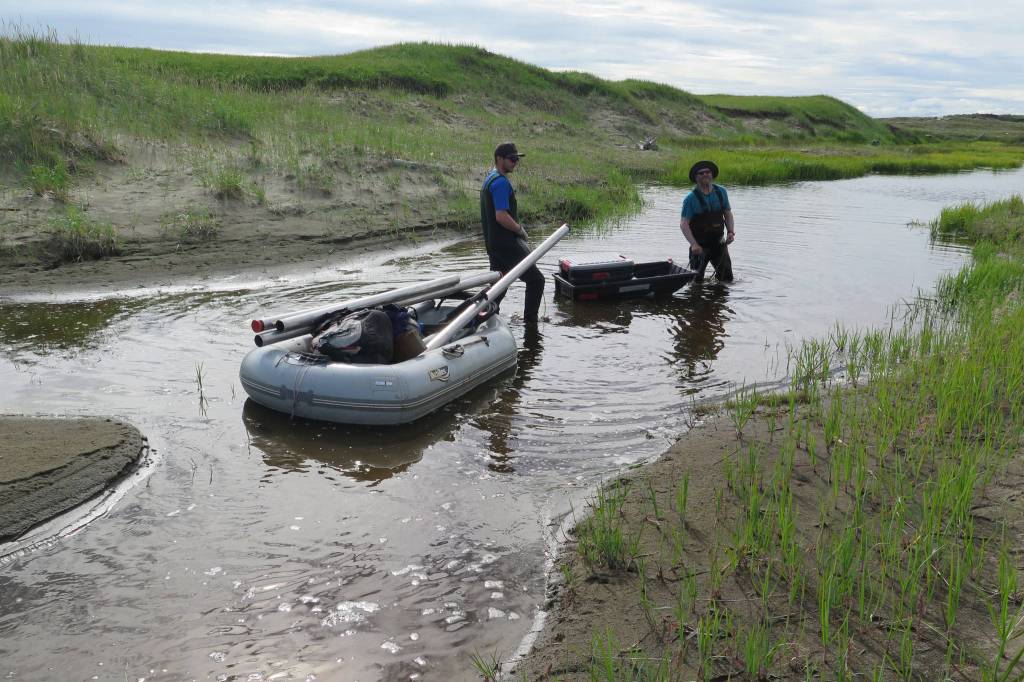
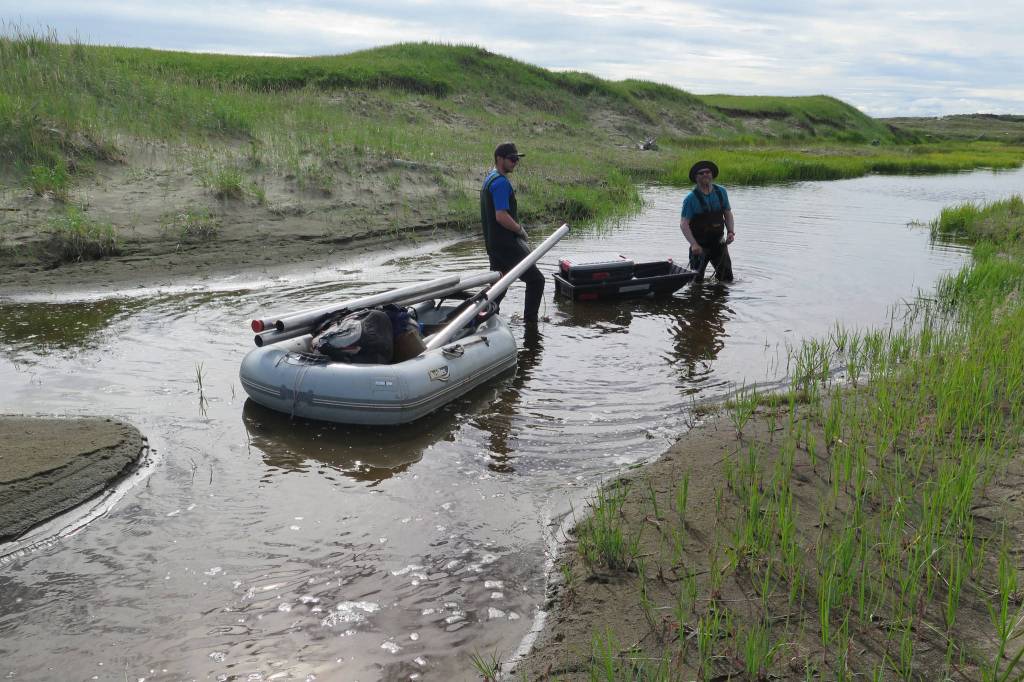
Reyce Bogardus, left, and Chris Maio in a surge channel on Cape Espenberg, preparing to travel inland to core a lake. (Courtesy Photo | Nancy Bigelow)

Reyce Bogardus, left, and Chris Maio in a surge channel on Cape Espenberg, preparing to travel inland to core a lake. (Courtesy Photo | Nancy Bigelow)

Sandy memories of ancient storms

Why did the people who lived on Seward Peninsula for more than 4,000 years leave?

Cape Espenberg is an eyebrow of sand driftwood, and low plants on the northeast corner of the Seward Peninsula. It is now quiet except for the swish of the wind through cottongrass and the songs of birds, but archaeologists have found a large village site there.

People lived on the cape for more than 4,000 years. Some of their descendants now live in the villages of Shishmaref and Deering. No one knows why the ancient people left.

Just a few feet above the Chukchi Sea, Cape Espenberg might have been hammered by storms that shoved water onto land. Or maybe an absence of storms meant driftwood was so rare people could not build homes. A researcher is using evidence from a nearby lake to see how often extreme storm surges have hit the area over the last few thousand years.

Chris Maio has floated a raft in a small lake at the end of a narrow trough cut through Cape Espenberg. The surge channel is a straight connection to the ocean, three-quarters of a mile long. It’s a pathway for salt water and beach sand, but only when driven by the strongest waves and fiercest winds.

Maio, a coastal geographer at UAF, along with Nancy Bigelow of University of Alaska Fairbanks, is part of a project led by Claire Alix from Paris University, who also works with the Alaska Quaternary Center. Owen Mason from the University of Colorado is also part of the study.

For part of the research, in 2017, Maio and coworkers pulled plugs of muck from the bottom of the lake, penetrating as deep as 10 feet.

Back in the lab, Maio and a few student interns cut, split and dated the lake cores. They found the cylinders had zebra stripes of mud layered with coarser sand. Based on radiocarbon dating, the material from the bottom of the cores is 3,000 years old.

The scientists found that during the last century — in 1913, 1974 and 2011 — storms were large enough to carry sand three-quarters of a mile inland from the beach.

“This site only captures monster storms,” Maio said.

They were able to match the most recent sand layer with a “huge extratropical cyclone” with hurricane-force winds. That storm lorded over most of the Bering Sea and battered western Alaska in November 2011.

Maio wants to dig deeper into the sediment archived in the lake, to see if there might be clues as to what types of storms occurred in the past. Ancient Inupiat people there dug into the sand, using driftwood and whale bones to build complex homes.

“These places are like fine-crafted log cabins buried within the dune,” Maio said.

How often do monster storms hit Cape Espenberg? Maio hopes the ancient sediments hold clues.

“Are these changes we’re seeing in the last 100 years anomalous compared to the last 1,000 years or 3,000 years?” he said. “The farther the history book goes back, the better we’ll be able to assess the future.”


• Since the late 1970s, the University of Alaska Fairbanks’ Geophysical Institute has provided this column free in cooperation with the UAF research community. Ned Rozell (ned.rozell@alaska.edu) is a science writer for the Geophysical Institute.

More in News

Map showing approximate location of a 7.0-magnitude earthquake on Saturday, Dec. 6, 2025. (Courtesy/Earthquakes Canada)
7.0-magnitude earthquake hits Yukon/Alaska border

Earthquake occurred about 55 miles from Yakutat

A commercial bowpicker is seen headed out of the Cordova harbor for a salmon fishing opener in June 2024 (Photo by Corinne Smith)
Planned fiber-optic cable will add backup for Alaska’s phone and high-speed internet network

The project is expected to bring more reliable connection to some isolated coastal communities.

Gustavus author Kim Heacox talked about the role of storytelling in communicating climate change to a group of about 100 people at <strong>Ḵ</strong>unéix<strong>̱</strong> Hídi Northern Light United Church on Wednesday, Dec. 3, 2025. (Mari Kanagy / Juneau Empire)
Author calls for climate storytelling in Juneau talk

Kim Heacox reflects on what we’ve long known and how we speak of it.

The Juneau road system ends at Cascade Point in Berners Bay, as shown in a May 2006 photo. (Michael Penn / Juneau Empire file)
State starts engineering for power at proposed Cascade Point ferry terminal

DOT says the contract for electrical planning is not a commitment to construct the terminal.

Members of the Alaska Air and Army National Guard, Alaska Naval Militia, and Alaska State Defense Force work together to load plywood onto a CH-47 Chinook helicopter, in Bethel, Alaska, Nov. 2, 2025, bound for the villages of Napaskiak, Tuntutuliak, and Napakiak. The materials will help residents rebuild homes and restore community spaces damaged by past storms. (U.S. Army National Guard photo by Spc. Ericka Gillespie)
Gov. Dunleavy approves Alaska National Guard assisting ICE in Anchorage

The National Guard said five service members will assist with administrative support; lawmakers and civil rights advocates worry that the move signals a ramping up of immigration enforcement operations in Alaska

A cruise ship, with several orange lifeboats visible, is docked in downtown Juneau. (Laurie Craig / Juneau Empire file photo)
CBJ seeks input on uses for marine passenger fees

Public comment period is open for the month of December.

Browsers crowd into Annie Kaill’s gallery and gift shop during the 2024 Gallery Walk. (Juneau Empire file photo)
Gallery Walk guide for Friday, Dec. 5

The Juneau Arts & Humanities Council announced community events taking place during… Continue reading

The Alaska State Capitol is seen on Tuesday, Nov. 25, 2025. (Photo by James Brooks/Alaska Beacon)
Alaska Senate Republicans confirm Rauscher, Tilton and open two vacancies in state House

The Alaska Republican Party is moving quickly after Republicans in the Alaska… Continue reading

Downtown Skagway, with snow dusting its streets, is seen in this undated photo. (Photo by C. Anderson/National Park Service)
Skagway’s lone paramedic is suing the city, alleging retaliation by fire department officials

This article was reported and published in collaboration between the Chilkat Valley… Continue reading

Most Read