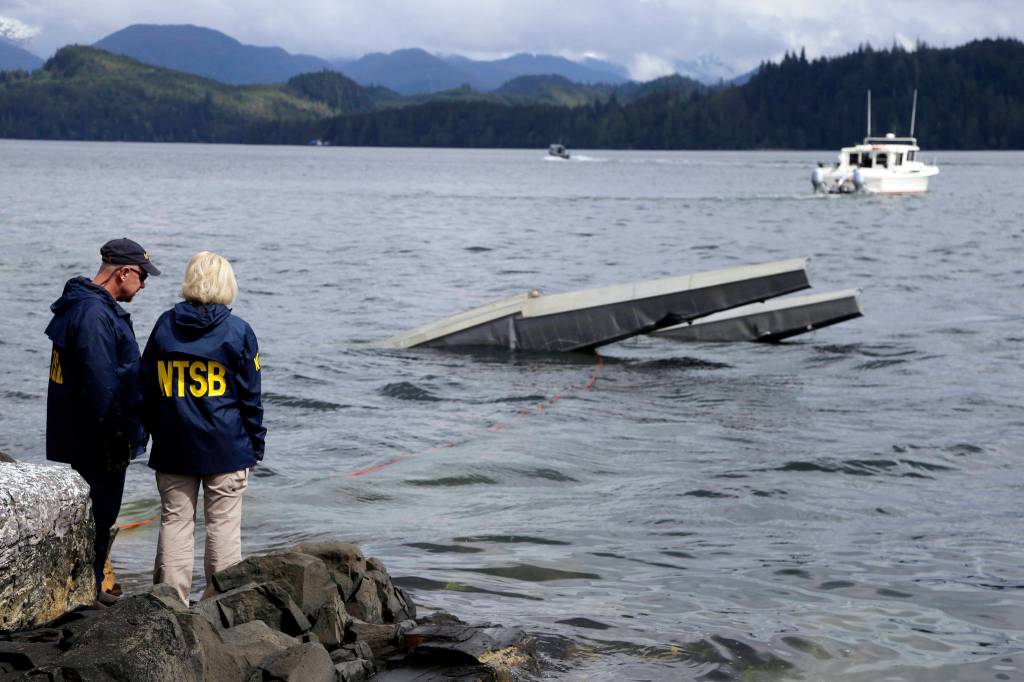
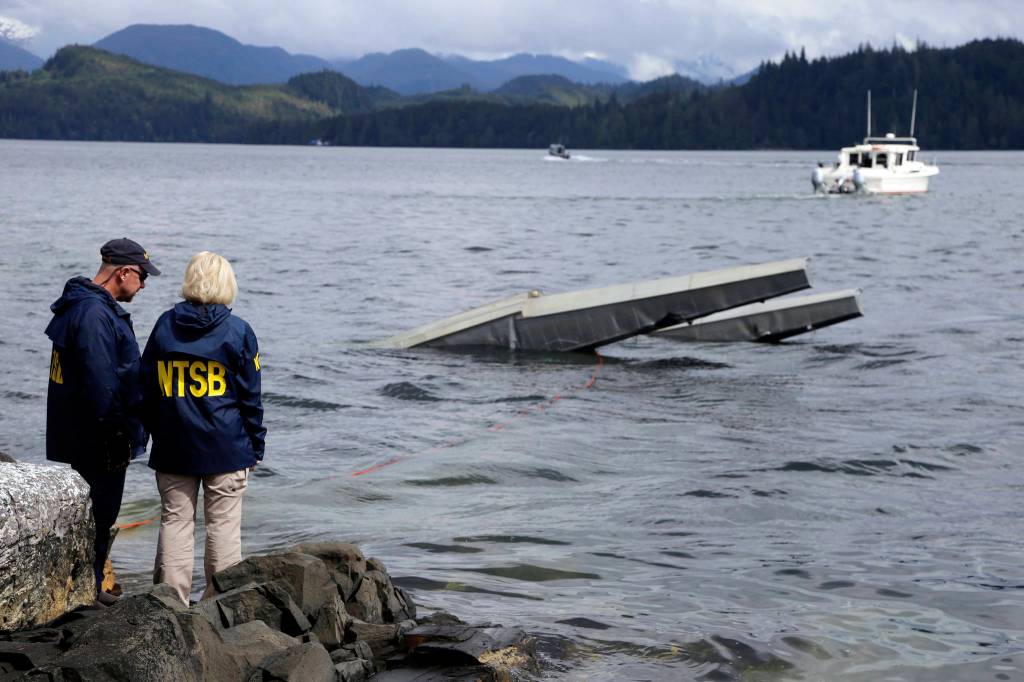
NTSB investigator Clint Crookshanks, left, and member Jennifer Homendy stand near the site of some of the wreckage of the DHC-2 Beaver, Wednesday, May 15, 2019, that was involved in a midair collision near Ketchikan, Alaska, a couple of days earlier. The pilots of two Alaskan sightseeing planes that collided in midair couldn’t see the other aircraft because airplane structures or a passenger blocked their views, and they didn’t get electronic alerts about close aircraft because safety systems weren’t working properly. That’s what the staff of the National Transportation Safety board found in their investigation. (Peter Knudson / NTSB)

NTSB investigator Clint Crookshanks, left, and member Jennifer Homendy stand near the site of some of the wreckage of the DHC-2 Beaver, Wednesday, May 15, 2019, that was involved in a midair collision near Ketchikan, Alaska, a couple of days earlier. The pilots of two Alaskan sightseeing planes that collided in midair couldn’t see the other aircraft because airplane structures or a passenger blocked their views, and they didn’t get electronic alerts about close aircraft because safety systems weren’t working properly. That’s what the staff of the National Transportation Safety board found in their investigation. (Peter Knudson / NTSB)

Pilot views obstructed, alerts missing in 2019 plane crash near Ketchikan

Collission occurred near Ketchikan.

WASHINGTON — The pilots of two Alaskan sightseeing planes that collided in midair couldn’t see the other aircraft because airplane structures or a passenger blocked their views, and they didn’t get electronic alerts about close aircraft because safety systems weren’t working properly.

That’s what the staff of the National Transportation Safety board found in their investigation of the May 2019 crash, which killed six people.

The board is meeting Tuesday in Washington to determine a probable cause of the crash and make recommendations to prevent it from happening again.

Mountain Air Service pilot Randy Sullivan and his four passengers, and a passenger in a plane owned by Taquan Air were killed. Ten people suffered injuries when the aircraft converged at 3,350 feet.

The Ketchikan-based floatplanes carrying passengers from the same cruise ship, the Royal Princess, were returning from tours of Misty Fjords National Monument.

[Plane crashes in Alaska outpace national norms]

Mountain Air’s single-engine de Havilland DHC-2 MK 1 Beaver and Taquan’s larger turboprop de Havilland DHC-3 Otter collided just after noon over the west side of George Inlet.

Aircraft rely on “see and avoid” by pilots to prevent midair crashes, the staff said. But the crash occurred on a clear day in the afternoon.

Vice Chairman Bruce Landsberg said the “see and avoid” system doesn’t work well in high traffic areas where the sight-seeing planes were traveling.

Chairman Robert Sumwalt read a statement of probable cause, which has not yet been approved by the board. He said the pilots didn’t see each other in time to avoid a collision. Contributing factors included “preoccupation with matters unrelated to duties such as attempting to provide passengers with a scenic view and physiological limits on the human vision, reducing the time opportunity to see-and-avoid other aircraft,” he said.

Staff members told the board the Otter pilot recalled seeing a white and red flash, then a tremendous collision.

The Beaver pilot’s view would have been obstructed by the airplane’s structure and a passenger seated to his right during the critical moments before the crash. The Otter pilot’s view was obscured by a window post, the staff said.

William Bramble, the NTSB’s human performance specialist, told the board that both planes were equipped with systems that track other planes, but visual and audible alerts weren’t working in either plane due to malfunctions.

“The Otter pilot seemed to miss seeing the target (the other plane) on the display because he last recalled looking at the display about four minutes before the collision,” Bramble said.

Documents released earlier by the NTSB show the propeller of the Taquan Otter hit the other aircraft, leaving deep cuts later documented by investigators. The tail of the Mountain Air plane hit the left side of the Taquan aircraft, popping open a door.

The leg of a passenger sitting near the door was sucked outside the plane as other passengers held him in place, witnesses said.

Otter Pilot Lou Beck estimated his plane took five seconds to hit the water 10 miles northeast of Ketchikan.

At least three people could be heard saying, “brace brace brace,” on a camera recording audio before the Taquan plane hit the water.

The Mountain Air Beaver plane broke up in flight, scattering debris across 3,000 feet.

Mountain Air Service closed after the accident.

More in News

The northern lights are seen from the North Douglas launch ramp late Monday, Jan. 19. A magnetic storm caused unusually bright northern lights Monday evening and into Tuesday morning. (Chloe Anderson/Juneau Empire)
Rare geomagnetic storm causes powerful aurora display in Juneau

The northern lights were on full display Monday evening.

Seven storytellers will each share seven minute-long stories, at the Kunéix Hidi Northern Light United Church at 7 p.m. Tuesday, Feb. 10, benefitting the Southeast Alaska Food Bank. (Photo by Bogomil Mihaylov on Unsplash)
Mudrooms returns to Juneau’s Kunéix Hidi Northern Light United Church

Seven storytellers will present at 7 p.m. on Feb. 10.

The Alaska State Capitol building stands on Tuesday, Jan. 20, 2025. (Mari Kanagy/Juneau Empire)
Rep. Story introduces bill aiming to stabilize education funding

House Bill 261 would change how schools rely on student counts.

Weekly events guide: Juneau community calendar for Feb. 9 – 15
Juneau Community Calendar

Weekly events guide: Feb. 9 – 15

teaser
Juneau activists ask Murkowski to take action against ICE

A small group of protesters attended a rally and discussion on Wednesday.

A female brown bear and her cub are pictured near Pack Creek on Admiralty Island on July 19, 2024. (Chloe Anderson for the Juneau Empire)
Pack Creek permits for bear viewing area available now

Visitors are welcome from April 1 to Sept. 30.

Cars pass down Egan Drive near the Fred Meyer intersection Thursday morning. (Clarise Larson / Juneau Empire file photo)
Safety changes planned for Fred Meyer intersection

DOTPF meeting set for Feb. 18 changes to Egan Drive and Yandukin intersection.

Herbert River and Herbert Glacier are pictured on Nov. 16, 2025. (Mari Kanagy / Juneau Empire)
Forest Service drops Herbert Glacier cabin plans, proposes trail reroute and scenic overlook instead

The Tongass National Forest has proposed shelving long-discussed plans to build a… Continue reading

A tsunami is not expected after a 4.4-magnitude earthquake northwest of Anchorage Wednesday, Feb. 4, 2026. (U.S. Geological Survey)
No tsunami expected after 4.4-magnitude earthquake in Alaska

U.S. Geological Survey says 179 people reported feeling the earthquake.

Most Read