Layoffs and larger classes planned along with consolidation at local schools, but BSA increase would help
Published 9:30 pm Tuesday, February 27, 2024


Consolidating Juneau’s schools and an increase in state education funding approved by the Alaska State Legislature could essentially solve the school district’s financial crisis, at least for next year. But district leaders on Tuesday said they aren’t counting on the extra funds as they contemplate grim budget-cutting scenarios.
Instead, an initial look at exactly who will be laid off and how much larger class sizes will be, along with a predicted 30% drop in enrollment during the next decade, was presented to the Juneau Board of Education on Tuesday as members face a tight deadline to pass a budget implementing the school consolidation plan they approved last week.
As such, some members are also expressing concern about the immense scope of changes they’re essentially being forced into and with potential impacts they can’t foresee.
“When we say restructuring I just feel like for folks, even for me, it’s ‘Oh, let’s just do this and do that. Move folks from here to here,’” said Amber Frommherz, a member of the board, during the meeting. “Because we’re reducing staff at the levels that we’re going to have to…I can’t imagine our forecast just yet.”
However, the board is in a situation where decisions rather than lengthy ongoing deliberations are needed, said Board President Deedie Sorensen.
“At some point along here we are going to have to determine what class sizes are going to need to be and what else we can cut in order to have a balanced budget,” she said. “Which, again, is why it is really important to get our act together so that people have information.”
District leaders are effectively facing a March 15 deadline to pass a budget that resolves a roughly $10 million projected deficit in a $77.7 million operating budget for the fiscal year starting July 1. The school board on Friday approved a plan to cover much of that gap by consolidating students in grades 9-12 at Juneau-Douglas High School: Yadaa.at Kalé, grades 7-8 and the HomeBRIDGE program at Thunder Mountain High School, and adding sixth-graders to the current K-5 elementary school system.
While about half of the shortfall could be covered by the education funding increase passed by the Legislature on Monday, Gov. Mike Dunleavy has said he will veto them unless key education policy priorities of his are also approved, resulting in district officials presuming the funds won’t be available.
In contrast, the Anchorage School Board on Tuesday passed a budget with minimal cuts to classroom instruction that assumes at least a fraction of the extra funding will be available, according to the Anchorage Daily News.
The state funding will be a key factor in determining, among other things, the pupil-to-teacher ratio (PTR) in Juneau’s classrooms during the coming school year, based on initial budget worksheets presented by Hauser to the board on Tuesday.
Proposed remedies so far for the roughly $10 million deficit include:
• Saving about $2.5 million by laying off about 30 of nearly 70 middle and high school employees such as administrators, custodians and counselors who would be “duplicates” if the schools are consolidated, Hauser said. For instance, there would be one principal instead of two and two librarians instead of four, but five of six counselors would be retained to ensure there are enough in proportion to the student population.
• Saving about $1.6 million by having the City and Borough of Juneau take over “shared costs” of facilities used by both the municipality and district for non-instructional purposes such as recreation programs. The Juneau Assembly has given preliminary approval to the concept — as well as providing $3.9 million in such funds for the current year, an amount that might be considered for next year and beyond depending on the district’s budget plan.
• Other adjustments that would leave the district with a remaining deficit of about $4.8 million if there is no increase in state education funding (and assuming the city funding remains at $1.6 million). That would become a nearly $565,000 surplus if the $680 per-student increase in the Base Student Allocation approved by the Legislature takes effect since it is expected to mean an extra $5.2 million for the district.
But without the BSA funding, the district will be facing additional layoffs — primarily teachers — to cover any remaining deficit since employee costs represent about 90% of the district’s budget, Hauser said.
As an example, he presented a chart showing laying off 25 of 141 employees at the middle and high schools, as well as two elementary schools, could save the district nearly $2.5 million. The tradeoff is the pupil-to-teacher ratio would be 25.5 (instead of 23.5) for K-3 students, 29 (instead of 26) for grades 4-6, 29 (instead of 25) for grades 7-8, and 30 (instead of 26) for grades 9-12.
Board members said if such staffing cuts — or even more — are necessary for a balanced budget, then options beyond simple across-the-board reductions by grade or school level should be considered.
Board Vice President Emil Mackey, for instance, suggested possibly raising the overall PTR for high school students to 31, but keeping a lower ratio for math since “you have to have a lot more support in that subject area.” He also suggested evaluating and eliminating some optional programs if they’re currently lacking strong financial support in recent budgets. Frommherz suggested another option might be looking at non-district pre-kindergarten services offered locally to see if a partnership agreement is possible for those programs.
But some board members also expressed concerns about an ongoing debate regarding differing approaches to addressing the issue and determining the actual number of layoffs that will be needed, given their tight deadline. By law, the district will have to give notice by March 15 to employees who may be laid off during the coming fiscal year.
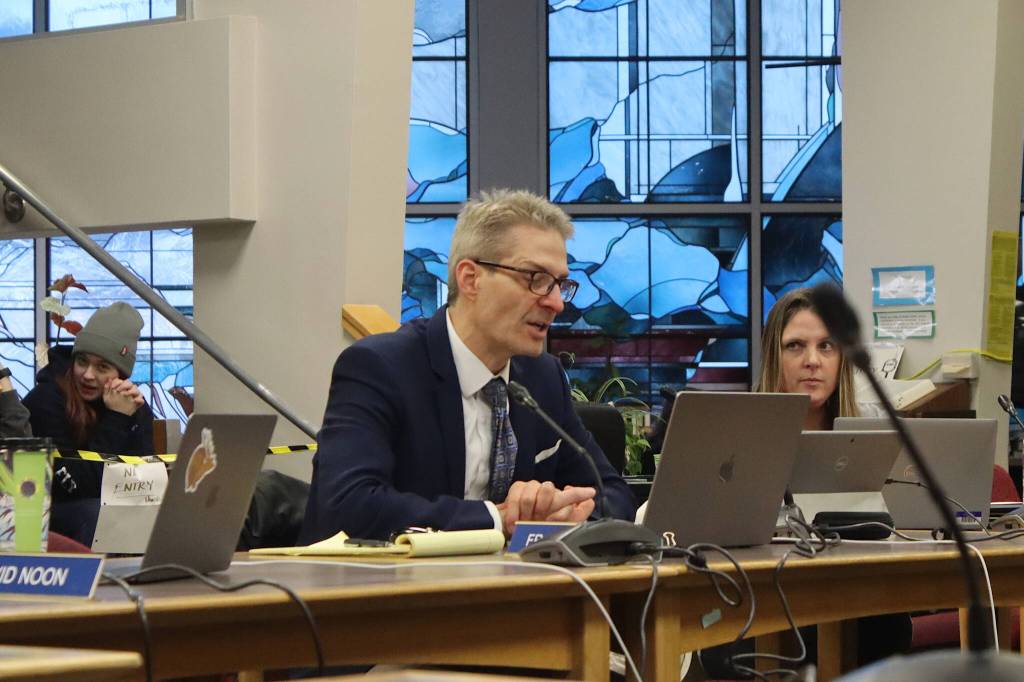
“At what point do we give the superintendent a PTR?” asked David Noon, one of two new members elected to the board last October.
“I can’t honestly answer that question because we’ve never had to do this before,” Sorensen replied.
Even if the district resolves its budget for the coming year, it is facing additional challenges both in the short- and long-term future.
Starting the year after next, the district will likely have to spend three years repaying a $4.1 million loan the Juneau Assembly is expected to approve to help the district with a nearly $8 million shortfall this year. That means the district will have to trim nearly $1.4 million in costs — or legally obtain that amount of revenue — during each of those years.
Beyond that is the ongoing and significant drop in enrollment that is cited as a major — and overlooked — factor in causing the district’s financial situation, along with largely flat state funding for the past decade and district-level accounting errors revealed in January.
Enrollment that peaked at 5,701 students in 1999 dropped to 4,082 (excluding preschool students) in 2023, according to a chart presented by Hauser on Tuesday. It shows K-12 enrollment is projected at 3,942 this year, 3,808 students next year and continuing to decline by similar amounts during the next decade, with 2,798 students forecast during the 2034 fiscal year. That will mean a corresponding reduction to the district’s per-student funding, which is one of the primary reasons some district leaders say the time to consolidate schools has arrived.
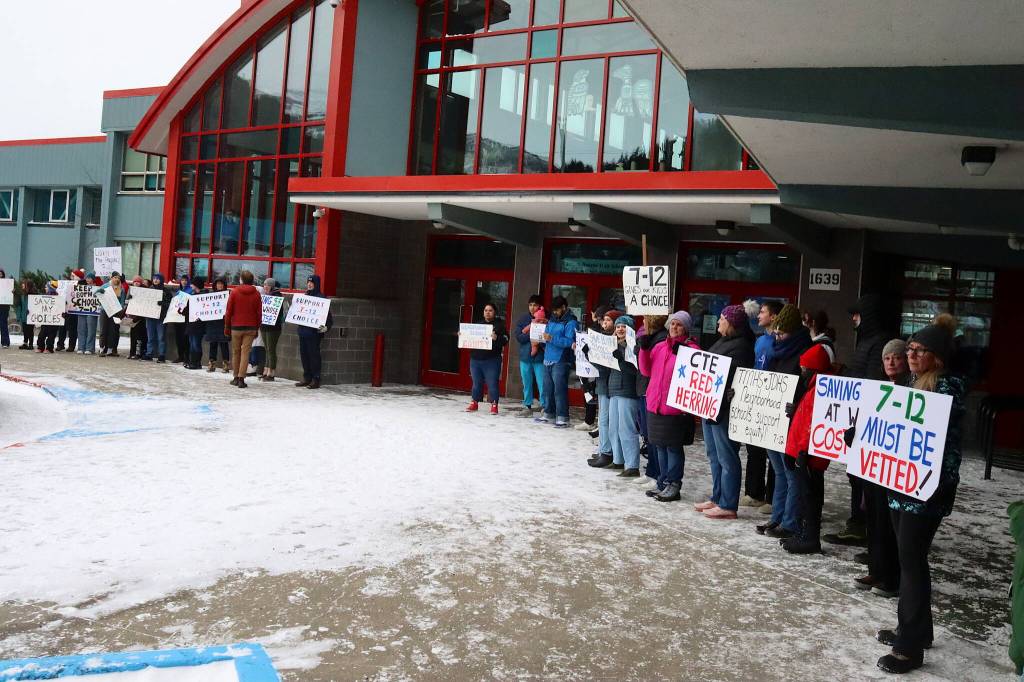
Prior to Tuesday’s meeting at JDHS a few dozen students, parents and teachers staged a rally in front of the school, many holding signs asking the board to consider keeping both high schools open by placing students in grades 7-12 in them. While school district leaders have emphasized the consolidation plan approved by the board is being treated as final, legally it could still be modified — and the budget implementing it must be approved by the district, Juneau Assembly, and state Department of Education and Early Development.
Shannan Greene, a parent of three students, said she was at the rally because she felt the school board violated procedure during last week’s meeting by first rejecting a consolidation plan and then, following a break, approving essentially the same plan when told by the city attorney the action was permissible. Furthermore, she said, the 7-12 schools plan many people advocated for during the meeting — citing the distinct culture and offerings at both high schools — hasn’t gotten proper consideration from board officials.
“This really isn’t about TMHS versus JDHS,” she said. “It’s about exploring an option that was kind of withheld from the public. And I look at it as kind of the lesser of two evils.”
The Juneau Assembly is scheduled to consider three ordinances providing the loan, and taking over shared costs for this year and next, during its regular meeting at 7 p.m. Monday. A first reading of the district’s revised budget for this year and proposed budget for next year, including separate consideration of layoffs, is scheduled at 5:30 p.m. next Wednesday at TMHS.
• Contact Mark Sabbatini at mark.sabbatini@juneauempire.com or (907) 957-2306.