Hundreds of property owners in flood zone may have to pay $7,972 apiece for Hesco barrier levee
Published 9:30 pm Thursday, November 14, 2024
This is a developing story.
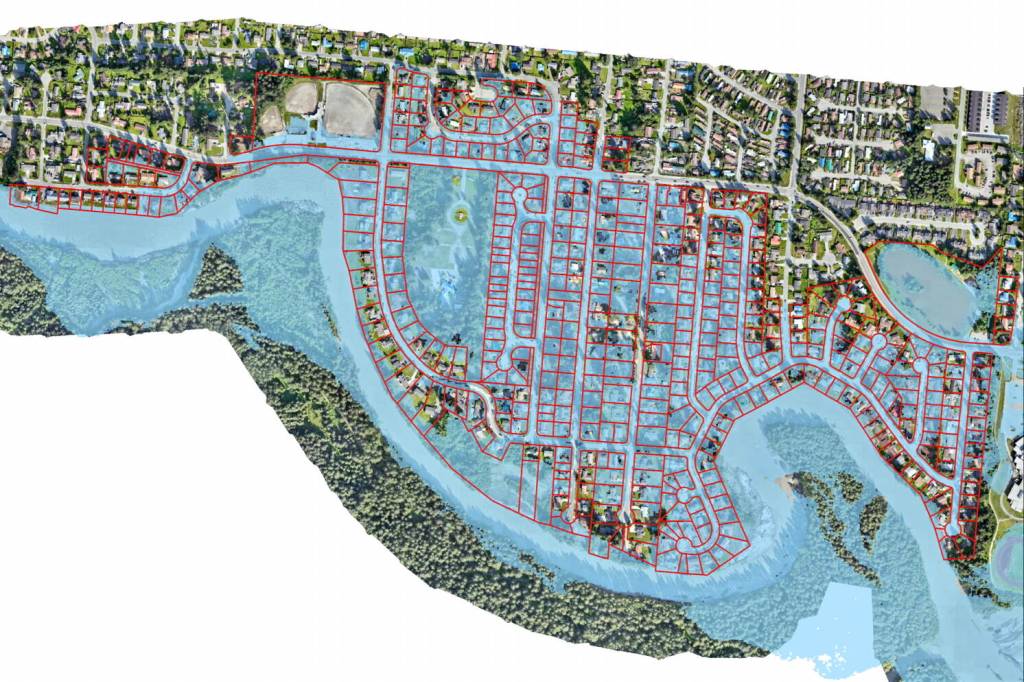
Owners of 466 properties at risk of Mendenhall River flooding will be required to pay nearly $8,000 apiece for the installation of a semi-permanent levee of military-grade flood barriers under a proposal being presented to the Juneau Assembly for initial consideration Monday.
Establishing a Local Improvement District (LID) to pay for the estimated $7.83 million installation cost of a barrier between Marion Drive and Rivercourt Way, with the City and Borough of Juneau paying half the bill and property owners in the area the other half — or $7,972 apiece — is a starting point in the discussion about the project, City Manager Katie Koester said in an interview Friday afternoon.
“The idea is that the Assembly will amend it on Monday so that the public has something to react to at the December meeting for a public hearing,” she said. “And only after that will we send notice to everyone on the assessment roll about the proposed assessment. Then that will trigger the opportunity to protest in writing the formation of the district.”
A timeline recommended by Koester also calls for a neighborhood meeting in mid-January, a second public hearing at an Assembly meeting Feb. 3 where an ordinance could be adopted that takes effect March 3, with April 3 being the last day to file legal challenges to the assessment roll.
The 466 lots proposed for an LID are based on inundation maps at the 16-foot flood stage, the same level reached during this year’s flood that peaked Aug. 6, Koester wrote in a memo to the Assembly.
“While some homes were spared in 2024 due to unique topography, all 466 parcels are at risk at a 16 ft or higher flood, which we anticipate will occur in the future,” she wrote.
The affected property owners would have up to 10 years to pay the costs owed at a 4.78% interest rate — a term based on the expected lifespan of the levee. The Hesco barriers are envisioned as remaining in place for roughly a decade while a more permanent solution to safeguard against glacial outburst floods is evaluated and implemented.
The levee would be built from Hesco barriers provided free by the U.S. Army Corps of Engineers, but the city would be responsible for installation and maintenance of the barriers. Koester said an ordinance establishing an LID would allow billing owners for the upgraded protection of their properties.
While limiting an LID to the properties where the barriers are placed has been discussed, both the potential intrusion to those homeowners as well as the wider protections provided make that alternative less practical, according to Koester.
“It is unlikely a property owner that needs to remove a deck to fit HESCO barriers, as an example, sees that as an improvement to their property,” she wrote. “Therefore, it makes sense for that cost to be borne by the entire district.”
A report prepared for Monday’s meeting includes the names and addresses of all the property owners in the proposed LID.
The initial proposal by Koester would also require four of the property owners to pay an additional $50,000 for riverbank armoring that will provide additional protection against erosion. Many property owners along the bank have already installed such armoring — especially following a then-record flood last year that washed away vast portions of the riverbank, with some people saying they paid $100,000 or more for the protection.
“At $50,000 a parcel, with favorable financing terms, those property owners are benefiting from the formation of the district,” Koester wrote in a memo to the Assembly. “Assessing them at a higher amount attempts to address the equity concern. If those properties were to armor their bank as a stand-alone project, it would cost anywhere between $70,000 and $140,000 per property.
The Assembly has already approved up to $2 million toward the installation of the barriers, which occurred at a meeting last month where the possibility of an LID was discussed. The total project could be lower if other sources such as federal funds for it are received, Koester noted in her memo to the Assembly.
“Tlingit and Haida submitted a grant application that would offset $750,000 of the total project cost,” she wrote. “CBJ is also actively lobbying for emergency supplemental disaster assistance federal funding for the total project cost. Any federal funding that is secured would be applied to the total project cost thereby sharing the benefit between CBJ taxpayers at large and benefited properties, unless the Assembly advises differently.”
• Contact Mark Sabbatini at mark.sabbatini@juneauempire.com.