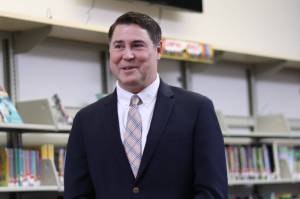
Get to know a candidate: Brian Holst
Published 10:30 pm Tuesday, September 8, 2020




Brian Holst
Date and place of birth: New York, 1966
Length of residency in Alaska and Juneau: 42 Years, since 1978
Education:1984, Juneau-Douglas High School; 1988, University of Notre Dame, BA in Politics, Philosophy and Economics; 2008, Mendoza School of Business, University of Notre Dame, executive certificate in Leadership and Management.
Occupation: Executive Director for Juneau Economic Development Council, 2008 to present. Worked internationally from 1992 to 2008 in Central and South America, Eastern Europe, Russia, Africa and Southeast Asia.
Family: Married to Estela since 1993. Four children, Brian, Jasmin, Samuel and Martin.
Community service: Juneau Board of Education, 2014 to present; Alaska Committee, 2008 to present; Parks and Recreation Volunteer Soccer Coach, 2008 to pandemic; Various University of Alaska advisory groups; Gastineau Rotary Club, 2008 to present.
Other experience: Alaska Early Childhood Coordinating Council, 2012-present; Board Chair, International School of Belgrade, 2005-2007; U.S. Peace Corps Volunteer, 1988-1992.
[Read about this year’s ballot propositions here]
School Board Candidates’ Questions
1. The newly adopted JSD Strategic Plan provides a five-year blueprint for the district. How can the board support the schools in accomplishing the goals?
We need to keep the strategic plan a constant part of conversations amongst staff at each of the buildings. The four pillars are: achievement, relationships, partnerships and equity. We need stakeholders to see themselves in the plan so they can own it and be a part of its realization. The board needs to show that we are committed to the plan by holding regular discussion on elements of the plan, holding ourselves and the administration accountable to the plan, and sharing with the public progress on the plan. Board members each serve on site councils and have an effective way to maintain engagement at the building level with leadership from parents and staff.
2. Reading at grade level by the third grade is a key indicator of future success in school. Too many Juneau students are not proficient. What more should the district do to support early literacy?
Improved reading by all students in the early grades has been a priority of Juneau’s schools for many years. We are making slow progress towards our goals, however. In order to accelerate improvements, we need to continue to expand and advocate for expansion of high-quality early education so that more children arrive in kindergarten ready to learn. We need to prioritize K-2, which we have recently done by lowering the pupil-teacher-ratio at those grade levels, even though PTR is rising elsewhere due to inadequate state funding. We also need to invest professional development and use our data to better refine our approaches. Finally, we need to continue to include partners, such as Baby Raven Reads and United Way Reading Tutors.
3. With the sizable budget budget reductions the district has faced over the last several years, what actions should be considered to mitigate budget cuts?
We have navigated budget cuts while continuing to make modest school improvements. Cuts need to be kept as far away from student learning as possible. Partnerships, a pillar of the district’s strategic plan, are key to mitigating impacts of budget cuts — allowing partners to pick up the slack when other support diminishes. We enjoy more partnerships with community groups than at any time in the history of our schools, because we actively embrace them. Collaboration with the CBJ Assembly has allowed us to focus on core education functions and use community support to contribute to needs like food service, transportation and activities. We need to advocate for increased State funding of schools for the long-term economic benefit of Alaskans and Alaska’s economy.
[Read about how this year’s mail-in election will work here]
4. COVID-19 has caused disruption to the school system. Under what circumstances should the district allow in class instruction? What actions should be taken to support teachers?
We understand that in-person learning will have the best results for the most students. We also need to take seriously the direct threat of illness of students and staff, and also the reality that concentrating hundreds of people in school buildings can spread disease. When the community has been able to bring the case load to levels considered low by state and local authorities, we can slowly bring in students under different circumstances, dictated by student needs and our ability to manage and minimize risks of disease spread. The district mask policy was an important measure to support staff and students. We will show flexibility with staff to adjust to their specific health concerns. Staff need time and training to retool so they can deliver a good education under challenging circumstances.
5. What role can or should the District play in helping to revitalize the Tlingit language?
The Juneau School District has taken an important step in outlining and articulating a policy for Tlingit language, serving as model for other Alaskan districts. We need to embrace Tlingit culture in our schools, which will enrich the educational experience and cultural understanding of every student. Let’s create a positive environment where Tlingit culture and language is central to the Juneau identity. In this context, we need to offer opportunities for our Native partners to work with students to develop their interests and skills. Programs like Tlingit Culture Language and Literacy need to enjoy increasing support. Our language programs need to extend K-12 and connect with pre-K and postsecondary efforts.
6. How can civics education be strengthened in Juneau schools?
As the capital of Alaska, we have a unique opportunity and expectation to provide a strengthened civics education through increased interactions with government structures. Kudos to the LWV and groups like the Alaska Committee that support bringing every middle school student to visit the State Capitol. This sort of experience is a valuable complement to in-class instruction. The Board of Education has created the valuable tradition of meeting regularly with the elected representatives of the student governments. We need to elevate and celebrate activities that allow students to engage in community service work and build leadership skills. Students need to learn to separate fact from fiction and to value different points of views.
• These questions were developed by the League of Women Voters. Candidates supplied the biographical information.