Bog plants and bird feeder begin to bustle
Published 1:30 am Tuesday, May 26, 2020


Just after mid-May, the alders and cottonwoods were suddenly — so it seemed — in full leaf, the fresh, bright green a pleasant contrast with the dark conifers. Even the blueberries and other understory shrubs made a new layer of green above the mosses.Hermit thrushes added their welcome voices to the canopy and fox sparrows tuned up in the thickets.
Early in the fourth week of May, I poked around in some low-elevation bogs (muskegs). Several species were beginning to flower — bog blueberry with deep pink buds and young flowers, bog laurel with broad, pink petals, and bog rosemary with small, pink flowers. The white flowers of trailing raspberry, or five-leaf bramble, starred the mosses under the scattered trees. The distinctive few-flowered sedge was surprisingly colorful, with vibrant green leaves and a yellowish inflorescence. An unidentified sedge with pale green leaves was common but only a few were yet in flower. Labrador tea, lupines and buckbean were budding. Round-leaf sundews were still just tiny rosettes, their sticky, insect-catching leaves glittering in the sun.
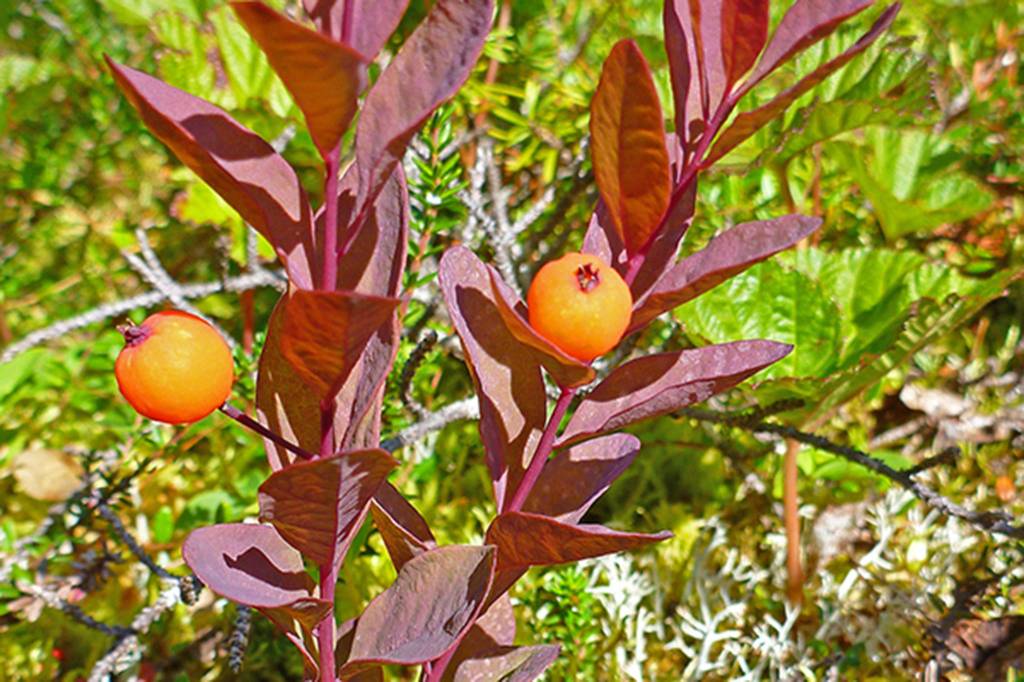
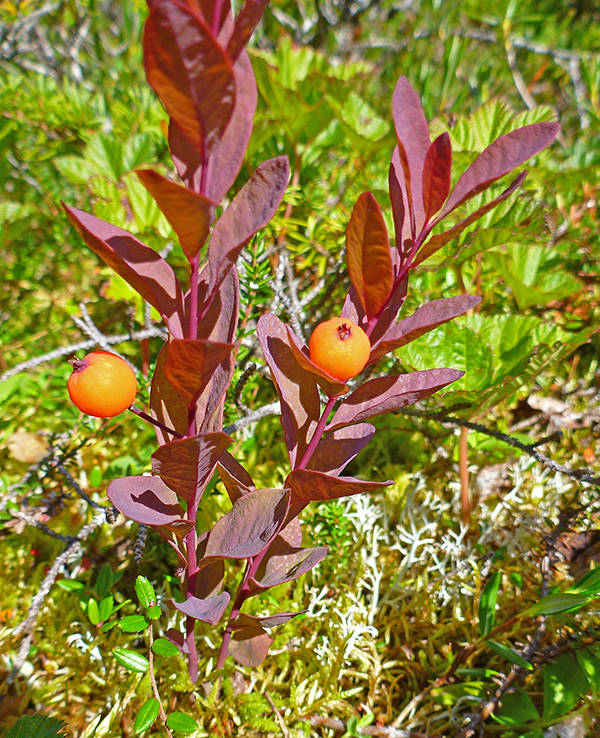
I found a single specimen of a weird little herb (Geocaulon lividum) sometimes called “bastard toadflax,” but also known as pumpkinberry or timberberry or other common names. Seldom common, it is nevertheless widely distributed across northern North America. It’s a hemiparasite — getting some of its nutrition from its green leaves and some by parasitizing the roots of other plants. It’s not fussy about its host plants; it parasitizes anything and everything from pine trees and blueberry bushes to asters and horsetails to sedges and grasses and even others of its own species.
[Do you know the differences between hares and rabits]
This plant makes only a few small inflorescences; each inflorescence typically has three flowers, usually one female flower in the middle, flanked by two male flowers that drop off eventually. The open flowers are dull yellowish-green with purple marks and I’m guessing they are pollinated by flies or beetles. The orange-red fruits are few, each one with a single seed. Very little seems to be known about seed germination and dispersal. But the seeds are sometimes harvested and cached by Arctic ground squirrels up north and presumably eaten, perhaps sometimes dispersed, by other rodents. It seems likely that birds would take the colorful, fleshy fruit and potentially disperse the seeds.
The fruit has plenty of sugar in it, especially when fully ripe at the end of the season, usually late summer. Estimates of sugar content found that each fruit has about 30 milligrams of sugar, which is more than blueberries or most other fruits in Southeast. Despite the sugar content, the fruit is reported to be just barely edible or tasteless to humans.
Here at home, there’s a lot of action on the pond. As many as five male mallards gather, all good pals now that their lady friends are incubating eggs. That changes, though, when one late-nesting — or re-nesting — couple shows up, and the male of that pair harasses the peaceful gang, keeping them well away from his mate.
The bird feeders are busy places. Siskins, juncos, chickadees and nuthatches visit the seed feeder that hangs over the pond. A jay slams into the side of that feeder, knocking cascades of seeds down for the ducks.
The peanut-butter feeders are the most fun. They’re just little blocks of wood with pits drilled into them, to hold a small gob of peanut butter. Chickadees and nuthatches went crazy over them, but now the juncos almost monopolize them. Juncos are not nearly as agile as the smaller birds, but they cling and stretch — and often fall off — to get a nice bite. Sometimes they perch on the deck railing and fly up to stab and grab out a bill-full.
The jay does the stab-and-grab method too, but he’s a bit rougher, hitting one of the smaller peanut-butter feeders hard enough to knock it off its hanger, so it fell to the deck and broke into four pieces.
But that’s not the end of the jay’s mischief.
It has started to come to the deck railing to scarf up leftover bits of cat food that I commonly leave out for a raven. One day, that jay made off with a whole set of chicken ribs, a load that it could barely carry to a nearby tree. The raven was out of luck again.
• Mary F. Willson is a retired professor of ecology. “On The Trails” is a weekly column that appears every Wednesday.