Become ice aware: CCFR, Forest Service host ice safety workshop Saturday
Published 9:03 am Friday, January 6, 2017
There’s no such thing as safe ice.
That’s the harsh reality that visitors venturing out to Mendenhall Lake need to absorb, says Mendenhall Glacier Visitor Center naturalist Laurie Craig.
Craig wishes everyone would stay off the ice, no matter how beautiful it is in the winter and how tempting it can be to venture out to the glacier or the ice caves.
But she also knows human nature.
“Most of the people who walk out on the lake don’t have a clue how dangerous it is,” Craig said. “I knock on wood every time I see people go out there.”
[VIDEO: What to do if you fall through the ice]
And so every year, the U.S. Forest Service, in conjunction with Capital City Fire/Rescue, hosts an ice safety workshop for those who do head out onto the ice some survival tips. This year the workshop will take place Saturday, from 1:30-3 p.m.
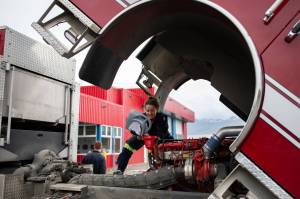
The program, which will be at the visitor center, will begin in the auditorium with a video and slide show illustrating the effects of cold water immersion and rescue techniques. An outdoor demonstration follows with a rescue from an icy pond.
“It’s a beautiful place,” acknowledges CCFR Engineer Jayme Johns, who will be on hand to help lead the demonstration. “For those adventurers going out to the face of the glacier and the ice caves, we want to give them the information on what to look for and how to keep safe.”
Johns tells people there is no safe ice. But there are things to look for.
“We really encourage people to read the ice, to have that gut instinct,” he said.
[Juneau man falls through Mendenhall Lake, warns others to be careful]
During the workshop, firefighters will talk about ice conditions. There are a lot of factors that play into those conditions, which change every day, Johns explained. Rain and wind play a huge part, of course, but so does wildlife such as birds, which congregate and keep portions of the lake ice warmer and thus a lot thinner than surrounding areas.
And firefighters will demonstrate safe ways to self-rescue or to rescue others.
“Don’t go out and become a victim yourself,” Johns advised, adding that firefighters will demonstrate ladder rescues and rope throws.
Johns highly recommended the video, saying it will give a good idea both of what it is like to fall into water that cold, and that there is a chance of survival.
“It’s pretty amazing,” he added. “You can be submerged for hours. There’s high survivability, as long as you keep your head above water.”
Knowing how long you can survive once you take that plunge is especially important, Johns said, because rescue “can be a long way away.”
In a worst-case scenario, if you fall through the ice at the face of the glacier, it will take firefighters about 10 minutes from the time they are called out to get to the visitor center, 1 and a half miles away.
Then the crew needs to assemble and a risk-benefit analysis has to be conducted — maybe another half-hour.
“I have to get the team out there safely, to where we can stage,” Johns explained.
How long it takes to get to the rescue site from there depends on a number of factors, including distance and ice conditions.
That’s why knowing how to self-rescue or safely rescue others can make a huge difference, Johns said.
“We really push that,” he said.
Both Craig and Johns said that Nugget Falls and the face of the glacier are the most dangerous places for people to venture.
Craig didn’t have statistics on the frequency of falls through the ice, because, she said, most people don’t let them know when there’s been an incident.
“We hear about it after the fact, or from someone else,” she said.
She estimated, however, that someone goes through every weekend.
There hasn’t been a human fatality in a really long time, Craig said. But that danger is ever-present.
“People do foolish things because they don’t know any better,” she said. “They will stand under the equivalent of a five-story building, on thin ice above 200 feet of icy water.”
“It’s the sword of Damocles,” she said. “It’s hanging by a thread. It could crush someone or it could shatter the lake.”
Many people don’t realize, for one, that the glacier is not frozen to the land, and that the friction creates an undertow. And, she added, rock slides will break up the ice, as will calvings from the face of the glacier. The glacier calves fairly regularly, creating a concussion wave that can knock people off their feet and break the ice.
Craig said she has lived here 50 years – but still found herself in shock after she saw what she described as a “small” calving turn the whole right side of the lake into “snowcone ice.”
“I had no idea that could happen,” she said. “Before I worked here, I thought the (lake ice) was stable. Now that I know more, no way would I go out there.”
The Forest Service doesn’t prohibit people from going on the ice. Craig just wants them to understand the risks they’re taking.
And, she said, they need to think about the fact that when they take this kind of risk, they are asking potential rescuers to take that same risk.
“If someone lost their life, how would you feel?” she asked. “You need to understand the risks and assume that responsibility.”
For more information on the upcoming workshop, call 907-789-0097.