Assembly moves forward on mill rate and utility fee hikes, $10M school projects bond
Published 9:30 pm Wednesday, April 30, 2025
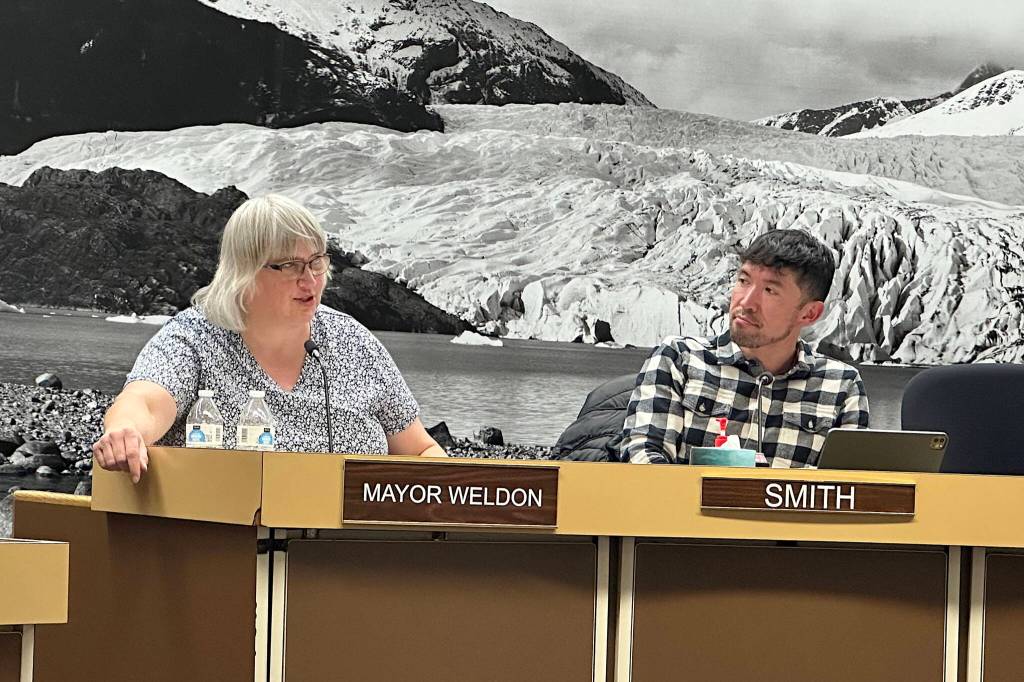
Juneau Assembly members moved toward a $10 million school projects bond and a 5% hike in utility rates for each of the next five years, away from a bond to fund utility projects, and stalled on a higher sales tax during tourism season during a pair of meetings Wednesday night.
The Assembly also advanced the municipal budget for the next fiscal year that starts July 1 — including raising the mill rate to 10.19 — a step forward after an opportunity for public testimony saw only one person speak up. Another opportunity for residents to weigh in is scheduled when the Assembly gives final consideration to the budget on June 9.
The necessity of taking some actions residents will literally find costly due to a difficult financial outlook for the city, while acknowledging there is a limit to how much they will tolerate or vote for, characterized the three-and-a-half hour session at City Hall.
The full Assembly started the evening with a relatively brief consideration of ordinances for the municipal, school district and capital projects budgets — primarily for the purpose of allowing public testimony — sending all of them along with the proposed mill rate increase back to the Assembly Finance Committee afterward for further review.
The committee then met to consider the tax and bond proposals — all of which will need further action by the full Assembly before being enacted or placed on the fall municipal election ballot.
Moving forward on next year’s budgets
Four ordinances containing components of next year’s budget for all City and Borough of Juneau entities took their next step forward in the two-month budget process. Wednesday’s meeting was essentially a midpoint public comment period before the Finance Committee makes final adjustments during the coming weeks.
The main components are a roughly $140 million municipal government budget, $152 million budget for Bartlett Regional Hospital, $95 million Juneau School District operating budget and $60 million in capital improvement projects. The total budget of about $537 million also covers Juneau International Airport, docks and harbors, Eaglecrest Ski Area, public works and utilities operations, and various grants and awards to community organizations.
CBJ’s biggest revenue sources are slightly more than $200 million in fees for services and more than $140 million in taxes. A year ago the Assembly reduced property taxes from 10.16 mills to the current rate of 10.04 mills — the lowest in decades — but are looking at the increase to 10.19 mills due to extra costs such as taking over three buildings from the school district after its consolidation during the past year.
The proposed rate means property owners would pay $10.19 for every $1,000 in taxable value of their properties — equating to $75 more on a $500,000 home.
That increase prompted the evening’s only public testimony. Nathan Reddekopp, a Mendenhall Valley resident who said he understands the difficulties the Assembly is facing since he works for the city, nonetheless expressed concern about the mill rate increase adding to a years-long and widespread workforce shortage.
“It definitely is going to put the hurt on the younger generation that’s coming up to do work for us and the wages that we have right now are not compriable to keep (in) Juneau a good sustained workforce,” he said. “It’s sad to see we haven’t kept up with the workforce labor and inflation in Juneau…We are not going to get qualified people coming up to do training or whatever.”
Plan increasing utility rates 5% for five years gets preliminary OK
Deputy Mayor Greg Smith said he regrets not voting for higher utility rates back in 2020 because it means the city is now facing a dilemma where operations and maintenance costs are far outpacing inflation.
“We’re obviously struggling with this because we’re caught between two things,” he said. “Keeping rates for every homeowner in town — trying to slow the growth of that, because it’s extremely impactful — and then also funding a critical piece of infrastructure. I will say I’m cringing and being like, ‘I wish I had voted for higher rates in 2020 and that I had put a 1% sales tax for water and the utilities on’ when that was happening years ago. So I should have done that and I’m feeling very bad about it now.”
As a result, consultants issued a report to city leaders this month stating both water and wastewater rates need to increase more than 55% over the next five years merely to cover a low-end plan covering only the maintenance and upgrade projects that are absolutely necessary.
However, the consultants also offered an alternative — an increase of 5% per year (about 28% over five years), and covering the remaining funds needed by alternate means such as sales taxes or a bond measure. The Assembly voted 6-2 during its Finance Committee meeting to have staff draft a proposal with the 5% increase that funds the remainder by having CBJ take on some new form of debt.
Even that 5% increase is going to be difficult for some residents, said Assembly member Alicia Hughes-Skandijs.
“It’s super unfortunate that these decades past have passed this problem up to residents now, but that makes me feel just really passionate about not continuing to pass it forward because it only gets worse and worse and worse,” she said.
The specifics of how CBJ would take on the additional costs will be part of the wording drafted by city staff for further consideration by the Assembly, which would still need to approve the rate increase plan itself.
School bond advances, utility bond nixed
The school district’s operating budget for next year of about $95 million is roughly $9.6 million more than this year’s, City Manager Katie Koester told Assembly members at Wednesday’s meeting. That’s a remarkable turnaround from a year ago when it was facing its worst financial crisis ever with a projected $10 million shortfall, which was resolved with a combination of cuts, accounting adjustments and a one-time increase in per-pupil state funding.
This year’s district budget assumes state lawmakers will provide a $400 increase in the Base Student Allocation — and there is a possibility more staff and programs previously scaled back could be added since the Legislature on Wednesday passed a bill with a $700 BSA increase and 10% boost to student transportation by a veto-proof majority.
But the bad news for the district is a lengthy list of repair and maintenance projects for aging buildings that officials say have been ignored to the point they are inhibiting school functions — and getting more serious and costly to address. As a result, the Juneau Board of Education earlier this year approved lists of bond projects at the $5 million, $10 million and $15 million levels for the Assembly to consider placing on the fall ballot.
The Assembly, during its Finance Committee meeting, voted 5-3 to have CBJ draft language for a $10 million bond measure after rejecting the $15 million proposal. Assembly members also talked about a second bond measure to fund utility facilities upgrades — suggesting amounts ranging from $5 million to $20 million — with a vote on having staff draft a $10 million proposal failing by a 4-4 vote.
“I’m interested in continuing down the road of looking at a school bond package, but don’t necessarily know if it’s something that we won’t put on the ballot,” said Neil Steininger, one of the Assembly members voting in favor of the bond for schools and against the one for utilities. “I think there’s a lot of factors that we don’t necessarily know today that hopefully will become clear before we hit the deadline of when we have to put it forward.”
“I could maybe be supportive of a utility bond, but I think I’d be more supportive of seeing an initial year higher on those utility rates and push the bond out a year or two so that we put a little bit of time from the last major utility bond that we had on the last ballot.”
Assembly member Wade Bryson, who as chair of the Finance Committee meeting voted against both bond proposals, including the deciding vote on the utility proposal after a long pause, said he might be willing to support the utility bond if it means lower rates for customers than they would pay otherwise, but this doesn’t seem like the right year to ask given the pending mill rate and utility fee hikes.
“I would rather us get the utility rates squared away,” he said. “If we’re going to have a first sticker shock here of bumping utility rates I’d rather that be the only thing that the citizens and residents of Juneau are thinking about.”
Seasonal sales tax
A seasonal sales tax that increases revenue from visitors — and thus possibly benefiting residents by a lower sales tax the rest of the year or a tax exemption on some essential items such as groceries — has been discussed by the Assembly in recent years. However, as in the past, discussion about putting such a proposal to voters this fall was inconclusive as members opted to review the issue further at a meeting later this month.
The primary concern of some Assembly members — notably Bryson — is the temporary tax would hurt residents and businesses making large warm-season purchases such as building materials.
Juneau’s 5% sales tax includes temporary taxes of 3% and 1% that voters have for decades renewed every five years. A memo presented to the Assembly by CBJ Finance Director Angie Flick assumes visitors will pay about $18.4 million of the $65 million in annual total sales taxes based on 2024 figures.
She stated that would increase to $21.1 million with a 5.75% sales tax between April and September, and a 4% tax the rest of the year, resulting in the same $65 million in total taxes. In another scenario, visitors would pay $26.7 million of the $65 million with a 6.75% seasonal sales tax and a 4.5% sales tax the rest of the year — with basic food items and utilities exempt from sales tax.
The Assembly will need to introduce an ordinance by June 9 meeting and approve it by July 28 to put the question on the fall ballot, according to Flick.
• Contact Mark Sabbatini at mark.sabbatini@juneauempire.com or (907) 957-2306.