Opinion: NASA’s mission is four billion miles off course
Published 5:00 pm Saturday, January 5, 2019
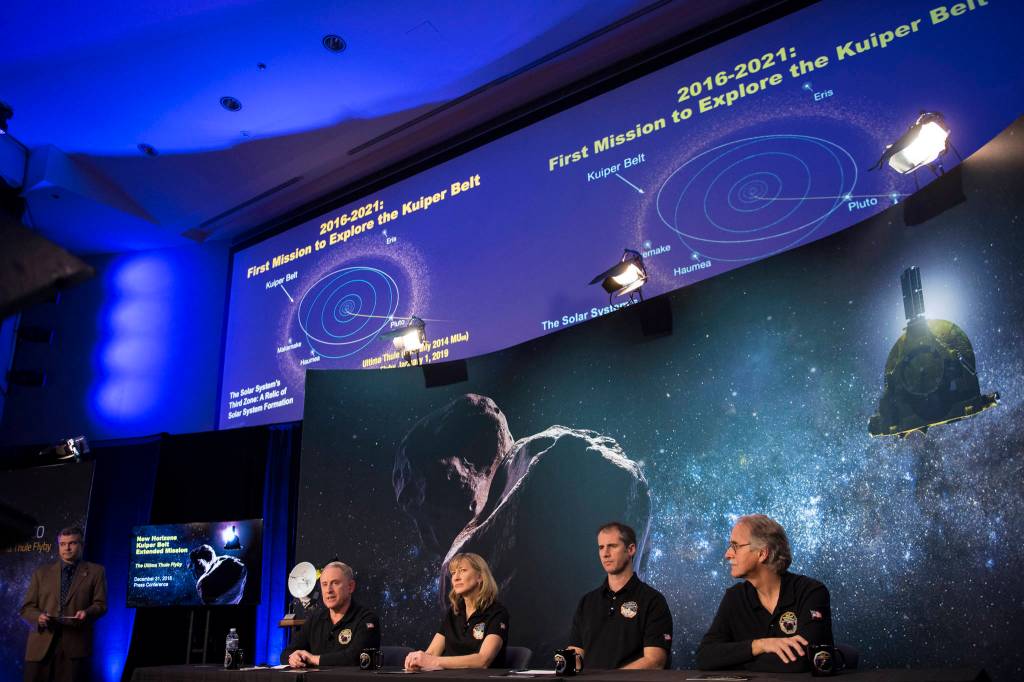

For some scientists, NASA delivered an amazing story to kick off the new year. A photograph taken four billion miles from Earth was received at the New Horizons mission control station where Alice Bowman, the operation manager, boldly claimed the expedition “will help us understand the origins of our solar system.”
Why bother though? Because if he were alive today, even a dedicated astronomer like Galileo would realize that distant object won’t help us with the more immediate problem identified by other NASA scientists — climate change.
New Horizons fulfills the first part of NASA’s mission statement: “We reach for new heights and reveal the unknown.” But images of Ultima Thule — described by one project scientist as a “pixelated blob” — will do nothing for the second part, which is “for the benefit of humankind.”
The expedition isn’t nearly as exciting as the moon landing 50 years ago. It took 10 years for it to reach Pluto, its primary destination. Another three to get to Ultima Thule. And 20 months just for the data it collects to arrive back on Earth.
[Warmer temperatures could cost Alaska up to $700 million]
From launch to splashdown, Apollo 11 took a little more than a week. And some of us got to watch Neil Armstrong take his “giant leap for mankind” live on TV.
We went back a few times, but in the end, Americans show more concern about life on the planet. Like the Vietnam War, nuclear arms race, air and water quality, and paying taxes.
Now, NASA is no longer the pride of the nation. And one party and the current occupant of the White House think its climate change research is bad science.
But the science in deep space is still fine. It doesn’t make government any bigger. It doesn’t slow economic growth, result in new taxes or new regulations. Simply put, that part of NASA’s program doesn’t challenge the Republican Party’s political ideology.
In an essay titled “The Alternative to Ideology,” Jerry Taylor asks how “does an ideological commitment to limited government, free markets and individual dignity inform an understanding of atmospheric physics or paleoclimate records?” The president of the Niskanen Center, a libertarian organization when it was founded in 2015, answers his own question by saying “libertarians have nothing at all to contribute to the conversation about the science of climate change as libertarians.”
The point here isn’t to put down those ideological beliefs. They deserve a place in our political discourse. But in terms of imagining the future, all political ideologies, liberal and conservative, aren’t any better than the study of the far reaches of our solar system.
The New Horizons mission demonstrates that scientists can be blind to their own biased ambitions. That includes those studying climate change. However, there isn’t a political theory on the planet that is free from such problems. And as Taylor explains, staying true to ideological biases “encourages fanaticism, disregard for social outcomes and invites irresolvable philosophical disputes.”
[Cruisers come to see ‘front lines’ of climate change]
Political science isn’t even a science. It’s a philosophy concerned with the practice of government and how it interfaces with human nature, moral values and the economic production and distribution and the economy — a so-called “social science” that’s also more philosophy than science. Even though scientists sometimes err in their rigorous process of experimentation, reproduction of results and peer review, they more often deliver superior evidence to politicians’ or economists’ offer to support their views.
Politics is more like religion, the one it’s paired with as a topic to be avoided at the dinner table. Which may be why, in our modern era, it’s starting to butt heads with science. In the same manner that Galileo was sure the Earth revolves around the Sun, climate change scientists are challenging the dominant dogmas Americans have trusted since the beginning of the Industrial Revolution.
Taylor still believes in the libertarian cause. But he’s not a rigid ideologue. To him, remaining loyal to that congregation means ignoring what he calls “incredibly dangerous risks stemming from the misuse of a common congregation pool resource, such as the atmosphere.” So, he’s choosing to trust NASA’s scientists. And because we live on earth, it’s their climate change findings that matter, not the imagined origin of the universe.
• Rich Moniak is a Juneau resident and retired civil engineer with more than 25 years of experience working in the public sector. He contributes a weekly “My Turn” to the Juneau Empire. My Turns and Letters to the Editor represent the view of the author, not the view of the Juneau Empire.