Humpback whale freed from entanglement in Endicott Arm
Published 3:30 am Friday, June 26, 2026
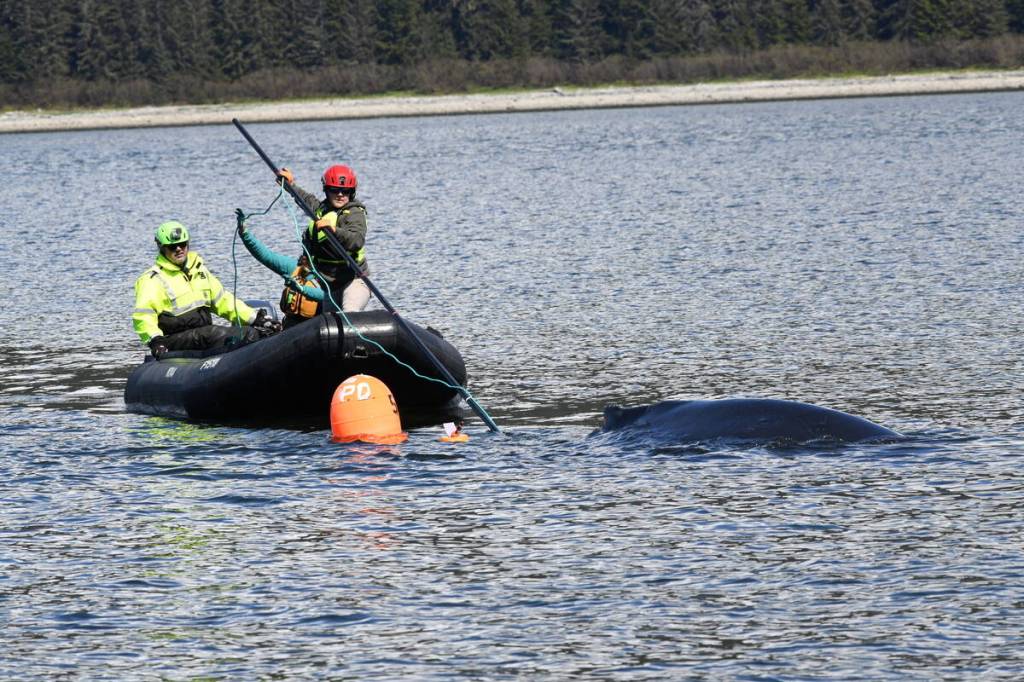
A maritime rescue of a different sort played out in the waters south of Juneau recently.
A juvenile humpback whale entangled near the entrance of Endicott Arm was successfully freed by a multi-agency response team last month.
In the evening of May 10, several mariners spotted the whale restricted in the narrow fjord opening, about 50 miles southeast of Juneau, as its movement was hampered by lines from two commercial Tanner crab pots — each weighing approximately 800 pounds. They reported the sighting to the National Oceanic and Atmospheric Administration (NOAA) Fisheries Alaska Marine Mammal Stranding Network 240-hour hotline.
The heavy lines ran through the whale’s mouth and baleen, leading back to a tight knot of line wrapped around the animal’s peduncle, the area just in front of the tail or flukes. The weighted pots on the seafloor acted as anchors, and the whale was unable to move far from the mouth of the 30-mile-long fjord.
“This configuration effectively hog-tied the whale and prevented it from using its flukes normally, forcing the whale to rely primarily on its pectoral fins to reach the surface to breathe,” said NOAA fisheries marine mammal specialist Suzie Teerlink.
A Juneau-based response team trained by NOAA’s Large Whale Entanglement Response Program mobilized on May 11. The team included biologists from NOAA Fisheries, the Alaska Department of Fish and Game’s Marine Mammal program, local partners from Alaska Sea to Shore, and Teerlink, who is an advanced responder on the team.
The U.S. Coast Guard Station Juneau supported the operation aboard their response vessel and served as a safety boat, directing vessel traffic near the entangled whale.
“Cutting gear off an animal of this size can be dangerous,” said John Moran, a NOAA research fisheries biologist and advanced responder on the team. “We use long poles fitted with specialized knives to extend our reach, which allows us to cut lines while reducing the risk of being injured by a 40-ton animal.”
Responders worked over five hours to make four precise cuts that freed the whale from the pots and most of the entangled lines. A small section of the unknotted line remained threaded through the whale’s mouth as it swam away.
Sadie Wright, large whale entanglement response coordinator for the NOAA Fisheries Alaska Region, said that the details provided by the public enabled the response team to prepare and execute a safe response to the life-threatening entanglement and led to a successful outcome.
“We are incredibly grateful to the whale watch community and everyone who reported this entangled whale to the NOAA Fisheries hotline,” she said.
The team collected photographs of the whale’s dorsal fin, which may assist with identification. Tiny pieces of skin from the entangling gear was also gathered, which may allow for genetic identification from DNA.
Teerlink said that the information can be used to potentially connect the whale to future sightings.
“If we know who the whale is, we can document future sightings and collect valuable data on movement and survival following this traumatic event,” she said.