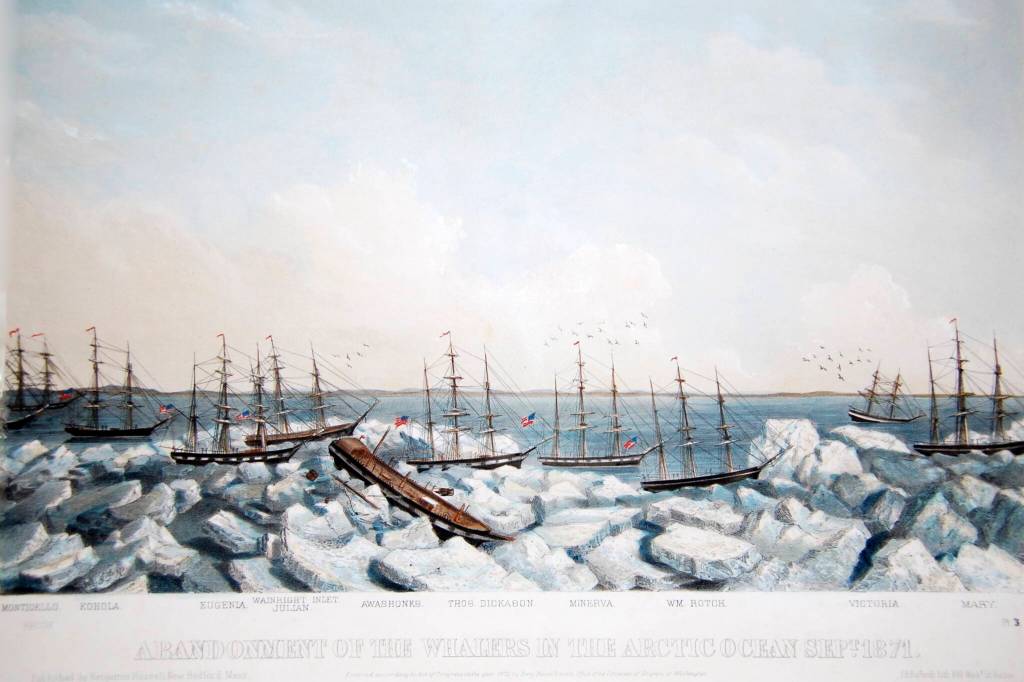
This painting, “Abandonment of the Whalers in The Arctic Ocean September 1871,” depicts the New England whaling ships trapped in pack ice off northern Alaska. Wainwright Inlet is in the background. (Photo courtesy Ted and Ellie Congdon, Huntington Library)

This painting, “Abandonment of the Whalers in The Arctic Ocean September 1871,” depicts the New England whaling ships trapped in pack ice off northern Alaska. Wainwright Inlet is in the background. (Photo courtesy Ted and Ellie Congdon, Huntington Library)

Alaska Science Forum: When the Civil War came to Alaska

About 150 years ago, a few days after summer solstice, the gray skies above the Diomede Islands were heavy with smoke from whaling ships set ablaze by Confederate sailors who didn’t know the Civil War had ended.

“The red glare from the eight burning vessels shone far and wide over the drifting ice of these savage seas,” wrote an officer aboard the Shenandoah, a ship commissioned by Confederate leaders to wreak havoc on Yankee whalers who were harvesting bowhead whales off the western and northern coasts of Alaska.

Though their timing was off — the Civil War was over for two months when the Shenandoah reached Alaska waters from England (after an eight-month trip around the southern capes of Africa and Australia) — the captain and crew of the Shenandoah succeeded in destroying the Yankee fleet, burning 22 whaling ships and capturing two others.

“It was the last hurrah of whaling — the place where commercial whaling died in the U.S.,” said Brad Barr, a biologist with NOAA’s Office of National Marine Sanctuaries in Woods Hole, Mass.

Barr and NOAA historians and archaeologists are interested in the often-overlooked history of Yankee whalers that first came to Alaska waters in 1848, finding a bonanza of bowhead whales. Weighing 100,000 pounds each and living their entire lives in waters with sea ice, the largest bowheads have two feet of blubber protecting them from cold northern oceans.

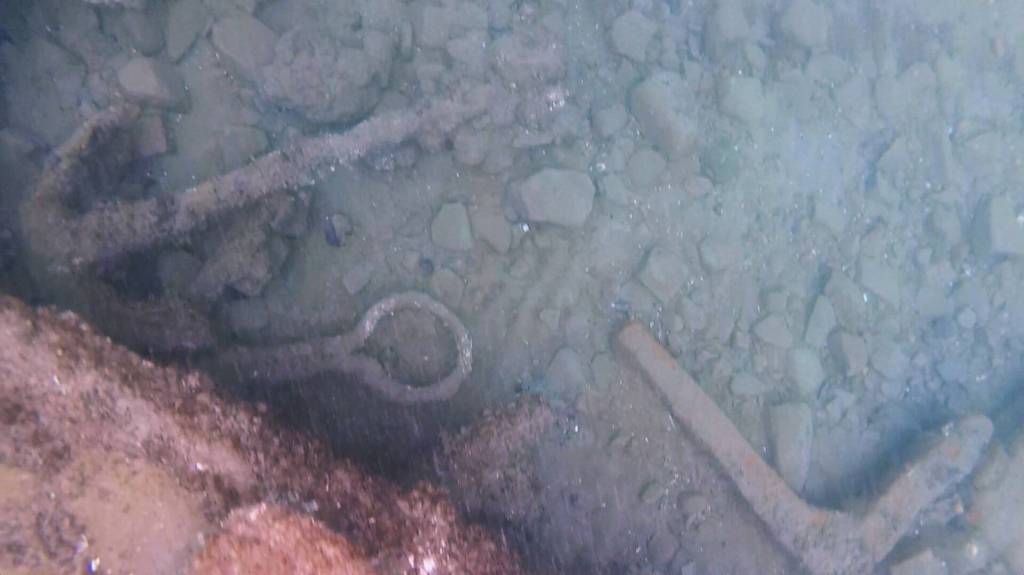
Researchers with NOAA’s Office of National Marine Sanctuaries in Woods Hole, Mass., discovered this anchor, chain plate (the metal loop) and an iron knee, likely part of a ship’s frame, on a 2015 search for remains of a whaling fleet lost off northern Alaska in 1871. (Photo courtesy NOAA’s Office of National Marine Sanctuaries in Woods Hole, Mass.)

Researchers with NOAA’s Office of National Marine Sanctuaries in Woods Hole, Mass., discovered this anchor, chain plate (the metal loop) and an iron knee, likely part of a ship’s frame, on a 2015 search for remains of a whaling fleet lost off northern Alaska in 1871. (Photo courtesy NOAA’s Office of National Marine Sanctuaries in Woods Hole, Mass.)

Whalers boiled down that fatty tissue to render about 120 barrels of oil from each whale. A century before an exploration crew found crude oil at Prudhoe Bay, whale oil and flexible bones known as baleen were the target of whalers who set out for the Arctic from eastern ports, such as Mystic, Connecticut, and New Bedford, Mass.

“They took (bowheads) like they were going out of style — at least until they took too many, and the whales were harder to find and harder to catch,” Barr said.

Along with the last shots of the Civil War fired from Confederate cannons, the waters off Alaska were the site of 32 whaling ships trapped in sea ice and destroyed by it in 1871.

When 12 more ships were stranded north of Barrow (now Utqiaġvik) in 1897-1898, that inspired the U.S. government to commission a reindeer drive of 400 animals from Nome to Barrow as food for the stranded whalers (that turned out not to be needed).

“There are all of these compelling stories of heroes and villains and survival,” Barr said. “Like the 32 ships trapped in the ice in 1871. Twelve-hundred-and-sixteen people had to abandon ship and drag their (smaller) whaleboats across the ice. They were rescued by seven ships that weren’t caught in the ice, and brought to Honolulu.”

Somewhere on the sea floor off western and northern Alaska are the waterlogged remains of those days long ago.

“We’ve identified 160 ships lost or abandoned from 1848 to 1914,” Barr said. “For the most part, nobody’s been able to find them, mostly due to operational difficulties in the Chukchi and Beaufort (seas).”

While mapping the sea floor offshore of Wainwright and Utqiaġvik in 2015, Barr and his colleagues found three pieces of wreckage, likely from two different whaling ships.

As for the bowhead whales, their population north and west of Alaska is now at more than 15,000. That’s a rebound from the 1,000 animals that remained when the last Yankee whaler harvested one in the late 1800s.

• Since the late 1970s, the University of Alaska Fairbanks’ Geophysical Institute has provided this column free in cooperation with the UAF research community. Ned Rozell ned.rozell@alaska.edu is a science writer for the Geophysical Institute. Portions of this story first ran in 2008.
More in Sports

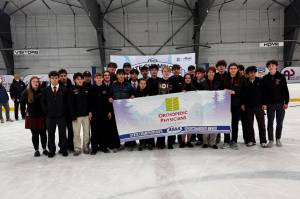
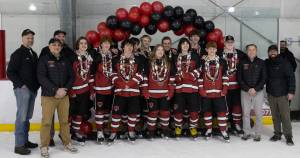
Senior Juneau-Douglas High School: Yadaa.at Kalé hockey players were recognized at the Treadwell Arena on Friday, Jan. 23, 2026 before the Crimson Bears faced the Homer High School Mariners. Head coach Matt Boline and assistant coaches Mike Bovitz, Luke Adams, Jason Kohlase and Dave Kovach honored 11 seniors. (Chloe Anderson / Juneau Empire)
JDHS celebrates hockey team’s senior night with sweeping victory over Homer

The Crimson Bears saw an 8-2 victory over the Mariners Friday night.

Photo by Ned Rozell
Golds and greens of aspens and birches adorn a hillside above the Angel Creek drainage east of Fairbanks.
Alaska Science Forum: The season of senescence is upon us

Trees and other plants are simply shedding what no longer suits them

Things you won’t find camping in Southeast Alaska. (Jeff Lund/Juneau Empire)
I Went to the Woods: Sodium and serenity

The terrain of interior Alaska is captivating in a way that Southeast isn’t

An albacore tuna is hooked on a bait pole on Oct. 9, 2012, in waters off Oregon. Tuna are normally found along the U.S. West Coast but occasionally stray into Alaska waters if temperatures are high enough. Sport anglers catch them with gear similar to that used to hook salmon. (Photo provided by the National Oceanic and Atmospheric Administration/West Coast Fisheries Management and Marine Life Protection)
Brief tuna bounty in Southeast Alaska spurs excitement about new fishing opportunity

Waters off Sitka were warm enough to lure fish from the south, and local anglers took advantage of conditions to harvest species that make rare appearances in Alaska

Isaac Updike breaks the tape at the Portland Track Festival. (Photo by Amanda Gehrich/pdxtrack)
Updike concludes historic season in steeplechase heats at World Championships

Representing Team USA, the 33-year-old from Ketchikan raced commendably in his second world championships

A whale breaches near Point Retreat on July 19. (Chloe Anderson/Juneau Empire)
Weekly Wonder: The whys of whale breaching

Why whales do the things they do remain largely a mystery to us land-bound mammals

Renee Boozer, Carlos Boozer Jr. and Carlos Boozer Sr. attend the enshrinement ceremony at the Naismith Basketball Hall of Fame in Sprinfield, Massachusetts, on Saturday, Sept. 6, 2025. As a member of the 2008 U.S. men's Olympic team, Boozer Jr. is a member of the 2025 class. (Photo provided by Carlos Boozer Sr.)
Boozer Jr. inducted into Naismith Hall of Fame with ‘Redeem Team’

Boozer Jr. is a 1999 graduate of Juneau-Douglas: Yadaa.at Kale

Photo by Martin Truffer
The 18,008-foot Mount St. Elias rises above Malaspina Glacier and Sitkagi Lagoon (water body center left) in 2021.
Alaska Science Forum: The long fade of Alaska’s largest glacier

SITKAGI BLUFFS — While paddling a glacial lake complete with icebergs and… Continue reading

Photo by Jeff Lund/Juneau Empire
The point of fishing is to catch fish, but there are other things to see and do while out on a trip.
I Went to the Woods: Fish of the summer

I was amped to be out on the polished ocean and was game for the necessary work of jigging

A female brown bear and her cub are pictured near Pack Creek on Admiralty Island on July 19, 2024. (Chloe Anderson for the Juneau Empire)
Bears: Beloved fuzzy Juneau residents — Part 2

Humor me for a moment and picture yourself next to a brown bear

Isaac Updike of Ketchikan finished 16th at the World Championships track and field meet in Budapest, Hungary, on Tuesday. (Alaska Sports Report)
Ketchikan steeplechaser makes Team USA for worlds

Worlds are from Sept. 13 to 21, with steeplechase prelims starting on the first day

Old growth habitat is as impressive as it is spectacular. (Photo by Jeff Lund/Juneau Empire)
I Went to the Woods: The right investments

Engaged participation in restoration and meaningful investment in recreation can make the future of Southeast special