Opinion: ‘Peace through strength’ is Orwellian call to arms
Published 3:00 am Friday, March 1, 2019


Eleven years ago, Lijon Eknilang came to Juneau to speak at the World Nuclear Awareness Conference, hosted at the University of Alaska Southeast. A survivor of the U.S. Nuclear Testing Program (NTP) in the Marshall Islands and a victim of the secret human radiation experiment called Project 4.1, Lijon dedicated her life raising awareness about the human and environmental costs of nuclear weapons testing and development.
Today is her birthday, March 1. In honor of Lijon, who passed away in 2012, I would like to take a moment to reflect on the history and future of nuclear weapons proliferation — and ask, what does this mean for Alaskans?
March 1, 2019, is also the 65th anniversary of Castle Bravo — the largest atmospheric thermonuclear test ever conducted by the United States. At 15 megatons, Castle Bravo was 1,000 times more powerful than the bomb dropped on Hiroshima.
After Castle Bravo, the U.S. thought that it had won the global arms race.
It had not.
Less than a decade after Castle Bravo, the Soviet Union responded with an even larger test: Tsar Bomba.
The Soviet test had a blast radius of 58 megatons, nearly 4,000 times larger than Hiroshima, and the shockwave broke windowpanes 560 miles away.
Tsar Bomba shook the planet and woke the world to the madness of the arms race. Within two years of test, the U.S. and the Soviet Union, along with 120 other countries, had signed the Partial Test Ban Treaty (PTBT) — banning nuclear tests in the atmosphere, underwater, or outer space.
After the PTBT came into force, atmospheric testing stopped, but global stockpiles continued to grow. By 1986, more than 70,000 nuclear warheads were stockpiled worldwide.
The pattern of proliferation changed in 1987, when U.S. President Ronald Reagan and Soviet Prime Minister Mikhail Gorbachev signed the Intermediate-Range Nuclear Forces (INF) Treaty. That bilateral agreement, signed at the height of the Cold War, eliminated an entire class of nuclear weapons, and restricted the stockpiles of both countries. It marked a turning point in the arms race. Some say it saved the world.
Since the INF Treaty was signed, global stockpiles have steadily decreased. Today, the number of nuclear warheads worldwide stands at 14,000; an 80 percent reduction since with INF Treaty was signed.
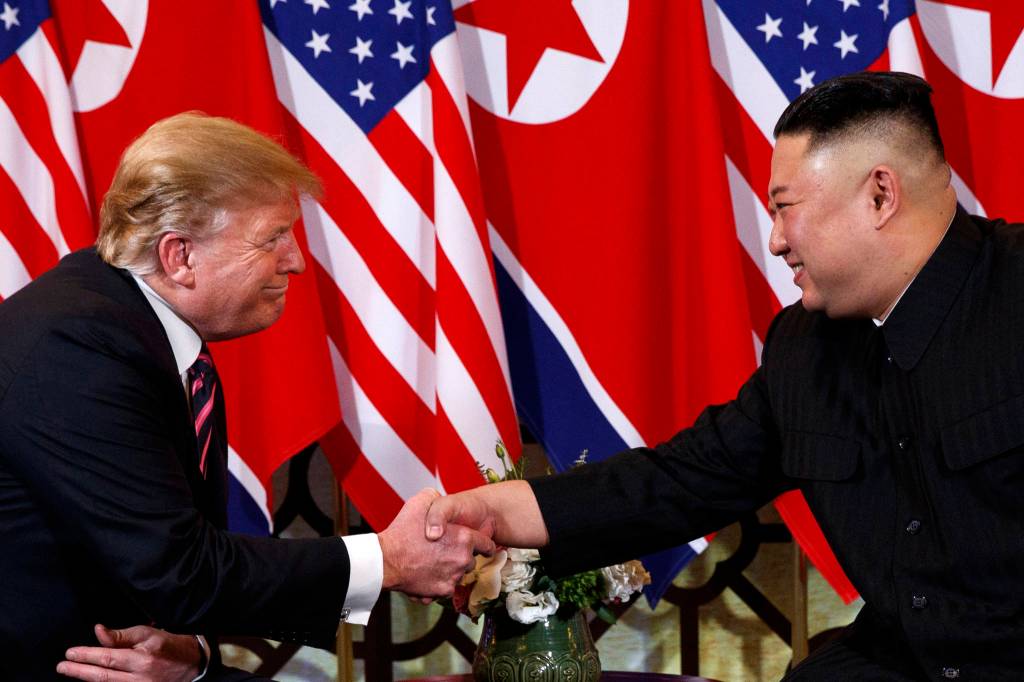
But on Feb. 1, 2019, the INF treaty expired when President Donald Trump formally withdrew the U.S. from the agreement.
In an opinion piece published in the Juneau Empire last month, James Jay Carafano argued that America needed “peace through strength,” and so should disregard arms control agreements (such as the INF Treaty) that put limits on the growth of the U.S. nuclear arsenal.
Peace through strength? I have never heard such an Orwellian call to arms.
As a lifelong Alaskan who has spent the last 15-years studying the history of nuclear weapons development and policy, I disagree that nuclear proliferation can bring peace. The dissolution of the INF Treaty signals the start of a 21st century nuclear arms race. If the race escalates into full-scale confrontation (whether due to accident or aggression), Alaska’s proximity to nuclear armed states could make it the closest target. The end of the INF treaty could also invite a new era of nuclear weapons testing. In the 1960s and ‘70s, nuclear testing directly impacted Alaska when underground tests were carried out on the island of Amchitka. Alaska was also impacted indirectly by nuclear testing; radiocesium from global atmospheric fallout remains concentrated in Arctic foodwebs, threatening human-ecological health.
I do agree with Carafano that the world needs “peace through strength” — but a different kind of strength. It needs the kind of strength that people like Lijon embodied. A fearlessness in the face of power. It needs the kind of strength shown by the community members of Point Hope when they stopped the U.S. Atomic Energy Commission from detonating five thermonuclear explosions on the North Slope as part of Project Chariot. It needs the determination and commitment from a group of people who believe that another future, one without nuclear weapons, is possible.
The world needs that kind of strength again today. The world needs it now.
• Shelby Surdyk is an activist and organizer from Skagway. She’s working with Veterans for Peace to organize a youth congress for the global elimination of nuclear weapons, to be held in Juneau in the Spring of 2020.