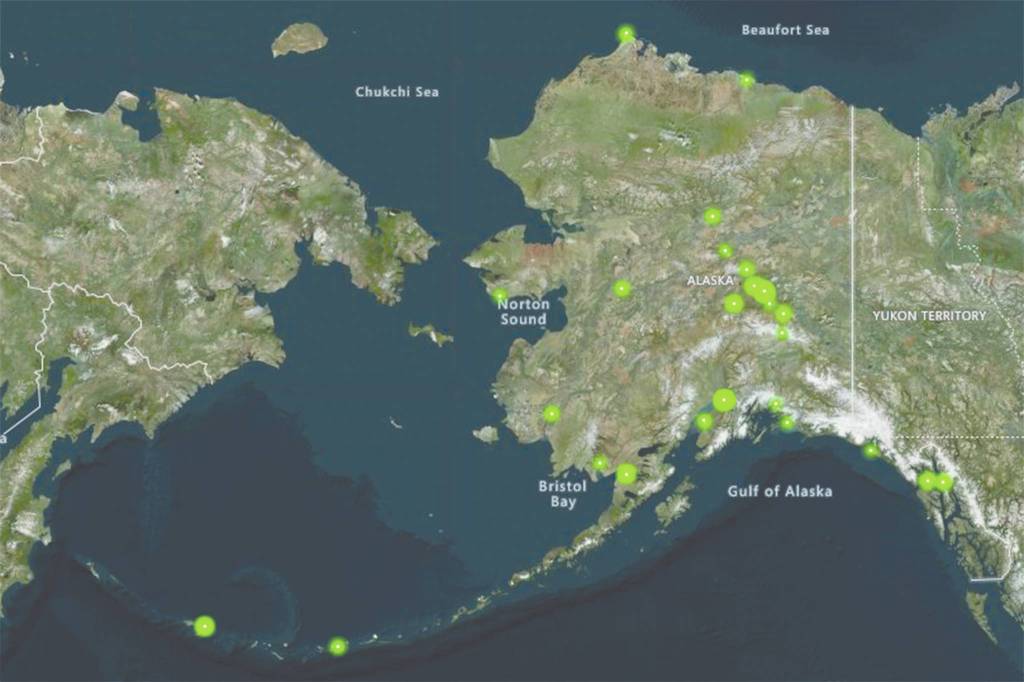
This screenshot of an Alaska Department of Environmental Conservation map of PFAS sites in Alaska shows that contamination from so-called “forever chemicals” is observable throughout the state. (Screenshot | Alaska Department of Environmental Conservation)

This screenshot of an Alaska Department of Environmental Conservation map of PFAS sites in Alaska shows that contamination from so-called “forever chemicals” is observable throughout the state. (Screenshot | Alaska Department of Environmental Conservation)

Opinion: Alaska needs to do more to ensure safe drinking water

Most of all, we need action at the local, state, and federal levels.

  • By Kelly McLaughlin
  • Thursday, April 8, 2021 5:26pm
  • Opinion

By Kelly McLaughlin

As we look at the possibility of visitors returning to pristine Glacier Bay and Gustavus this year, we are still grappling with the not-so-little secret that Gustavus is not pristine. We have a major water contamination issue that many still haven’t heard of — PFAS.

Last year Sen. Jesse Kiehl and Rep. Sara Hannan introduced legislation that helped to fill critical gaps in how our Great State currently regulates PFAS chemicals. PFAS are a group of human-made chemicals that do not easily break down and have been widely used in industry and consumer products for decades. PFAS have been linked to cancer, thyroid disease, infertility, high blood pressure, liver and kidney damage, and a host of other ailments. PFAS are key ingredients in firefighting foam that has long been used for fire suppression at airports across Alaska, where regular training with the foam has led to significant groundwater contamination.

The legislation introduced last year would have lowered the “action level” for key PFAS chemicals in drinking water in Alaska.In the past year, similar legislation was passed in many other states. These states are stepping up and taking action to protect residents and visitors in the absence of regulatory action at the federal level. Unfortunately, COVID-19 shut the Alaska legislature down early last session, and the considerable momentum that had quickly built for the bills died with the last legislative session. Now Kiehl and Hannan are preparing a similar set of PFAS bills to be introduced this session.It is time for Alaska to join the many other states across the nation who have passed stringent legislation to regulate these insidious chemicals.

Our legislators have the chance now to take a stand and protect the health of Alaskans in a way that will positively impact current and future generations. PFAS are called “forever chemicals” because they do not ever naturally break down. The PFAS that have contaminated groundwater around the Gustavus airport will eventually move further away from the airport (dilute), and our contamination levels may someday drop to below the current action level, but at current rates we will not have safe drinking water until at least year 2741, and PFAS will never truly biodegrade.

Meanwhile, in 2021, Gustavus is facing a major airport runway repaving project scheduled to begin this month, yet the asphalt set to be ground down and repurposed was only just last week finally tested for PFAS. Results are pending. We know that the dirt that lies under and around the asphalt is contaminated. So is the groundwater.

The construction planned involves grinding up this asphalt (creating potentially PFAS-laden dust), and rebatching it into new asphalt, then distributing this recycled product all over our runway. This plan has the potential to redistribute PFAS over a much wider area, potentially leading to further groundwater contamination and more poisoned drinking wells. This process could also release vapors while heating potentially PFAS-laden asphalt, putting construction crew and locals at undefined risk.

Maybe the DOT and FAA would like to put some of the $20 million runway repaving dollars toward cleaning up the AFFF they pushed Gustavus volunteers and DOT employees to use here for so many years. If they don’t, we’ll be steeped in it for the next 720 years.

I recently got a pupp. In assessing my responsibility in adopting a new dog,I had to consider if this was an ethical decision, since this puppy will be exposed to PFAS from my contaminated property, for the rest of his life. That’s not a decision I wanted to ever have to make for a puppy, let alone for my children.

What is clear is that we don’t have the answers, we need more testing, we need regulations, legislation, and most of all, we need action at the local, state and federal levels. Start by calling your state representatives, and ask them what they’re doing to protect you.

• Kelly McLaughlin chairs the Gustavus PFAS Action Coalition. She resides in Gustavus.Columns, My Turns and Letters to the Editor represent the view of the author, not the view of the Juneau Empire. Have something to say? Here’s how to submit a My Turn or letter.

More in Opinion

Web
Have something to say?

Here’s how to add your voice to the conversation.

David Guttenfelder/The New York Times
FILE — Federal agents arrest a protester during an active immigration enforcement operation in a Minneapolis neighborhood, Jan. 13, 2026. The chief federal judge in Minnesota excoriated Immigration and Customs Enforcement on Wednesday, Jan. 28, saying it had violated nearly 100 court orders stemming from its aggressive crackdown in the state and had disobeyed more judicial directives in January alone than “some federal agencies have violated in their entire existence.”
OPINION: When silence signals consent

Masked ICE enforcement and the failure of Alaska’s congressional leadership.

Northern sea ice, such as this surrounding the community of Kivalina, has declined dramatically in area and thickness over the last few decades. Photo courtesy Ned Rozell
20 years of Arctic report cards

Twenty years have passed since scientists released the first version of the… Continue reading

Dr. Karissa Niehoff
OPINION: Protecting the purpose

Why funding schools must include student activities.

A sign reading, "Help Save These Historic Homes" is posted in front of a residence on Telephone Hill on Friday Nov. 21, 2025. (Mari Kanagy / Juneau Empire)
OPINION: The Telephone Hill cost is staggering

The Assembly approved $5.5 million to raze Telephone Hill as part of… Continue reading

Win Gruening (courtesy)
OPINION: Eaglecrest’s opportunity to achieve financial independence, if the city allows it

It’s a well-known saying that “timing is everything.” Certainly, this applies to… Continue reading

Gov. Mike Dunleavy gestures during his State of the State address on Jan. 22, 2026. (Photo by Corinne Smith/Alaska Beacon)
OPINION: It’s time to end Alaska’s fiscal experiment

For decades, Alaska has operated under a fiscal and budgeting system unlike… Continue reading

Atticus Hempel stands in a row of his shared garden. (photo by Ari Romberg)
My Turn: What’s your burger worth?

Atticus Hempel reflects on gardening, fishing, hunting, and foraging for food for in Gustavus.

At the Elvey Building, home of UAF’s Geophysical Institute, Carl Benson, far right, and Val Scullion of the GI business office attend a 2014 retirement party with Glenn Shaw. Photo by Ned Rozell
Alaska Science Forum: Carl Benson embodied the far North

Carl Benson’s last winter on Earth featured 32 consecutive days during which… Continue reading

Van Abbott is a long-time resident of Alaska and California. He has held financial management positions in government and private organizations, and is now a full-time opinion writer. He served in the late nineteen-sixties in the Peace Corps as a teacher. (Contributed)
When lying becomes the only qualification

How truth lost its place in the Trump administration.

Jamie Kelter Davis/The New York Times
Masked federal agents arrive to help immigration agents detain immigrants and control protesters in Chicago, June 4, 2025. With the passage of President Trump’s domestic policy law, the Department of Homeland Security is poised to hire thousands of new Immigration and Customs Enforcement (ICE) agents, and double detention space.
OPINION: $85 billion and no answers

How ICE’s expansion threatens law, liberty, and accountability.

Yereth Rosen/Alaska Beacon
The entrance to the Alaska Gasline Development Corp.’s Anchorage office is seen on Aug. 11, 2023. The state-owned AGDC is pushing for a massive project that would ship natural gas south from the North Slope, liquefy it and send it on tankers from Cook Inlet to Asian markets. The AGDC proposal is among many that have been raised since the 1970s to try commercialize the North Slope’s stranded natural gas.
My Turn: Alaskans must proceed with caution on gasline legislation

Alaskans have watched a parade of natural gas pipeline proposals come and… Continue reading