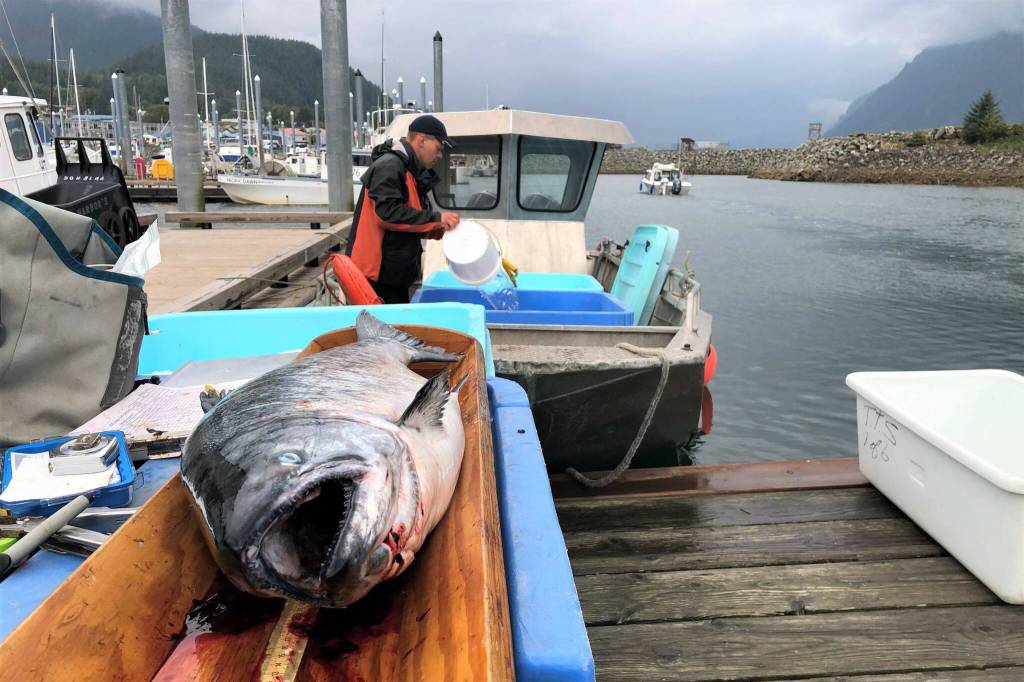
A king salmon is laid out for inspection by Alaska Department of Fish and Game at the Mike Pusich Douglas Harbor officials at the Golden North Salmon Derby on Aug. 25, 2019. King salmon in the Taku River have been on the decline in recent years. The cause of the decline remains undetermined. (Peter Segall / Juneau Empire)

A king salmon is laid out for inspection by Alaska Department of Fish and Game at the Mike Pusich Douglas Harbor officials at the Golden North Salmon Derby on Aug. 25, 2019. King salmon in the Taku River have been on the decline in recent years. The cause of the decline remains undetermined. (Peter Segall / Juneau Empire)

Opinion: A pessimist’s view of Taku River king salmon

How serious is the problem on the Taku, you ask?

  • By Larry Edfelt
  • Thursday, June 23, 2022 2:30am
  • Opinion

The last living animal in a lineage is known as an endling. There have been several famous endlings, such as Martha, the last passenger pigeon, who perished in 1914. If the endling was the last for a species, such as Martha, that’s an extinction. If it’s the last for a localized population, that’s an extirpation. I wonder what they will name the last king salmon in the Taku River.

The unprecedented disappearance of king salmon from nearly all rivers from the Bering Sea to Oregon is a mystery, and the Taku River is among the worst of the lot. The decline is not a management failure, even though the official government answer to the question “Why is the Taku on its lips?” is the same this year as last year: “We don’t know.”

King salmon do not suffer from lack of a lobby. Alaska king salmon do not suffer from man-made habitat degradation. Nor funding. Alaska, the federal government, and the Pacific Salmon Commission have a staff of dozens devoted to king salmon management, research, and enhancement.

How serious is the problem on the Taku, you ask? Using the Juneau spring chinook fishery as an example, the last year Juneau enjoyed an average spring fishery was in 2007. After that the sport fishery suffered record low catches until it was shut down completely.

The Taku chinook escapement goal of 27,500 spawners has not been achieved since 2011, and even the lower bound of the escapement goal range has not been reached for seven straight years.

The worst statistic of all for the Taku is that for nine of the past 12 years, the total return to the river has been less than the parent year escapement. The stock cannot even replace itself, and appears to be on a one-way slide to extirpation, not recovery.

So, to whom do we assign the blame for this? Trawling in the Gulf of Alaska is often pointed to as causing declines in local king salmon stocks. However the stocks the trawlers catch in the Gulf are incredibly mixed and are mostly Canadian and southern U.S. hatchery fish. The trawl fishery, although important for chinook bycatch, can’t target specific Alaska stocks enough to explain the decline of king salmon in any one system.

Well, if we can’t blame the trawlers, how about squid predation then? It’s possible an influx of squid is selecting for outmigrant king salmon smolts shortly after they leave the rivers. The Juneau area has had a large invasion of squid, and I’m sure the size of king salmon smolts makes them an attractive target for squid predation as opposed to the much smaller size of pink, chum and sockeye smolts. This could account for why only king salmon are declining but not other salmon species. A scenario like this could explain the Taku shortage, but what about other impaired chinook systems where squid abundance is not suspected to be an issue?

It certainly isn’t fishing that is causing the Taku decline. Sport and commercial fisheries are severely restricted or closed, as is the in-river Canadian gillnet fishery.

Climate change is a possible catch-all cause of king salmon decline, as is the blob, as is the super abundance of pink salmon, but no one knows the specific mechanism.

So we are stuck in a pattern of ever decreasing king salmon abundance with no one to blame. All we can do is wave our arms and shout the obvious “they’re not here anymore!”

I want to believe, as some scientists do, that king salmon will bounce back in the Taku and recovery, when it happens, will be fast. But the data do not reflect that optimism, and for now I remain a skeptic. I hope I am wrong, but if not, I volunteer to stand guard over the Taku’s king salmon endling.

• Larry Edfelt is a retired Alaska Department of Fish and Game biologist and administrator, a former member of the Alaska Board of Fisheries, and currently sits on the Transboundary Rivers Panel of the Pacific Salmon Commission. He has called Juneau home for more than 50 years.


More in Opinion

Web
Have something to say?

Here’s how to add your voice to the conversation.

A demonstrator holds a sign in front of the U.S. Supreme Court as arguments are heard about the Affordable Care Act, Tuesday, Nov. 10, 2020, in Washington. (AP Photo / Alex Brandon)
My Turn: The U.S. is under health care duress

When millions become uninsured, it will strain the entire health care system.

The U.S. Coast Guard Cutter Storis is underway, June 3, 2025, from Pascagoula, Mississippi. The Storis is the Coast Guard’s first new polar icebreaker acquisition in 25 years and will expand U.S. operational presence in the Artic Ocean. (Photo courtesy of Edison Chouest Offshore)
My Turn: Welcoming the Coast Guard for a brighter future

Our community is on the verge of transformation with the commissioning of the icebreaker Storis.d

Photo by Nathaniel Herz/Northern Journal
Text messages between Alaska Gov. Mike Dunleavy and President Donald Trump.
Commentary: Alaska’s governor said he texts Trump. I asked for copies.

A couple of months ago, I was reporting on the typhoon that… Continue reading

Faith Myers stands at the doors of the Alaska Psychiatric Institute in Anchorage. (Photo courtesy Faith Myers, file)
Alaska’s system of protecting Trust beneficiaries is 40 years behind best practice

The lower 48 has a 3-century headstart on protecting people in locked psychiatric facilities.

veggies
File Photo 
Community organizations that serve food at their gatherings can do a lot by making menus of whole, nutritious offerings according to health and wellness coach Burl Sheldon.
Food served by “groups for good” can be health changemakers

Health and wellness coach thinks change can start on community event menus

Construction equipment operating at night at the White House. (photo by Peter W. Stevenson/The Washington Post)
Opinion: Gold at the center of power

What the White House’s golden ballroom reveals about Modern America

Win Gruening (courtesy)
Opinion: Affordability message delivered to Juneau Assembly; but will it matter?

On October 7, frustrated voters passed two ballot propositions aimed at making… Continue reading

Alaska Children’s Trust Photo
Natalie Hodges and Hailey Clark use the online safety conversation cards produced by the Alaska Children’s Trust.
My Turn: Staying connected starts with showing up

When our daughter was 11 and the COVID lockdown was in full… Continue reading

Telephone Hill as seen from above (Photo courtesy of City and Borough of Juneau)
Letter: For Telephone Hill, remember small is adaptable

Writer finds the finances don’t add up on planned development

Doug Mills/The New York Times 
President Donald Trump disembarks the USS Harry S. Truman before delivering remarks for the Navy’s 250th anniversary in Norfolk, Va., Oct. 5, 2025.
Opinion: Trump’s job is done

The ultra-rich have completed their takeover of America.

Google Maps screenshot
The star shows the approximate location of the proposed Cascade Point Ferry terminal by the Alaska Department of Transportation & Public Facilities in partnership with Goldbelt, Inc.
Opinion: An open letter to Cascade Point ferry terminal proponents

To: Governor Dunleavy, DOT Directors, and Cascade Point ferry terminal project consultants,… Continue reading