What’s on taproot: Carrots and their wild relatives
Published 3:30 am Tuesday, September 22, 2020




Species of the carrot family (formerly named Umbelliferae, now Apiaceae) are still called umbellifers informally, referring to the structure of the flat-topped inflorescence, called an umbel. The nominate example of this family is the domestic carrot, which typically has a thick, straight, tapered taproot containing of about 15% carbohydrates, some vitamins and minerals and a lot of water,according to one source. Carrots were originally domesticated in Asia, over 1,000 years ago. Parsley, parsnip and celery are other familiar members of the family. They have many wild relatives, of which perhaps seven genera are said to occur in the Juneau area.
The roots of these species are sometimes described as taproots and sometimes as clusters of fleshy roots; and sometimes the same species is described has having both kinds of root systems. Frustrated by the vagueness and possibly conflicting descriptions, I dug up a few specimens of four fairly common species to see for myself. Because I don’t know how long or how vertical a root must be, in order to be called a taproot, here I will just mention there being a main root, if a thick one occurs at the base of the stem. Thick and fleshy roots, in general, are storage organs for these plants, a source of energy for growth and reproduction.
[Wild Shots: See reader-submitted photos of Mother Nature in Alaska]
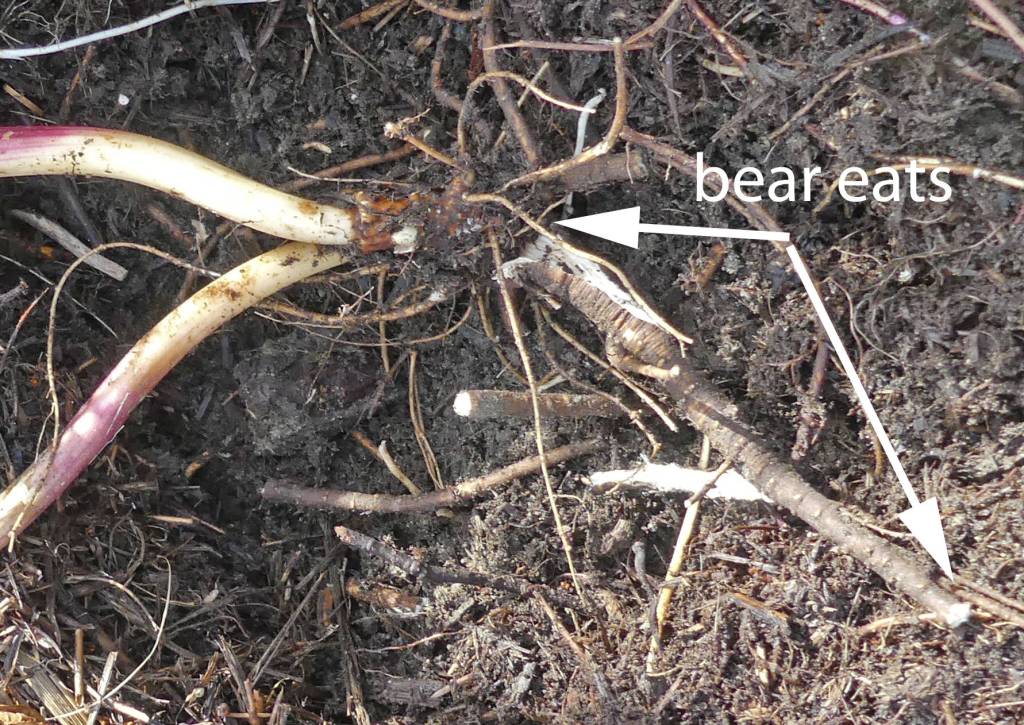
Out on local beaches and gravelly meadows, we find beach lovage (Ligusticum scoticum). The roots of beach lovage are a popular bear food, as seen recently in the meadow near the Boy Scout Camp. In the big meadow at Eagle Beach this year, lovage plants had been common but were almost entirely demolished by hungry bears. The roots were gone, leaving a few reddish leaf stalks near the hole. Elsewhere in North America, other lovage species are sometimes called “bear-root” in Native languages, reflecting harvesting by bears. My excavations indicated that lovage usually has a short (about an inch or two — just a little snack!) main root, bearing several thick, fleshy side roots, in total perhaps equivalent in size to a small-to-medium carrot.
Those side roots may be likely to break when a bear digs for the main root, leaving fragments that can regenerate; a big, carroty main root might not be able to do that, because the whole thing probably would be dug up. Various Native groups that harvest some of these carrot-family relatives take just the main root, leaving the side roots for future growth. Could it be that short main roots with storage in side roots are somehow an adaptation (in part) to the risks of being dug up — a way of surviving, via regenerating fragments, that’s not available to strictly single-main-rooted forms?
We have two species of Angelica: sea-coast angelica or seawatch (A. lucida) and, less commonly, kneeling angelica (A. genuflexa). Both are dug up by bears, which eat the roots and sometimes the lower stem and leaf stalks. My little excavations indicated that there is usually a short main root with some fleshy side roots.
Hemlock parsley (Conioselinum pacificum) that I excavated all had a short main root supporting a cluster of fleshy roots, but another local naturalist found one with a long main root. A year or two ago, there were many reports of bears digging up this plant in the Eagle Beach meadow. This year, in the same part of the meadow, I found that, while bears had taken almost every lovage root in part of the meadow, some hemlock parsley was still standing there.
Cow parsnip (Heracleum lanatum) has a hefty, sometimes both fat and long, main root, sometimes with side roots, but I have not seen evidence of bears digging up this plant. I’ve seen the seeds in bear scats, where they eventually germinate quite well. In addition to domestic livestock, marmots, bears, deer, moose and many other animals in other areas are known to eat the upper, vegetative and floral parts, which one report says provide a decent source of protein. Stems and leaves are reported to be a major food source for bears in Montana. However, I’ve not observed vertebrate use of this species here; other local naturalists have documented that the leaves are eaten by marmots; stems and leaves may be eaten occasionally by bears and rarely by mountain goats. That begs a question: why are there so few observations of wildlife use of this very common plant here?
[Trails offer signs of autumn’s beginning]
The stems and leaves of sweet-cicely (Osmorhiza) are part of bear diets at least in some regions, but the two or three local species are not very common here and I’ve not seen signs of vertebrate usage.
Pacific water-parsley (Oenanthe sarmentosa) is suspected of being poisonous, largely by taxonomic association with highly toxic relatives. However, cattle are reported to eat the foliage without ill effects. I found no information about wildlife usage.
Cicuta douglasii (Douglas water-hemlock) is extremely poisonous to grazing livestock and probably bears and moose, too, although I have found no reference to wildlife usage. The roots and base of stem are said to particularly toxic. This is not the same as the species called poison hemlock, Conium maculatum, which reportedly does not grow near Juneau.
Humans eat many of these species, presumably avoiding the most toxic ones; however, some toxins are found in other carrot-relatives — be careful of eating these species. Ligusticum roots and leaves have made good human food, although it has been used by certain Native cultures to poison fish. Heracleum flowering stems can be eaten, if peeled; but the juices of this plant contain furanocoumarins that on human skin may be activated by sunlight to produce nasty blisters. Angelica stems and leaf stalks are edible; Conioselinum roots are used by humans in some regions. Roots and leaves of Osmorhiza are said to be edible. Despite rumors of toxicity, Oenanthe roots and stems are eaten by people in some places.
Note: “hemlock” derives from old English words meaning straw or stalk and plant; in other words, a plant with hollow stems. That has nothing to do with our local tree of the same name. The hemlock tree got its name, supposedly, because of a perceived similarity of the smell of its crushed foliage to the smell of the poison hemlock plant.
• Mary F. Willson is a retired professor of ecology. “On The Trails” is a weekly column that appears in the Juneau Empire every Wednesday.