Typhoon displaced students, teachers from Western Alaska continue school across the state
Published 3:50 am Thursday, October 30, 2025
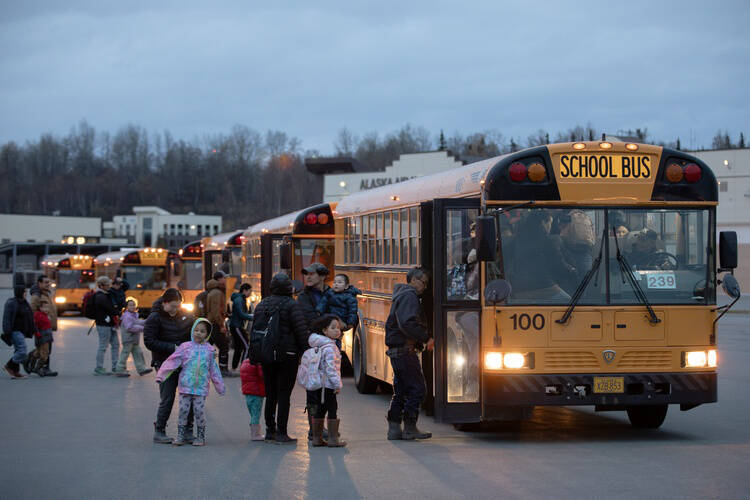

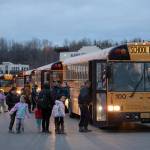


Hundreds of students displaced by the storm devastation of ex-Typhoon Halong in Western Alaska are entering school in other communities, including Bethel and Anchorage.
Deena Bishop, commissioner of the Alaska Department of Education and Early Development, said most displaced students have enrolled in Bethel or Anchorage schools. She estimates 100 students have enrolled in Bethel, remaining in the regional hub of Western Alaska and the Lower Kuskokwim School District. State officials estimate 140 students have enrolled in the Anchorage School District so far, according to an update on Sunday.
Students have also enrolled in other schools across the state, but in smaller numbers, depending on where families have relocated after the storm, Bishop said. Those include the Nenana and Fairbanks areas, the Kenai Peninsula, Matanuska-Susitna Valley Borough, and other rural areas, as well as boarding schools.
“All the support from the state, including from the Department of Education, has been in support of what the family would like to do,” Bishop said.
For those in Anchorage, she said the Anchorage School District is coordinating with state, tribal and non-profit partners to provide services to students and families — including transportation from emergency shelters to schools, health services, meals, and English translation services for predominantly Yup’ik families.
The Anchorage School District said it is trying to keep displaced students together. It has enrolled a number of students in the Yup’ik immersion program at College Gate Elementary, which provides bilingual classes and cultural activities, as well as the Alaska Native Charter School, Lake Otis Elementary, A.J. Wendler Middle School, Bettye Davis East Anchorage High School and King Tech High School.
Bishop said teachers and school communities are welcoming students, and “doing an excellent job in just a devastating situation.”
Anchorage Superintendent Jharrett Bryantt was not available for an interview, but echoed the district’s commitment in an update to the school board on Oct. 21. “There was one common trend, which is that our teachers, our principals and our community members are standing with Western Alaska, and they were there to greet the students and make them feel as welcome as possible during this difficult time,” he said.
Many students left their villages in the mass evacuation in the days after the storm devastation, with just one bag they could carry. Bryantt acknowledged the culture shock and trauma of the displacement as families relocate and resettle. Evacuees face challenges like finding housing and replacing clothing and personal belongings. Some are reuniting with family, neighbors and pets.
“We’re not just here to teach them. We need to address the whole child, and in this moment, as strong as these students are, they’re going through trauma and it’s going to take a lot of work,” he said. “But we’re going to put that in, because these kids are worth it, and they deserve a wonderful education that we want to offer them, in ASD, for as long as they’d like to be here.”
Lower Kuskokwim School District Superintendent Andrew “Hannibal” Anderson said the re-enrollment of their students into other schools in Bethel and Anchorage is going well, and added the districts are working with families through the ongoing logistics of replacing documentation and finding long term housing. Particularly in Anchorage, he said there’s an effort to keep Lower Kuskokwim students and classes together.
“So Anchorage [School District] has really very much been the key in helping our students find places and to find opportunities for more of our students to be together rather than randomly spread throughout the Anchorage community,” he said.
Anderson said some teachers and paraprofessionals who evacuated from the west coast region have even begun working for ASD, but the majority have stayed in their district and communities where they’re working out new positions.
He said as the students flow to different parts of the state, the district is working to reassign the teachers who stay. That involves considering their certifications and any vacant positions that already exist in the district, as well as new positions that have emerged as displaced students enroll.
“The primary effort is to support as well as we can the already existing relationships between students and teachers, and then see what we can do with that as time moves forward,” Anderson said.
Rural schools at center of Typhoon recovery
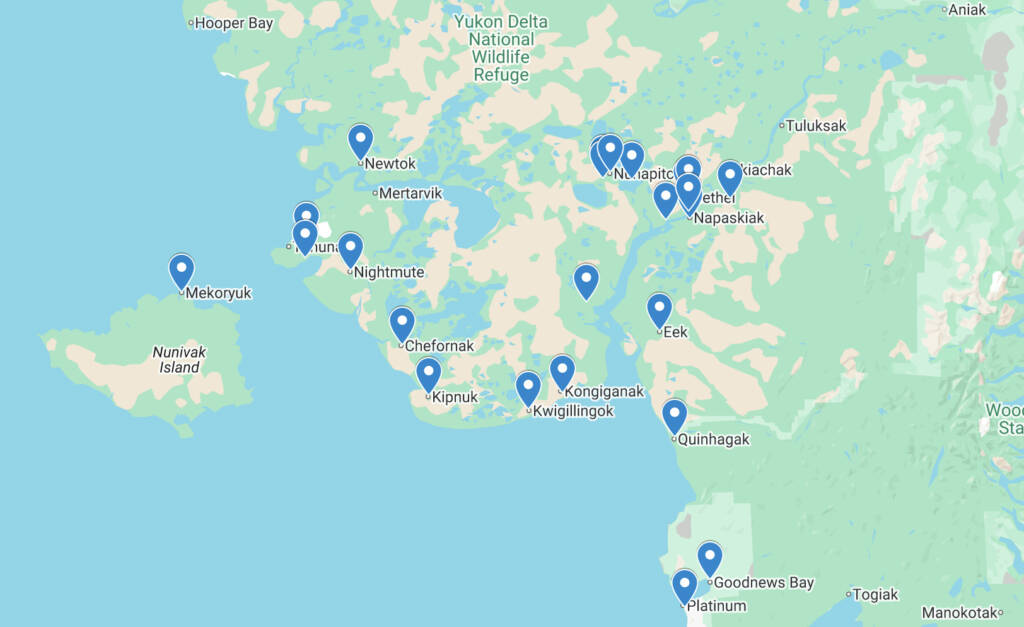
The Lower Kuskokwim School District encompasses most of the region hardest hit by ex-Typhoon Halong. Many of its 22 village schools served as emergency shelters in the days after the storm, and are now centers for the recovery and relief efforts. The region is accessible only by boat and plane.
Some 400 people sheltered in the school in Kwigillingok, and more than 500 people in Kipnuk, two of the hardest-hit communities in the first days after the storm, before mass evacuations began.
Anderson commended the schools and staff on the frontlines of the disaster for “receiving so many of the community members into the shelters and there and taking care of them, providing all they could for the needs of large numbers of people.”
And now he said many school staff are involved in the relief efforts, as schools have utilities and space to serve as central community sites and house emergency crews responding to storm damage. Anderson said schools are often the largest and most stable facilities in their communities, so it is a “great contribution” to the recovery effort.
Some schools in the region are still grappling with power outages, including Kipnuk, Kwigillingok, Kotlik, Nightmute and Akiak. Akiak has been without power since a power plant failure in mid September. Others that suffered less storm damage are up and running, Anderson said. “Far and away, most of the schools in the district are functioning,” he said.
Disaster funding for rural schools
Bishop said disaster relief is the state’s immediate priority. But as students and families find more permanent housing and get settled into schools, she said DEED is applying to federal grants so that the state can fund districts’ extra costs.
She said school districts are taking care of students and making sure they don’t have to wait for services, so now the state will work with districts to figure out financial support that adheres to statute.
She said “it was definitely the message of the governor that either receiving schools, as well as the Lower Kuskokwim schools, should be compensated, and we are to work on figuring that out.”
She said districts will also qualify for disaster relief from FEMA, the Federal Emergency Management Agency, under the federal disaster declaration. “Each of the schools affected could get upwards of a $250,000 grant,” she said.
Bishop said the long term impacts remain to be seen, and the ultimate goal is to get residents back to their communities. “We don’t want anyone to get lost in a big city, and we don’t want anyone to get lost anywhere. We want to be able to work with the state and those other divisions to restore those communities, to create healthy communities again, where they can live and work and go to school together,” she said.
State officials estimate more than 1,500 people are displaced by the storm disaster. The state has received 1,104 applications for state individual assistance, according to a statement from the Alaska Division of Homeland Security and Emergency Management on Tuesday. Applications are open on the state’s website, through Dec. 9. Individual assistance is also available from FEMA and from the American Red Cross.
Corinne Smith started reporting in Alaska in 2020, serving as a radio reporter for several local stations across the state including in Petersburg, Haines, Homer and Dillingham. She spent two summers covering the Bristol Bay fishing season. Originally from Oakland, California, she got her start as a reporter, then morning show producer, at KPFA Radio in Berkeley. She completed a master’s degree focused on investigative journalism in 2024 at USC Annenberg School for Communication and Journalism in Los Angeles. She is thrilled to be back in Alaska and based in Juneau, covering education and social and criminal justice.
Alaska Beacon is part of States Newsroom, the nation’s largest state-focused nonprofit news organization.