Rough seas in Southeast during Trump’s early days, but smoother waters ahead, Murkowski tells regional leaders
Published 9:30 pm Monday, February 10, 2025
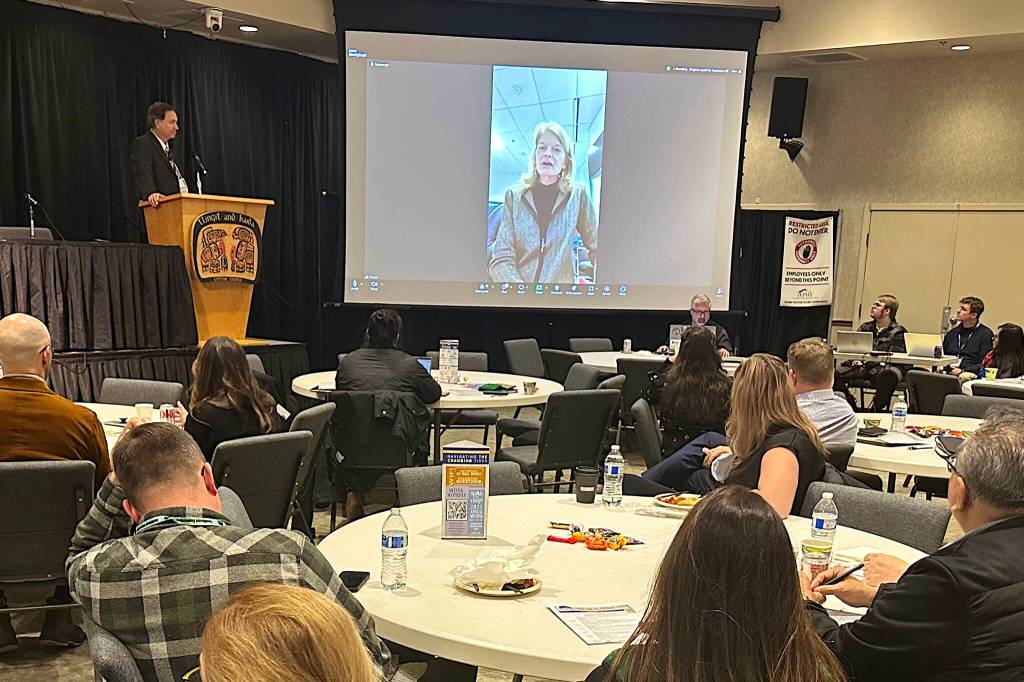
People in Southeast Alaska are used to choppy waters so while “right now people are vomiting on either of the sides of the boat” at the onset of Donald Trump’s return to the White House, smoother sailing is on the horizon, U.S. Sen. Lisa Murkowski told a conference of regional business and political leaders Tuesday.
A mix of uncertainty, optimism and concern about the Trump administration’s impacts on the region was expressed by other federal, state and industry officials participating in the opening day of Southeast Conference’s Mid-Season Summit at Elizabeth Peratrovich Hall. A timber industry representative, for instance, said she is hopeful since “in the last two years the U.S. Forest Service has sold less than 8% of the total volume that our industry needs” and a Forest Service official later during the day confirmed an emphasis on resource development is the agency’s new priority.
Murkowski, an Alaska Republican who is among the few in her party challenging Trump on some of his early second-term actions, said she is trying to work with the new administration on a range of issues including transportation, energy, education and infrastructure projects — despite vows by the president to slash federal spending in many of those areas. She said she also sees promising signs from the administration on supporting things such as a larger U.S. Coast Guard presence in Alaska.
But at the moment there’s also some rough seas to navigate, she said.
“Coming from Southeast we know what choppy water is all about and it’s rough, and it’s kind of swirling around and it’s unpredictable,” Murkowski said in remarks that were delivered live online from Washington, D.C. “But you know that eventually you’re going to get through the choppiness and you’re going to get to smoother waters, and things are going to be just fine. But right now people are vomiting on either of the sides of the boat and the edge is near, and you know we’re going to really take a deep breath, we’re going to get through this and we’re working together.”
Much of the uncertainty is due to a barrage of executive orders and other actions by Trump that in some instances are being rescinded and/or put on hold by the courts, Murkowski said. A freeze on all government loans and grants is an example, which if implemented could affect Southeast projects ranging from hydropower facilities to Alaska Marine Highway System upgrades — and a delay could at the least mean some of those projects miss this year’s construction season.
“I know that you need to be planning those projects right now,” she said. “You need to be signing the contracts, you need to be procuring the equipment, hiring the workers, drawing on the accounts and you also need to be able to to rely on the commitments that have been made, instead of having the rug pulled out from underneath you.”
Murkowski said she is meeting with top Trump administration officials such as the Secretaries of Interior and Energy to emphasize the importance of the projects, especially for parts of Alaska lacking infrastructure found elsewhere. She also sent a letter to the federal Office of Management and Budget “urging them to issue guidance to affirm that Indians, Indian tribes and Indian programs aren’t affected by the president’s orders on DEI and environmental justice.”
“The Department of Interior had led on this with the secretarial order, but it had just been limited to that department,” she said. “We needed the assurance that it was going to be respected across all departments and agencies. To their credit the Department of Health and Human Services already agreed and confirmed in writing that’s not going to be the case. So we are starting to move through some of this.”
Budget negotiations continue to be a concern with a March 14 federal funding deadline approaching to continue current spending, as well as work now underway on next year’s budget, but Murkowski said Coast Guard funding and aviation safety upgrades are two areas where she believes Alaska will get strong support.
The other members of Alaska’s all-Republican congressional delegation, Sen. Dan Sullivan and Rep. Nick Begich III, are scheduled to address the conference on Wednesday.
Much of the conference’s opening day consisted of panel discussions by various groups of experts on matters such as tribal issues, tourism and natural resources opportunities. The latter group expressed generally optimistic hopes about the region’s economic prospects in industries such as mining and timber due to a day-one executive order by Trump mandating the elimination or modification of all federal government regulations inhibiting maximum utilization of Alaska’s natural resources.
Tessa Axelson, executive director of the Alaska Forest Association, told a panel discussion audience “the biggest challenge continues to be in this industry, a predictable, sustainable supply of timber.” She said the industry has a stronger relationship with the state under Republican Gov. Mike Dunleavy than existed a decade ago under former independent Gov. Bill Walker, but federal-level policies under the Biden administration were problematic.
“The fact of the matter is the federal government, the U.S. Forest Service, has a requirement pursuant to the existing plan to provide volume to the industry, to all parts of the industry, the largest parts of the industry and the smallest parts,” she said. “And they have failed to do that significantly. In the last two years the U.S. Forest Service has sold less than 8% of the total volume that our industry needs. And so we have become heavily reliant on the state of Alaska, and that’s been important and that partnership has been really good. But the state only has a certain amount of timber that can be sold in different parts of the state.”
An affirmation a shift in priorities will occur under the Trump administration was offered by federal officials participating in a subsequent panel discussion titled “State and Federal Partnerships.”
“The president has communicated his prioritized focus on energy, minerals and timber, and specific direction to the Department of Agriculture to review this rule and applications in the national forests,” Chad VanOrmer, regional forester for the Forest Service’s Alaska Region, told the audience. “So currently we’re waiting for the department’s direction on how this review or this rule will be implemented here coming into the future.”
Other officials said some difficulties are occurring as the Trump administration enters its third week. Jocelyn Fenton, director of programs for the Denali Commission, a federal agency that provides utilities and infrastructure support in Alaska, said a freeze on federal hiring means a slower implementation of work for projects, with the potential freeze on funds adding additional uncertainty.
“We are still planning on moving forward,” she said. “It could just take a little bit longer to move to move that program forward, I would say.”
• Contact Mark Sabbatini at mark.sabbatini@juneauempire.com or (907) 957-2306.