Low ceilings, low visibility: Weather interferes with flights
Published 10:30 pm Wednesday, July 27, 2022
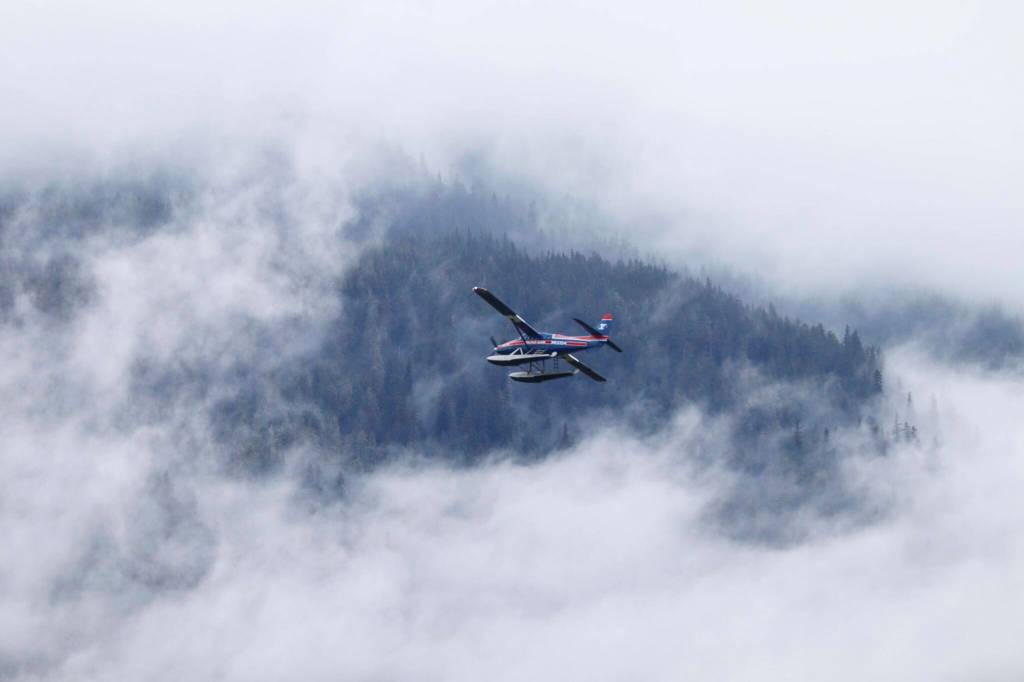


Travelers around the small communities of Southeast Alaska may have noticed stoppages and delays in aircraft travel around the region recently and correctly attributed it to the weather.
How exactly does the weather affect flights, and what’s needed to fly safety?
“About the last week has been one of the longer stretches of low visibility and low ceiling cover that we’ve seen in years, at least for that duration of time,” said Sean Kveum, director of operations for Alaska Seaplanes, in a phone interview. “We can really only go when the weather’s good enough, when it’s safe and legal to do so.”
[Two stable following plane crash near Outer Point]
Small aircraft are often governed by visual flight rules — meaning the pilot needs to be able to see where they’re going, Kveum said. In the Southeast, especially when socked in by low clouds and fog or rain, that’s not always possible, making it unsafe to fly, Kveum said.
“Southeast Alaska is known for having a lot of misty, poor-weather days and there’s nothing but water and mountains,” Kveum said. “We do our best to move people and stuff when we can.”
That’s unlikely to change anytime soon, as the weather conditions that create the low, hazy weather are forecasted to continue, said National Weather Service meteorologist Ben Linstid.
“On the northern half of panhandle, we’ve got this onshore flow. It brings plenty of moisture in,” Linstid said in a phone interview. “It’s a positive feedback loop. We have the clouds there keeping the temperature cooler. With the cooler temperature, we get higher humidity.”
That positive feedback loop means the weather is creating the conditions it needs to persist cool, damp and cloudy, Linstid said. And it’s not going anywhere anytime soon, with Wednesday’s brief sunshine all Juneau is likely to see for a while, Linstid said. .
“That was your break (Wednesday) morning. We got another system coming in,” Linstid said. “Looking into the weekend, after this system comes by, we still have that onshore flow. There’s another system coming in Saturday night/Sunday morning.”
IFR/VFR
For planes equipped for instrument flight rules, clouds pose less of an imposition, Kveum said.
“With VFR flight, you have to have good visibility. You cannot be in a solid cloud,” Kveum said. “Whereas with IFR, you’re able to fly in the clouds, and you’re able to fly on the instruments on the aircraft to get where you’re going.”
In Southeast Alaska, shot through with its rugged mountains and fjords, the terrain often reaches through the ceilings created by the clouds.
“With VFR, you need to fly lower and stay below it and maintain good visibility all the way to your destinations which is a challenge,” Kveum said. “(In) the history of flying in Alaska and especially Southeast Alaska, many accidents are CFIT accidents — controlled flight into terrain.”
While many small planes, including Seaplanes’ seaplanes, are governed by VFR rules, others with appropriate onboard instrumentation are able to fly on instruments, Kveum said.
“The one thing we do have in our advantage is most of our wheel planes are IFR equipped,” Kveum said. “We don’t have the ability to fly the floatplanes IFR.”
Juneau’s microclimate creates unique problems for planes seeking to land at Juneau International Airport flying VFR, Kveum said.
“The problem with Juneau is you’re in this little dome here. It’ll be reporting good inside Engineer’s Cutoff but outside Auke Bay it’ll be socked in,” Kveum said. “A lot of the time it’ll look good when they launch from Haines, and by the time they get down here it’s closed back in.”
Seaplanes began a program to expand its IFR landing guides around Juneau International Airport, scheduled to be completed next year, Kveum said.
“We’re building our proprietary approaches in and out of Juneau,” Kveum said. “With those, with all the advancements in automation and whatnot, we’re able to build some of these with lower visibility and cloud clearance requirements.”
Go/No-go
Safety is the topmost consideration when deciding whether or not to launch, Kveum said.
“We understand folks need to get where they’re going. We’re doing everything in our power to be as safe and efficient as we can,” Kveum said. “I wouldn’t want one of these guys launching out into conditions where I wouldn’t put my own family on that aircraft. The weather is what it is.”
Technology can help remove some of the guesswork leading to pilots needing to abort mid-flight, Kveum said.
Some of our float destinations, Pelican, Elfin Cove, Sitka — all of those destinations are seeing a lot more localized conditions with marine fog,” Kveum said. “We also use aviation weather cameras on the coast to help us make those go/no-go decision.”
Technology can only go so far, Kveum said, and sometimes, pilots hit bad weather and need to turn around or find somewhere else to land. Kveum mentioned a flight he flew recently to a smaller community that ended up with the plane and passengers needing to overnight in a third community since the weather was bad in both the launch and landing locations.
“Usually we’re able to make a pretty good guess based on the weather forecast. Here lately the forecasts have been really unpredictable,” Kveum said. “That’s the thing with flying in Southeast Alaska: you always want to leave yourself an out.”
Technology has made flying in Alaska safer in the last 20-30 years, Kveum said, but it’s never entirely without risk. Making good decisions with the best available weather data reduces that risk further, Kveum said.
“There were a number of accidents down in the South end here that low weather played into,” Kveum said. “But overall for Alaska, it’s definitely gotten better.”
• Contact reporter Michael S. Lockett at 757-621-1197 or mlockett@juneauempire.com.