Long-distance migrations: How birds fly thousands of miles
Published 6:00 am Friday, December 28, 2018
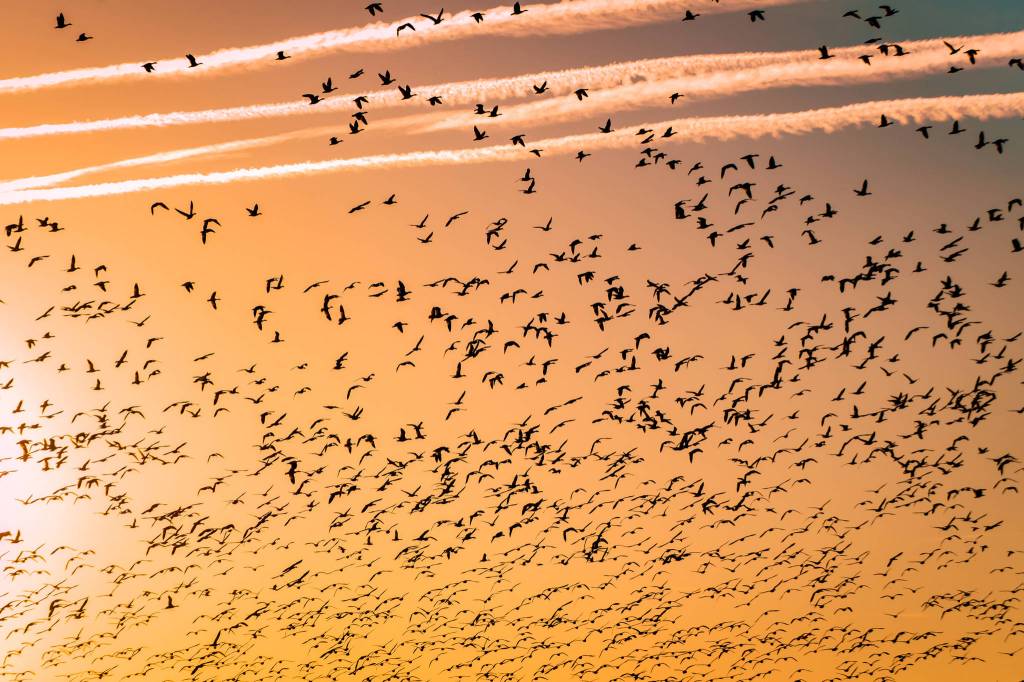


The Arctic terns that nest near the Mendenhall Glacier (and around the whole Arctic) are champion long-distance migrants — they are said to have the longest regular migration of any bird species. They fly from Arctic and subarctic summer nesting areas to the southern oceans around Antarctica to feed during the winter (southern-hemisphere summer) and then they fly back. They do this gigantic circuit every year. The average flight distances they cover are huge: one estimate is about 12,000 miles (one-way) but another estimate found distances over 22,000 miles in a zig-zag route over the Atlantic.
Short-tailed shearwaters do quite well, too, flying up to the Bering and Chukchi seas (to feed during our summers) from their nesting areas around southern Australia. The distances covered are estimated at about 9,000 miles one-way. Both the shearwaters and the Arctic terns feed in the open ocean and make stopovers to feed along the way, fueling up for the next leg of the journey.
Bar-tailed godwits are even more remarkable! These are large shorebirds that nest on the tundra in western Alaska and Eurasia. They feed in shallow waters in wetlands and along the coast. The Alaska nesters fly to New Zealand waters for the southern summer (our winter) and then come back in the spring. On the way back north, they often stop over in the Yellow Sea (between China and Korea) — a rapidly disappearing resource, because of shoreline development by China. One bird clocked over 6,000 miles — nonstop — from New Zealand to the Yellow Sea remaining wetlands and then went another 3,000 miles back to Alaska. Still more impressive was a godwit that made the southward migration directly over the open Pacific Ocean, a nonstop(!) trip of over 9,000 miles, taking about nine days without eating or drinking!
[Eagle eyes: How does visual acuity work?]
How is that possible?
We are used to the idea that migrating birds put on a lot of fat before migrating, sometimes doubling their body weight, and some (like the terns and shearwaters) can eat along the way. But godwits cannot feed in the open ocean. They put on some fat, of course, but that is not all they do: they also lose weight from various body parts: the digestive system, liver and kidneys atrophy, shriveling up to a fraction of their former weights. Fat and protein from those organs are recycled and used as a source of energy. This also reduces the wing-loading or the “freight” carried by the (non-feeding) migrant.
This weight-saving trick is used by some other fairly long-distance migrants as well, including some other shorebirds and songbirds. Furthermore, as migration continues, protein and fat from the muscles — including the flight muscles and heart — are gradually metabolized and used as fuel for the journey.
The fascinating thing is that when these birds arrive at their destination, the atrophied digestive tract and associated organs are restored to their former functional size and condition. Lost muscle mass is restored, too. The birds are able to “turn off” the internal organs and turn them back on again.
That kind of information has some medical researchers thinking about a human affliction called cachexia, which is a dramatic, potentially catastrophic, loss of muscle mass and fat that often occurs along with other afflictions, such as certain kinds of cancer, HIV or multiple sclerosis. If research could figure out how migrating birds can turn off and then restore digestive tissues and rebuild muscle mass, they might figure out a means of mitigating cachexia in human patients. That’s a long way in the future, but it is interesting and significant that knowledge from avian migrations — seemingly quite far removed from cancer wards and hospitals — might yet contribute to human health.
Still an open question is how did such tremendously long-distance migrations evolve?
• Mary F. Willson is a retired professor of ecology. “On The Trails” is a weekly column that appears every Friday. Her essays can be found online at onthetrailsjuneau.wordpress.com.