Limit of 16,000 cruise passengers daily, 12,000 on Saturdays, agreed to by CBJ and industry
Published 9:30 pm Sunday, June 2, 2024
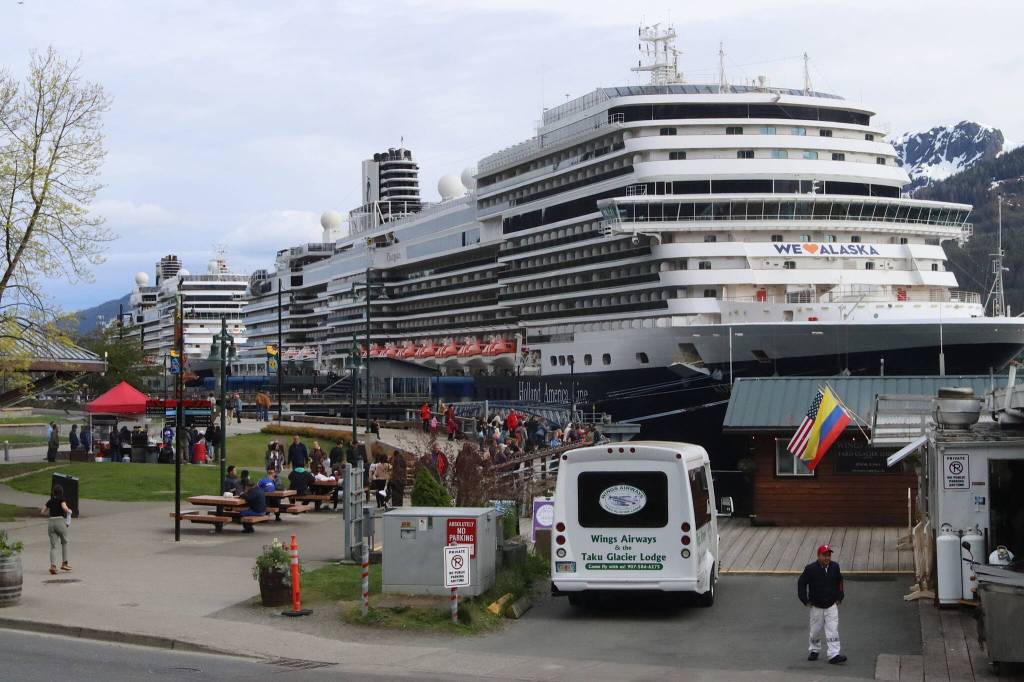
A voluntary agreement of 16,000 cruise ship passengers a day in Juneau, with a lower limit of 12,000 on Saturdays, beginning in 2026 was announced Monday between the City and Borough of Juneau and an association representing major cruise lines making stops in the capital city.
The agreement follows a pact between the industry and CBJ imposing a five-ship-per-day limit that took effect this year. The new agreement allows CBJ’s tourism director to approve exceeding the limit on individual days during the season on a case-by-case basis, and stipulates an annual meeting between the parties to review visitor numbers and possible modifications to the agreement.
“I have the ability to sign off on days over 16,000, but for 2026 my stated goal is to not have to sign off on any and we’re continuing to work towards that with the 2026 schedule,” said CBJ Tourism Director Alexandra Pierce in an interview Monday. The annual meetings “are really the key piece (because) it’s not about maxing out every day and 16,000 people. It’s about making sure that we can bring our numbers on our busy days down.”
[Limit of 16,000 cruise passengers most days, 12,000 on Saturdays being discussed by industry and CBJ]
A comparable example to the exemption is occurring with this year’s five-ship limit, when on two days an additional 900-passenger ship will be at anchor, Pierce said.
“It’s not that we can have lots of days over 16,000 and I just sign off on all of them,” she said. “It’s more that scheduling and deployment is challenging, and every once in a while there’s a ship that needs somewhere to go. And if it doesn’t create additional impacts and it’s a case-by-case, occasional basis we can look at that.”
The lower daily limit on Saturdays is because that’s already a day when fewer people typically arrive, while the goal during the rest of the week is to even out distribution of passengers since certain peak days can go a few thousand past the 16,000 figure, according to Pierce.
City officials began exploring a voluntary agreement with Cruise Lines International Association representatives in Alaska at the beginning of this year after being told a mandatory daily limit likely was illegal due to people’s constitutional right of interstate travel. The general framework of an agreement was presented to Juneau Assembly members on May 13, who expressed their support for such a pact.
“I’ve said repeatedly that we believe it’s in the industry’s best interest to partner with the communities that we visit,” said Renée Limoge Reeve, CLIA’s vice president of government and community relations, in an interview Monday. “This is our third (Memorandum of Agreement) and each of them has been in response to community conversation, and in Juneau’s case the Visitor Industry Task Force recommendations. I view this as a voluntary partnership that we have with CBJ and the community, and I think you will continue to see that drive dialogue and communication between the parties. At least that’s our goal here at CLIA and I believe that’s a shared goal.”
Beginning the daily limits in 2026 allows cruise lines sufficient advance time to make adjustments that conform to the limits, since trips for next year are already being sold, Reeve said. It also will help prevent “unintended consequences for the other communities throughout Alaska that welcome cruise visitors.”
Such agreements don’t exist at other port stops in Alaska, although discussions about limiting impacts are occuring with officials in Sitka, she said.
The daily passenger agreement is being criticized by backers of a ballot petition seeking to ban large cruise ships in Juneau on Saturday and July 4. That petition is still being reviewed by the municipal clerk’s office after being submitted last Thursday, but if it qualifies for the ballot and voters approve it would result in significant shuffling of the industry’s schedule.
Reeve said she doesn’t know how sailing schedules and voluntary agreements with Juneau might be affected if the Saturday ban on large cruise ships is approved by voters.
Karla Hart, one of the petitioners for the Saturday ban initiative, stated in an email to Juneau Assembly members last month the agreement would allow total visitors “to increase to over 2.5 million passengers over a 22-week season.” A record 1.67 million passengers visited last year, with roughly the same number forecast this year and next.
Another concern is the language of the agreement specifies the limit applies to “lower-berth” passengers, which means extra occupants such as a third and/or fourth person in a cabin wouldn’t count toward the voluntary maximum, Hart said in an interview on Monday. Furthermore, the only days that appear to exceed 16,000 on the schedule are during “hot-berthing” when two ships arrive at the same dock at different times during the day.
“I think that the residents of Juneau, a significant number of us, are speaking pretty strongly that the cruise industry is having significant adverse impacts on our life,” she said. “And the city tourism director and whoever else is making decisions with the city do not seem to be understanding that they have a real issue that cruise tourism is making a lot of people in Juneau, unhappy in many different ways.”
Pierce said the intent of the voluntary agreement is to reach solutions that minimize adverse impacts on the community while still allowing the industry to be a strong economic presence, while trying to avoid antagonism between groups with varying interests.
“You get a lot more accomplished by working constructively than you do by using blunt tools and trading legal barbs,” she said. “And that’s what we’re trying to achieve with this. We’ve committed to doing a lot more work on an annual basis in order to have a functional and sustainable industry that works for the community, as opposed to putting in the work of fighting back and forth through legal action and through taking more drastic measures which isn’t really constructive or productive. And we’re confident that this agreement will help us to hold the line on growth so that we can build better infrastructure and make a million-and-a-half people feel like a million people.”
• Contact Mark Sabbatini at mark.sabbatini@juneauempire.com or (907) 957-2306.