LGBT Alaskans closely watching US Supreme Court hearings
Published 12:50 pm Tuesday, October 8, 2019
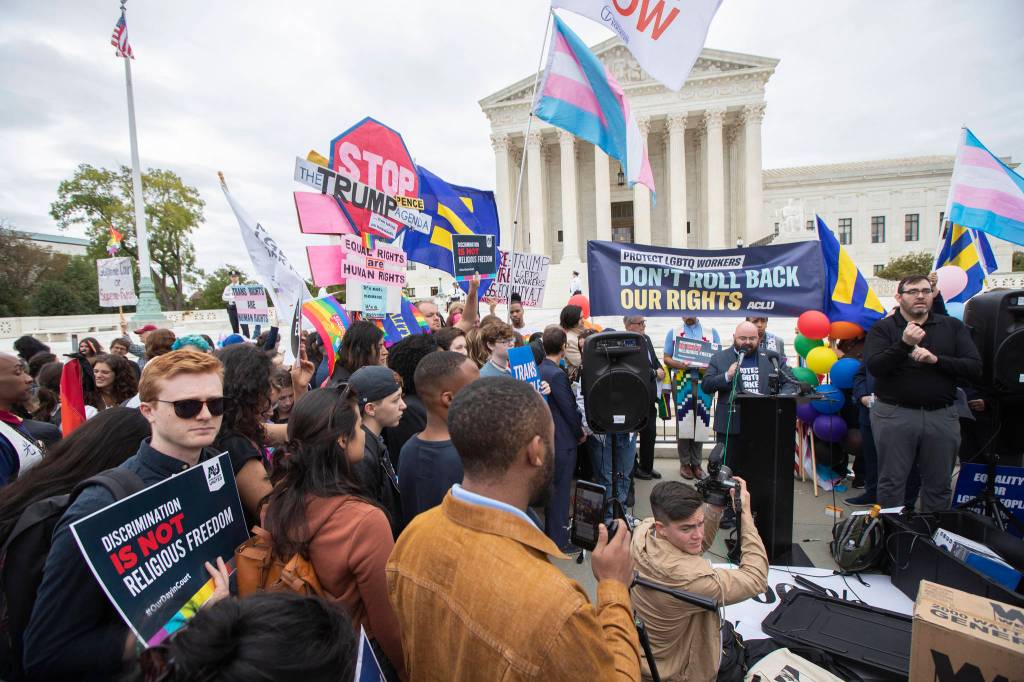
Alaskans are bracing for what could be big changes in laws concerning LGBT people in the workplace.
The U.S. Supreme Court heard arguments Tuesday on three cases centered on whether or not employees can be fired for their sexual orientation or gender identity.
“There’s a lot weighing on this ruling,” said Megan Edge, communications director for the American Civil Liberties Union of Alaska. “This is a cruel and unnecessary move, we don’t want to give anti-equality organizations a license to take more aggressive action.”
The cases center around interpretations of Title VII of the 1964 Civil Rights Act which bars discrimination against a person for their race or sex, among other things. The question before the court is whether or not sex-discrimination extends to a person’s sexual orientation or gender identity.
The three cases before the court came from either gay or transgender people who claimed they were fired because of their their identities. Two of the cases come from men who claimed they were fired for revealing that they were gay, and the third from a woman who came out as transgender at her workplace.
Lawyers for the plaintiffs argued that by firing someone for whom they had a relationship with was discrimination based on sex because it forced a traditional stereotype of heterosexuality on those people, the New York Times reported.
“When an employer fires a male employee for dating men but does not fire female employees who date men,” said Pamela S. Karan, lawyer for the plaintiffs, according to the Times, “he violates Title VII.”
The implications for the cases decision are broad. Several local governments have passed anti-discrimination laws but whichever way the court rules will give legal precedent to either strengthen or unravel those laws.
Those who oppose sexual orientation and gender identity being covered by Title VII argue that such laws would violate some people’s religious convictions.
In August, several state Attorneys General, including Alaska’s Kevin Clarkson, signed a friend-of-the-court brief urging the Supreme Court not to extend Title VII protections.
“Title VII prohibits only ‘sex’ discrimination, and the plain meaning of ‘sex’ is biological status as male or female, not sexual orientation or gender identity,” the brief says.
The brief goes on to say that should the court expand the interpretation of sex under Title VII, it would undermine state sovereignty.
“Judicial rewriting that extends a statute beyond its plain language to regulate to a greater degree than Congress intended could impede state policy making efforts.”
In an email Tuesday, Assistant Attorney General Cori Mills said that Clarkson had signed onto the brief because it argued that such interpretations of the law were up to Congress and the states, not the courts.
“The issue is which branch of government has the authority to expand the scope of Title 7 — the courts or Congress?” Mills wrote. “It is the Department of Law’s position that it is for Congress, not the courts, to decide whether the law should change.”
Juneau, Anchorage and Sitka have all passed their own anti-discrimination laws. The Fairbanks City Council passed an anti-discrimination law but the Mayor there vetoed the law in March.
Lin Davis, a LGBT activist in Juneau said that the ruling from this case could have a greater impact than the 2015 Obergefell v. Hodges which legalized same-sex marriage in the U.S.
“There’s a huge worry about employment,” Davis told the Empire Tuesday. “If you can’t work you are unable to support your family. It’s something that many sectors of the LGBT community have experienced.”
Davis said that she worked for the Department of Labor for 15 years.
“Every month I would talk to or hear about LGBT people who were fired because they were gay, or they couldn’t get jobs (because they were gay).”
The Supreme Court has until June 2020 to make a decision, and according to the Associated Press, it’s not yet clear how the court is going to rule. The court is steeply divided on the issue, AP reported, saying that Justices John Roberts and Brett Kavanaugh did not make their views on the matter clear during Tuesday’s hearing.
There are roughly 8.1 million LGBT workers in the U.S. age 16 and older, 15,000 in Alaska, according to the Williams Institute at the UCLA School of Law. Twenty-six states, including Alaska, have no statewide laws prohibiting discrimination based on gender identity or sexual orientation, according to the Williams Institute.
The three cases before the Supreme court are Bostock v. Clayton County, Georgia, Altitude Express Inc. v. Zarda and R.G. & G.R. Harris Funeral Homes Inc. v. Equal Employment Opportunity Commission.
• Contact reporter Peter Segall at 523-2228 or psegall@juneauempire.com.