Juneau’s judges heading toward retention along large margins
Published 10:30 pm Tuesday, November 8, 2022
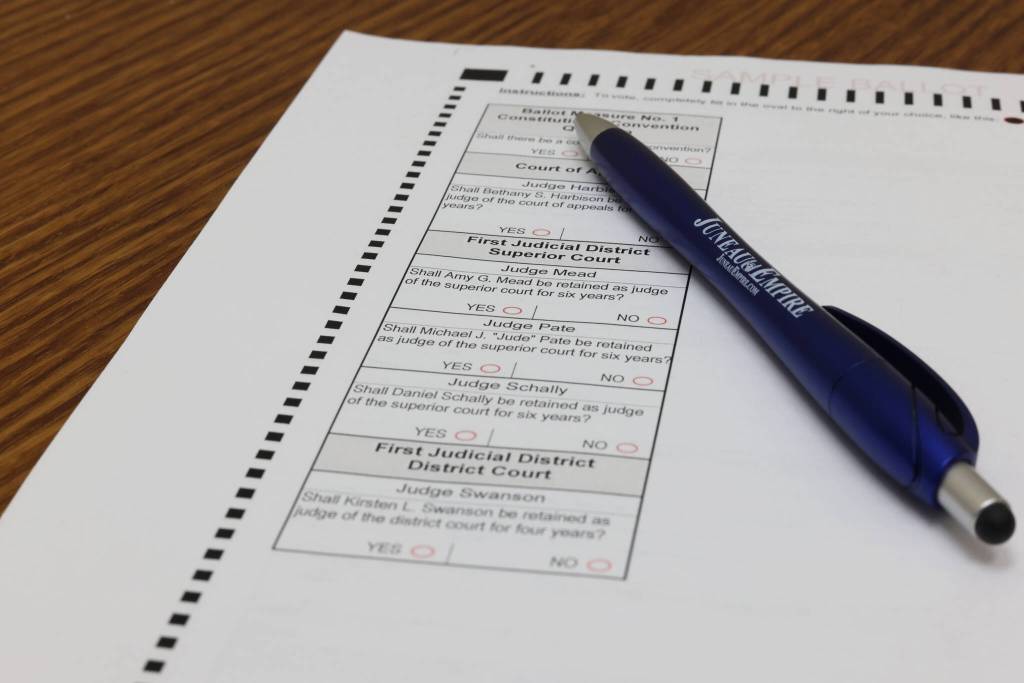


All of the Alaska judges to appear on ballots Tuesday are trending toward retention, and all three of the Juneau judges are virtual locks to secure subsequent terms.
Superior Court Judges Amy Mead, Daniel Schally, and District Court Judge Kirsten Swanson from the First Judicial District each received over 70% of the vote to keep their positions. Like other judges on the ballot, that outcome was recommended by the Alaska Judicial Council, which unanimously recommended retention for all of Alaska’s judges in the 2022 Electoral election.
“With regards to the First Judicial District, I think it’s virtually assured that they’ll be retained. I think the judges fared well and it’s a reflection that people have confidence in their judges and our judiciary in Southeast,” said attorney and board member for the Alaskans for Fair Courts Bruce Botelho.
Outcomes are less decisive for judges in Alaska’s Third Judicial District where most votes for retention seem to be favoring retention along a narrower margin with about 55% of voters for it. Southeast Alaska, including Juneau, comprises the first district. The third district includes Anchorage, Cordova, Dillingham, Glennallen, Homer, Kenai, Kodiak, Naknek, Palmer, Sand Point, St. Paul Island, Seward, Unalaska and Valdez.
“I’d have to say that looking statewide I was troubled at the relatively close margins in the Third Judicial District,” Botelho said. “The judiciary is crucial to our Alaska democracy as it were in terms of dispensing fair and impartial justice around the state, to be able to have the credibility as an institution of being fair and impartial, to the extent that large segments of the public are voting against retention, even when there did not appear to be any issues with specific judges in terms of their conduct.”
Alaska’s method of judicial appointment is sometimes subject to criticism from people who would like to see judges determined through elections.
In Alaska, the Alaska Judicial Council —- an independent commission consisting of three attorneys, three laypeople and chaired by the state supreme court justice — screens and recommends applicants for judicial openings. Once the council recommends a pool of potential judges to fill an opening, one is appointed by the governor. The council also recommends whether voters should retain judges. According to the council, since 1976 it has recommended against retention twelve times and voters have decided not to retain six judges in the state’s history.
Botelho said that the early low projections within the Third Judicial District illustrate a disconnect with large segments of the population when considering the fact that the Alaska judicial council unanimously recommended all of the state’s judges be retained.
Executive director of the Alaska Judicial Council Susanne DiPietro said that the reason behind the council’s decision to recommend unanimous retention came from the council’s year-long evaluation process of the performance of all the judges on the 2022 ballot. DiPietro said that as required by statute, the Alaska judicial council evaluated the performance of all judges standing for retention and made that performance evaluation available to the public.
“The council does that in advance of every retention cycle, which takes about a year, it’s an exhaustive evaluation of the judge’s performance,” DiPietro said. “That evaluation includes surveys of people who appeared in front of the judges including attorneys, every law enforcement officer in the state is surveyed, jurors are surveyed, court employees are surveyed, social workers are surveyed, basically all of groups that have experience actually appearing in the judge’s court, keeping in mind that many of the people surveyed may have won their cases but many will have lost their cases.”
According to DiPietro, the council also takes into consideration judges’ financial disclosure statements that are required to be filed, as well as any ethical issues that may have arisen along with other performance indicators such as legal ability, integrity, temperament, fairness, diligence and administration skills.
“The staff assembles all of that information for the council members, and additionally offers public hearings where anyone from the public is welcome to attend and share experiences with any of the judges,” DiPietro said. “Based on all of that information compiled together the council then decides if each judge met the performance standards and should then be recommended for retention.”
Botelho said the Judicial Council unanimously recommending retention for all of Alaska’s judges is a positive reflection of Alaska’s judicial system as a whole, pointing out that some of the members on the council are divided by parties.
“I think it’s a rigorous process in addition to the polling that’s done of virtually every segment that has frequent contact with the courts, and so I think that system is sound,” Botelho said. “I think the other thing that is probably worth highlighting is that the judicial council is made up of three attorneys and three laypeople presided over by the chief justice, but two of the three lay people currently serving are appointees of Governor Dunleavy, so to the extent that there are accusations that our judiciary is too liberal or out of touch, I think there is significance of the fact that the recommendations this year in terms of retention were unanimous.”
DiPietro echoed Botelho’s sentiments regarding retention recommendations largely reflecting positively on Alaska’s judicial system, given that not everyone within the surveying process potentially agrees with one another on all other voting issues or otherwise.
“I’m certainly pleased that the performance evaluation the council did shows that thousands of people who have direct professional experience with the judges rated them highly in all areas,” DiPietro said. “To me, that goes, really, to a positive impression of the quality of Alaska’s judiciary. The people that the council surveyed are people who may very well not agree with each other on anything but they all pretty much agreed that the judges were doing a good job.”
• Contact reporter Jonson Kuhn at jonson.kuhn@juneauempire.com.