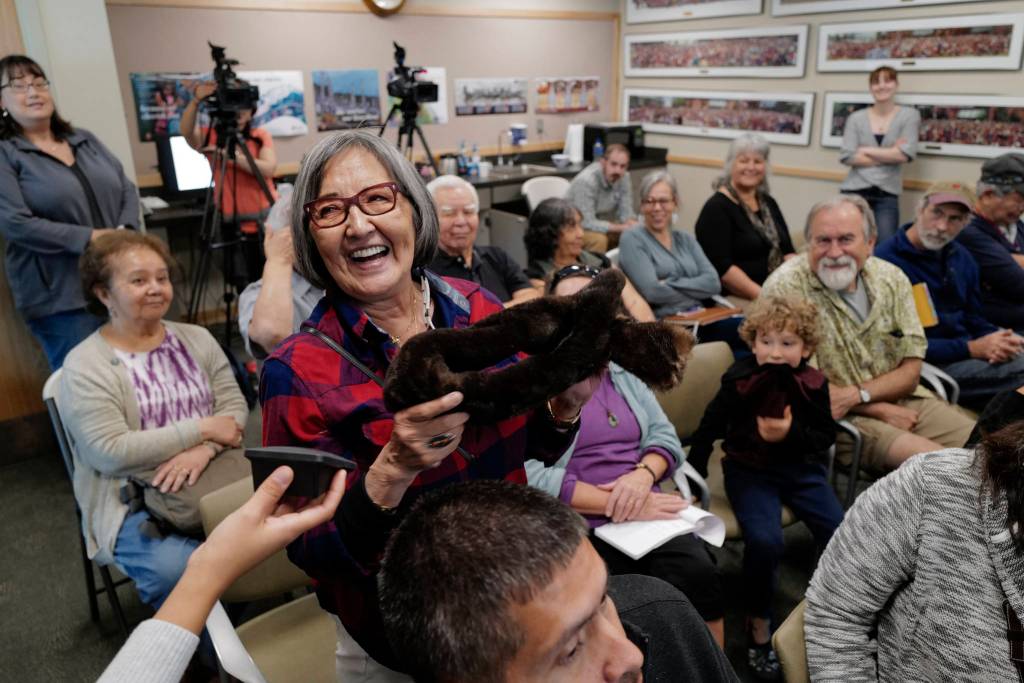
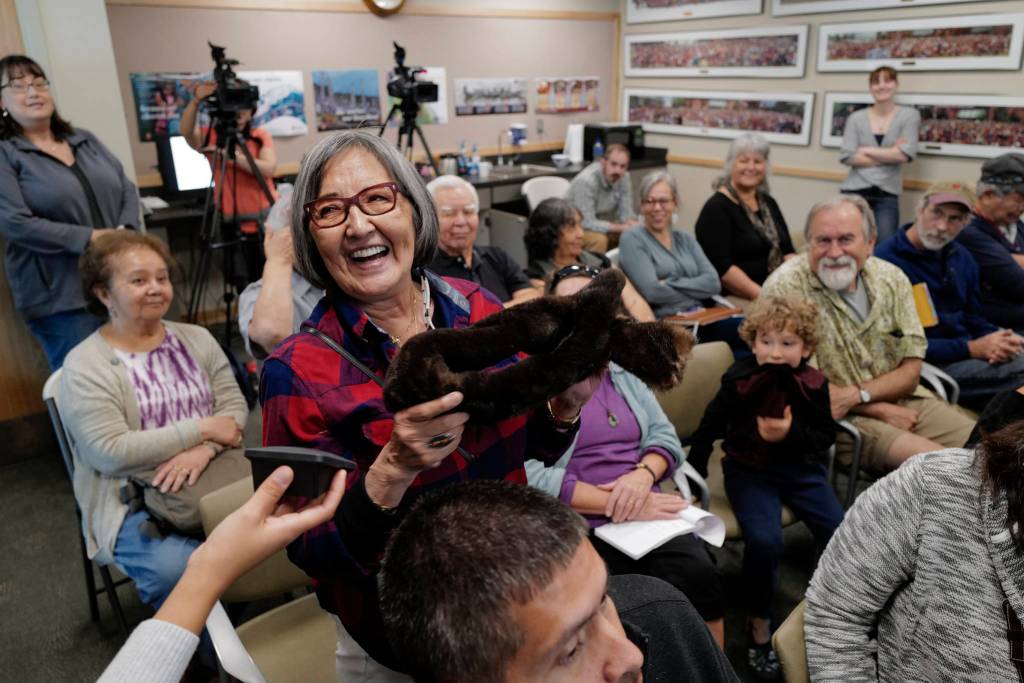
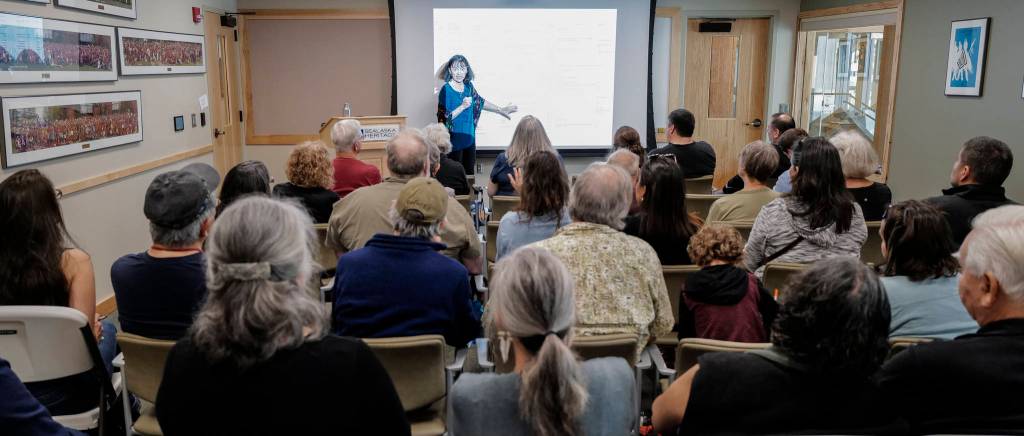
Dr. Rosita Worl, President of Sealaska Heritage Institute, holds up sea otter fur during a speech by Dr. Madonna Moss, professor of anthropological archaeology at the University of Oregon, on Tlingit relationships with sea otters and whether Tlingit people consumed sea otters as food in the past during a lecture at the Walter Soboleff Center on Friday, Aug. 2, 2019. (Michael Penn | Juneau Empire)

Dr. Rosita Worl, President of Sealaska Heritage Institute, holds up sea otter fur during a speech by Dr. Madonna Moss, professor of anthropological archaeology at the University of Oregon, on Tlingit relationships with sea otters and whether Tlingit people consumed sea otters as food in the past during a lecture at the Walter Soboleff Center on Friday, Aug. 2, 2019. (Michael Penn | Juneau Empire)

Fur or food? To answer modern-day sea otter question, Alaska Native org looks to the past

Simple question has complicated answer

cMadonna Moss set out to answer a simple question, and through in-depth research she came up with a complex answer.

The University of Oregon anthropology professor and curator of zooarchaeology for the Museum of Natural and Cultural History was asked by Sealaska Heritage Institute to determine whether Tlingit people historically harvested sea otters for food.

“I think they hunted sea otters primarily for pelts,” Moss said near the end of a lecture Friday at SHI’s Walter Soboleff Building. “I do not think they were a dietary staple.”

However, she said it would be inaccurate to say sea otters were never a food source.

“I think people were occasionally — not always, not every sea otter — cutting out the back straps of sea otters and eating them,” Moss said.

One of the reasons SHI, a nonprofit that supports and promotes Alaska Native arts and culture, funded Moss’ project was to help determine how Native people had traditionally harvested sea otters, said Chuch Smythe, Director of history and culture for SHI.

[Otter hunting makes earrings for Aleut artist]

Alaska Natives are allowed to harvest sea otters, which would otherwise be federally protected by the Marine Mammal Protection Act, but Smythe said some feel the practice of harvesting otters for their fur — something that is done to provide materials for SHI skin sewing workshops — is wasteful.

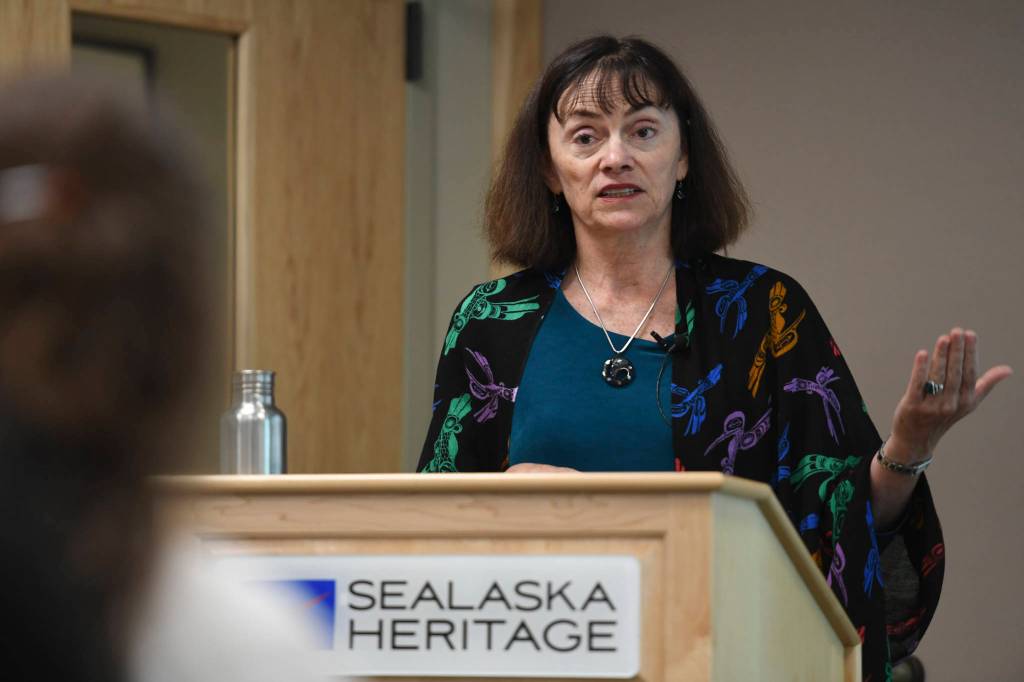
Dr. Madonna Moss, professor of anthropological archaeology at the University of Oregon, speaks on Tlingit relationships with sea otters and whether Tlingit people consumed sea otters as food in the past during a lecture at the Walter Soboleff Center on Friday, Aug. 2, 2019. (Michael Penn | Juneau Empire)

Dr. Madonna Moss, professor of anthropological archaeology at the University of Oregon, speaks on Tlingit relationships with sea otters and whether Tlingit people consumed sea otters as food in the past during a lecture at the Walter Soboleff Center on Friday, Aug. 2, 2019. (Michael Penn | Juneau Empire)

The act specifically states marine mammals may be taken “for purposes of creating and selling authentic Native articles of handicraft and clothing.”

However, Smythe said he’s also heard some say otters should be eaten in order for the Marine Mammal Protection Act exception to continue. Sometimes, Smythe said that opinion comes paired with the assumption that Natives traditionally ate sea otters.

However, Moss’ research arrived at the conclusion that sea otters were primarily harvested for their fur, not their meat.

That conclusion came after a lot of research.

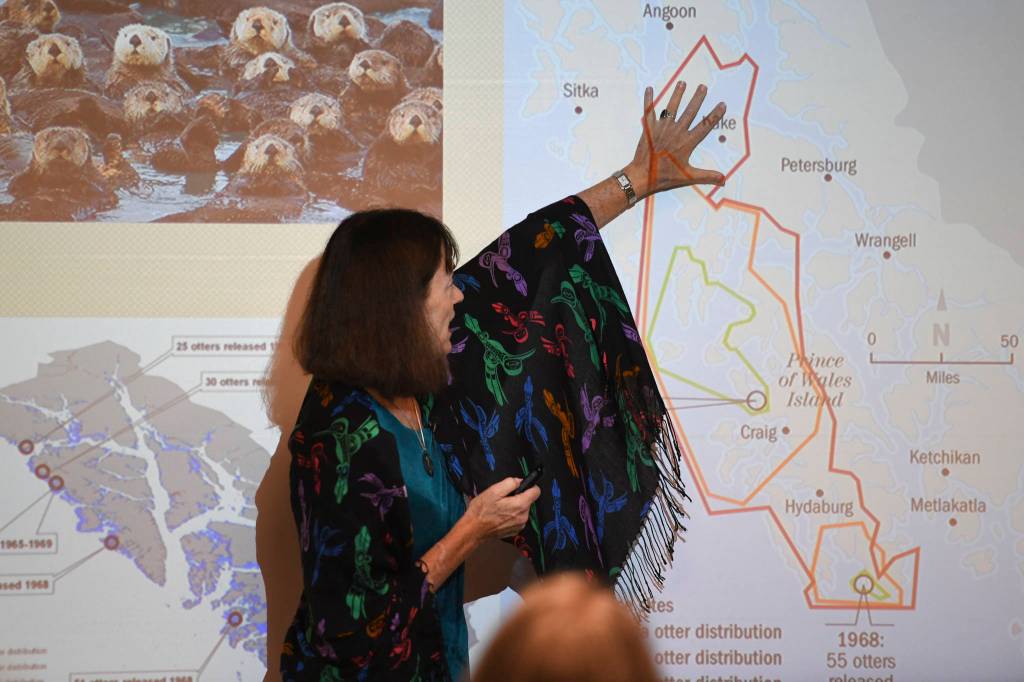
One of the reasons extensive research was required is the 19th century Russian occupation of Alaska. A desire for otter fur led to over-hunting, and Moss said by 1830 sea otters in Southeast Alaska were largely extinct, Moss said.

Sea otters were reintroduced in the 1960s, and Moss said the population has now rebounded to an estimated 30,000 otters.

Dr. Madonna Moss, professor of anthropological archaeology at the University of Oregon, speaks on Tlingit relationships with sea otters and whether Tlingit people consumed sea otters as food in the past during a lecture at the Walter Soboleff Center on Friday, Aug. 2, 2019. (Michael Penn | Juneau Empire)

Dr. Madonna Moss, professor of anthropological archaeology at the University of Oregon, speaks on Tlingit relationships with sea otters and whether Tlingit people consumed sea otters as food in the past during a lecture at the Walter Soboleff Center on Friday, Aug. 2, 2019. (Michael Penn | Juneau Empire)

While otters are common enough now that some Alaskans, including fishermen and state legislators consider them a nuisance, they had been essentially absent for more than a century. So for answers, Moss had to turn to the past.

Moss compared seal bones and sea otter bones initially excavated in the 1950s from a pair of pre-contact sites in Angoon. Since seal was definitely known to be a food source, if the ancient bones showed signs of similar wear, tear and cutting, it could be a sign that sea otter was also eaten.

“I saw some differences between how people were using sea otters and seals, but I wasn’t sure how to interpret it,” Moss said.

[Formline meets the red line at Douglas ice rink]

Some clarity was added when Moss was provided the carcass of a recently skinned sea otter.

Since Moss knew the animal was not dismembered and that it was used solely for its pelt, she was able to examine its bones for cut marks after the otter’s flesh was eaten by beetles.

She found cut marks where she did not expect to find them, which she inferred were caused by a need to create leverage to pry the sea otters’ pelt from its body.

Dr. Madonna Moss, professor of anthropological archaeology at the University of Oregon, speaks on Tlingit relationships with sea otters and whether Tlingit people consumed sea otters as food in the past during a lecture at the Walter Soboleff Center on Friday, Aug. 2, 2019. (Michael Penn | Juneau Empire)

Dr. Madonna Moss, professor of anthropological archaeology at the University of Oregon, speaks on Tlingit relationships with sea otters and whether Tlingit people consumed sea otters as food in the past during a lecture at the Walter Soboleff Center on Friday, Aug. 2, 2019. (Michael Penn | Juneau Empire)

Those cuts were comparable to what she saw on the ancient bones, but did not match up exactly, Moss said.

After speaking with Tlingit people about whether otter was known to be good eating, Moss came to the idea that the “back straps” of otters were likely easier to eat and tastier than other muscular and tough portions of the animal.

However, whether that meat was eaten by people because other food was less available or whether it was fed to dogs is less clear.

“That’s unknown,” Moss said.


• Contact reporter Ben Hohenstatt at (907)523-2243 or bhohenstatt@juneauempire.com. Follow him on Twitter at @BenHohenstatt.


More in News

The emergency cold-weather warming shelter is seen in Thane on Thursday, April 10, 2025. (Jasz Garrett / Juneau Empire file photo)
Man charged for alleged rape at warming shelter

Staff have increased the frequency of safety rounds, and are discussing potential policy changes.

Photo by James Brooks/Alaska Beacon 
Alaska Gov. Mike Dunleavy speaks during a news conference in Juneau on Thursday, April 27, 2023. To his side is a screen displaying significant budget deficits and exhausted savings accounts if oil prices perform as expected.
Disasters, dividends and deficit: Alaska governor unveils first-draft state budget

In his final year, Gov. Dunleavy again proposes to spend from savings in order to pay a larger Permanent Fund dividend

Eaglecrest Ski Area as seen in a photo posted to the hill’s Facebook page on Tuesday, Dec. 11, 2025. (Eaglecrest Ski Area photo)
Eaglecrest boots up for a limitted opening this weekend

15 degree highs usher in the hill’s 50th season.

Sen. Jesse Bjorkman, R-Nikiski, speaks Wednesday, April 23, 2025, on the floor of the Alaska Senate. (Photo by James Brooks/Alaska Beacon)
State senators express skepticism about proposed Juneau ferry terminal backed by Dunleavy

In a Friday hearing, members of the Alaska Senate spoke critically about… Continue reading

SouthEast Alaska Regional Health Consortium is one of the primary health care providers in Juneau, accepting most major public and private insurance plans. (Mari Kanagy / Juneau Empire)
Marketplace health premiums set to rise in 2026

Here’s what you need to know about how coverage is changing, and for whom.

Capital City Fire/Rescue completes last season’s ice break rescue training at the float pond near Juneau International Airport. (photo courtesy of Capital City Fire/Rescue)
On thin ice: Fire department responds to season’s first rescue at Mendenhall Lake

This week’s single digit temperatures have prompted dangerous ice ventures.

Brenda Schwartz-Yeager gestures to her artwork on display at Annie Kaill’s Gallery Gifts and Framing during the 2025 Gallery Walk on Friday, Dec. 5. (Mari Kanagy / Juneau Empire)
Alaska artist splashes nautical charts with sea life

Gallery Walk draws crowds to downtown studios and shops.

A totem pole, one of 13 on downtown’s Totem Pole Trail in Juneau, Alaska, Nov. 27, 2024. (Christopher S. Miller/The New York Times)

Most Read