Fun with 3 fungal curiosities
Published 9:30 pm Monday, October 19, 2020

By Mary F. Willson
for the Juneau Empire
This essay is about an eclectic assortment of fungi, my choices being based entirely on happenstance and whim.
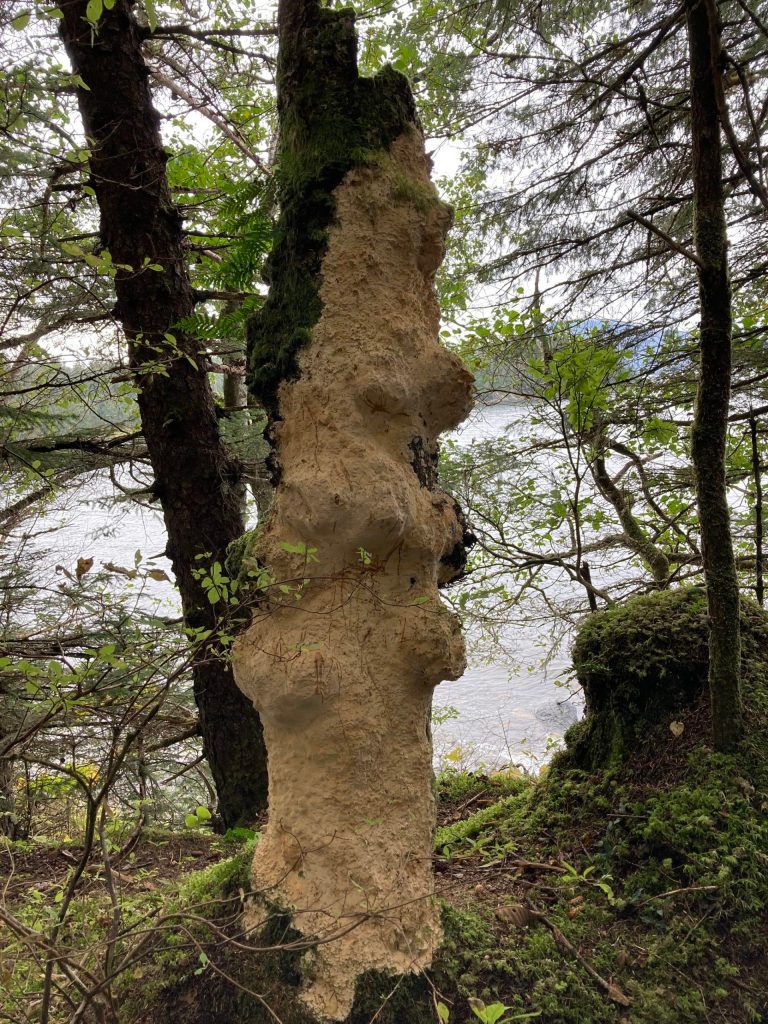
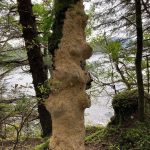
One September day on the Outer Point Trail, we spotted a very large, yellowish patch on a tall alder snag. That patch covered most of one side of the snag; at a guess, it may have exceeded ten square feet. At first glance, I thought it was a huge crustose lichen, but no, it was a fungus. On certain places on this expansive crust, there were small ridges like miniature conks, and on their undersides were numerous pores where spores would be produced. The crust has covered mosses and engulfed the stems of licorice ferns.
I went back to look at it about 10 days later, and now the surface featured many shallow furrows that had turned brown. The furrows were four or five millimeters wide and several inches long, crisscrossing the flat surface of the big fungus. Were they the work of slugs or land snails, grazing their way along? No, there were no marks of the scraping radula or tongue. A few days later, another observer suggested that wind-bent branches hit the fungus. No, when I tried it, small branches striking the surface didn’t leave furrows like that. A few more days later, we finally noticed that all the furrows occurred between human knee height and head height. Then I found that I could mimic the furrows very well with the flat of a fingernail. So we — finally! — concluded that these furrows are just graffiti. Much less interesting than slug trails, but perhaps closer to truth. ‘Twas a shame to deface such a beautiful organism.
[On the Trails: Bussling bogs and bird feeders]
What is this magnificent, hall-of-fame specimen? It seems that nobody really knows! It might be X or maybe Y, or something else altogether. Several mycologists have been consulted, with no concrete results. A sample sent to a lab for DNA analysis might yield a solid answer.
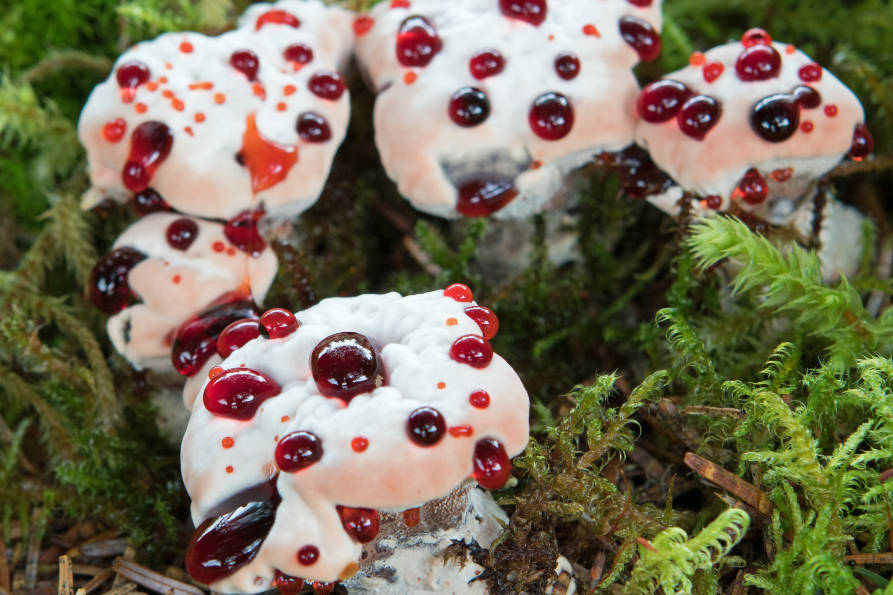
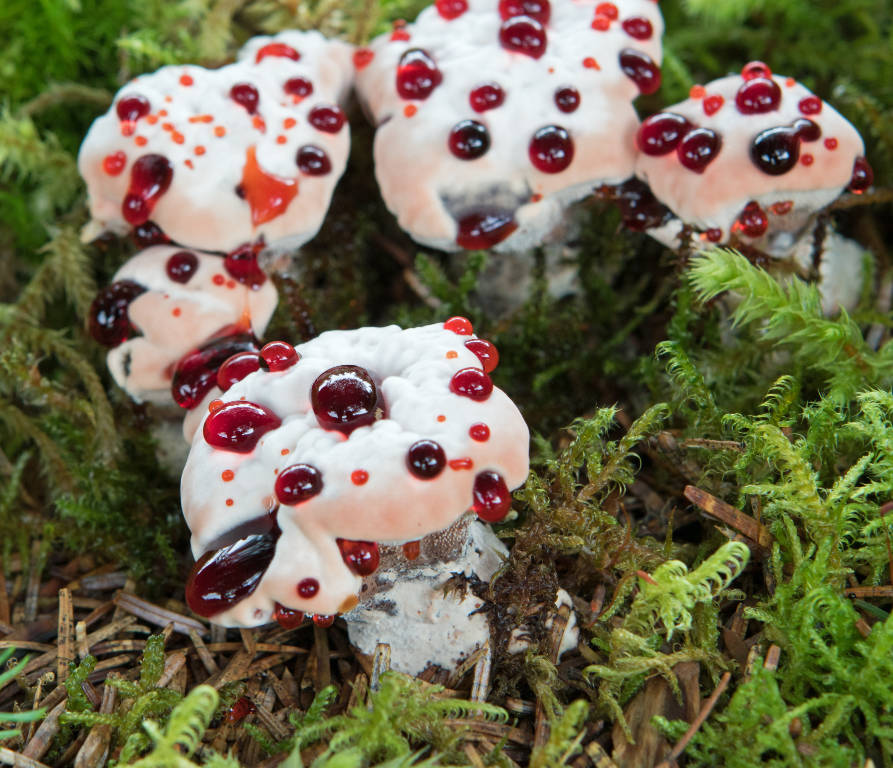
A strange fungus sometimes seen near the visitor center, among other places, is called the bleeding tooth fungus (Hydnellum peckii). Its name is not about bleeding teeth; it’s a tooth-fungus (with spore-bearing ‘teeth’ instead of gills or pores) that seems to ‘bleed’. The immature cap is white, but sometimes there are little pools of red fluid on the surface. Another name, perhaps for the more squeamish observers, for this critter is strawberries and cream. As far as I can tell, nobody really knows why those pools form on the cap. The present idea is that it’s a way to get rid of excess moisture, as some other fungi and some plants do by exuding droplets of water. But why are the pools red? Is the color just an incidental by-product of some metabolic process?
This fungus is mycorrhizal, forming connections with the roots of conifers and exchanging nutrients. The cap turns dark as it matures and produces spores. The stalk is thick and short, so short that the cap is often semi-buried in moss and debris. That raises the question of how the spores get dispersed from under the cap.
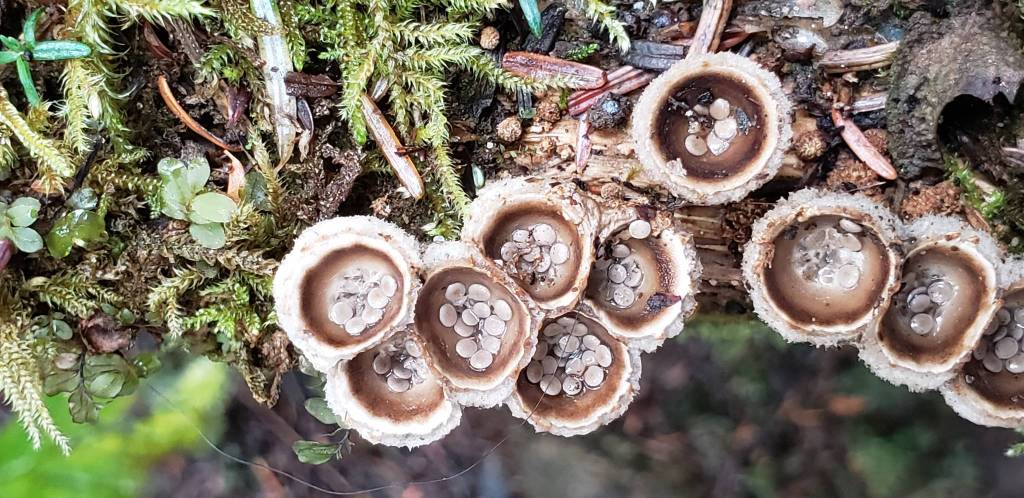
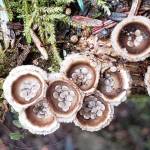
Yet another curiosity is a bird’s nest fungus (Nidula candida), a decomposer living on dead wood and rotting vegetation that is quite common around here.
It earned its name from its appearance: the mature, reproductive form features a small (roughly one cm) cup containing several little round, somewhat flattened, objects. So it resembles a miniature bird’s nest with eggs. The ‘eggs’ contain spores. The cap is ingeniously built so that a raindrop can splash the ‘eggs’ out of the cup to a distance of a meter or more. The ‘eggs’ of some bird’s nest fungi (but not ours) are ejected with long, sticky threads, which catch on vegetation as they fly off. Eventually the ‘eggs’ deteriorate, releasing the spores. The spores germinate, producing stands called hyphae; two hyphae of the right mating type can merge to develop a nest-like fruiting body. Splash-cup dispersal mechanisms are uncommon means of spreading offspring around, but they are known also from some plants.
• Mary F. Willson is a retired professor of ecology. “On The Trails” is a weekly column that appears in the Juneau Empire every Wednesday.