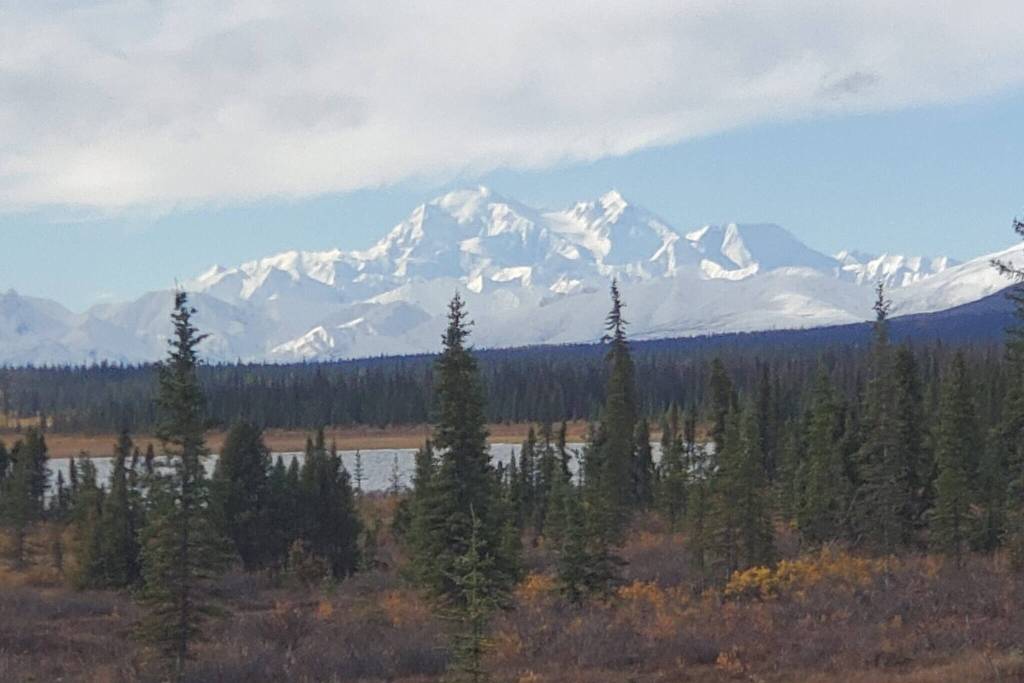
North America’s tallest peak, known as Denali until President Donald Trump changed the name earlier this year, is seen from Parks Highway on Sept. 20, 2022. (Yereth Rosen/Alaska Beacon)

North America’s tallest peak, known as Denali until President Donald Trump changed the name earlier this year, is seen from Parks Highway on Sept. 20, 2022. (Yereth Rosen/Alaska Beacon)

Five months after Trump order, most federal agencies are using ‘Gulf of America,’ Mount McKinley

On Friday, the federal agency in charge of offshore oil and gas drilling announced that it will be rewriting its core regulations to replace all references to “Gulf of Mexico” with “Gulf of America.”

The change by the Bureau of Ocean and Energy Management is only the latest in a series of actions by federal agencies, and a review of the Federal Register — the official journal of the federal government — shows most agencies have already implemented President Donald Trump’s Jan. 20 executive order, which instructed the federal government to replace the gulf’s name in official records.

That order also officially renamed Denali to Mount McKinley, the name used by the federal government between 1896 and 2015 for North America’s tallest peak.

In February and March, the domestic names committee of the U.S. Board on Geographic Names formalized the president’s order and a subsequent one by the U.S. secretary of the Interior about the Gulf of Mexico and Mount McKinley.

At Denali National Park, websites changed the name of North America’s tallest mountain within 10 days; it was listed as Denali on Jan. 28, and by Jan. 30, it was “Mount McKinley.”

The printed brochures took longer but are now updated.

The National Oceanic and Atmospheric Administration, which handles ocean mapping, changed the gulf’s name on ocean charts, and the U.S. Geological Survey changed the name in the Geographic Names Information System, the federal government’s core database. Even the agency in charge of the nation’s spy satellites altered its records.

As the Atlantic hurricane season begins, the National Weather Service’s National Hurricane Center has already updated its maps, and the U.S. Coast Guard changed its regulations in March.

Other agencies, including the BOEM, have taken longer to act. In late May, the federal agency in charge of pipeline safety changed its regulations.

More actions are coming, according to notices published in the Federal Register, the official daily journal of the federal government.

In August, the Federal Aviation Administration will change parts of its aviation maps to account for the new names.

Additional changes are expected in the coming months from other agencies and from states, which have been slower to act on the new names.

• James Brooks is a longtime Alaska reporter, having previously worked at the Anchorage Daily News, Juneau Empire, Kodiak Mirror and Fairbanks Daily News-Miner. This article originally appeared online at alaskabeacon.com. Alaska Beacon, an affiliate of States Newsroom, is an independent, nonpartisan news organization focused on connecting Alaskans to their state government.

More in News

Guests ride the Porcupine chairlift at Eaglecrest Ski Area. (Eaglecrest Ski Area photo)
Eaglecrest opens Westside, offers $7 lift tickets Saturday

After a rocky start to the season, the ski area is celebrating its 50th birthday.

Thomas Hatley stands before a helicopter. He was announced the new fire chief for Capital City Fire and Rescue on Friday, Jan. 16, 2025. (Thomas Hatley photo)
Hatley appointed new Juneau fire chief

Former Fire Chief Rich Etheridge announced his retirement in September.

Salvage captain Trevin Carlile, left, and diver Phil Sellick at Melino’s Marine Service re-float a sunken boat in Harris harbor on Jan. 8, 2026. Record-breaking snow at the beginning of the month caused at least eight boats to sink in Harris, Douglas and Aurora harbors, resulting in oil spills. (Chloe Anderson for the Juneau Empire)
A historic storm in Juneau: 10 sunken boats and what it takes to re-float them

Sunken boats don’t become wrecked relics. Left underwater, they can damage vessels overhead and threaten the environment

The Department of Environmental Conservation helped a Nikiski resident dispose of over 43 tons of contaminated soil after a home heating oil spill in November. DEC on Friday launched a program to help eligible homeowners cover cleanup costs relating to home heating oil spills. (Photo courtesy of DEC)
State launches program to help homeowners cover heating oil spill cleanup costs

The Department of Environmental Conservation announced the program on Friday, Jan. 9.

Mount Juneau stands among fog on Jan. 14, 2025. (Chloe Anderson / Kenai Peninsula Clarion)
CBJ lifts all avalanche evacuation advisories for Juneau

That includes the advisory for the Behrends slide path, the last remaining evacuation notice.

Juneau Jazz Fest founder Sandy Fortier will be leading Alaska Arts Education Consortium. (Alaska Arts Education Consortium)
Juneau Jazz Fest founder to lead Alaska arts consortium’s education efforts

Sandy Fortier, now AAEC executive founder, was a Juneau music teacher

A City and Borough of Juneau map from 2021 shows labels four avalanche slide paths on Mount Juneau. (City and Borough of Juneau)
Avalanche hazard on Behrends path to peak late Tuesday, CBJ says

‘Likelihood of large avalanches’ could significantly increase during that time, advisory warns.

A City and Borough of Juneau map from 2021 shows labels four avalanche slide paths on Mount Juneau. (City and Borough of Juneau)
Evacuation advisory in effect for Behrends slide path, all others lifted in Juneau

Avalanche hazard is still high across all known slide paths, CBJ says.

A map from the City and Borough of Juneau shows the potentially impacted area of an avalanche advisory that was issued Friday morning (Jan. 9, 2026) (City and Borough of Juneau)
UPDATE: Thane Road reopened, “Hazard is still high” for downtown avalanche

Avalanche risk remains high, and more rain is expected through tomorrow evening

Most Read