Fantastic spiders and where to find them
Published 1:30 am Tuesday, May 5, 2020
Spiders are generally predatory, with good vision.
Most of them have eight eyes. Two large, forward-looking eyes have a lens for sharp focusing, and the rest are in various positions on the head for detecting motion and, somehow, gauging distance. They also have color vision, particularly in the green and ultraviolet ranges of wavelengths. Some of the jumping spiders go one more step: they have a filter over some of the green receptors that shifts reception to the red wavelengths. Thus, they can see reds, oranges and yellows, in addition to greens, blues, and UV.
As useful as that broad-spectrum vision may be in finding and capturing prey, what has attracted the attention of jumping-spider researchers are the colorful displays of certain male spiders. These displays can be used in aggression between males, and they are used in courting females. The females are brown and gray and not colorful, but they can see and respond to the flashier males.
[How vertabrates use ultraviolet vision]
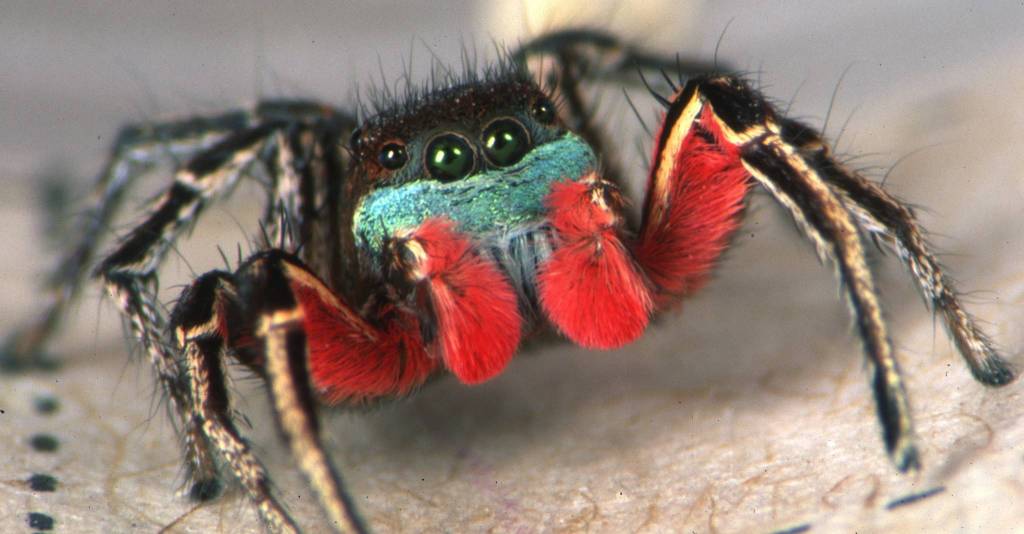
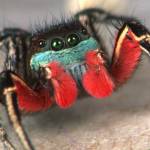
So-called “paradise spiders” (genus Habronattus, with many species) live mostly in North and Central America. Their nickname comes from an imagined, distant similarity to birds of paradise. They are small — less than a centimeter in length. Males court females with colorful displays, displaying brilliant facial markings, showing colorful parts on the first or third legs, waving fuzzy, colored pedipalps. In one species, the pedipalps look like fluffy red mittens. Pedipalps are appendages between jaws and the first walking legs, variously used for manipulating prey, as sense organs, and as the means for males to transfer sperm to females, as well as part of a courtship display.
The color show is often accompanied by special dance movements: moving side to side, bobbing up and down, waving the front legs, flicking just the foot on the raised front legs, and so on. Some of these spiders even “sing,” making vibrations on the substrate or by clicking together different body parts; the songs are distinctive to each species and, at least in some of them, the motifs of the songs change as courtship progresses.
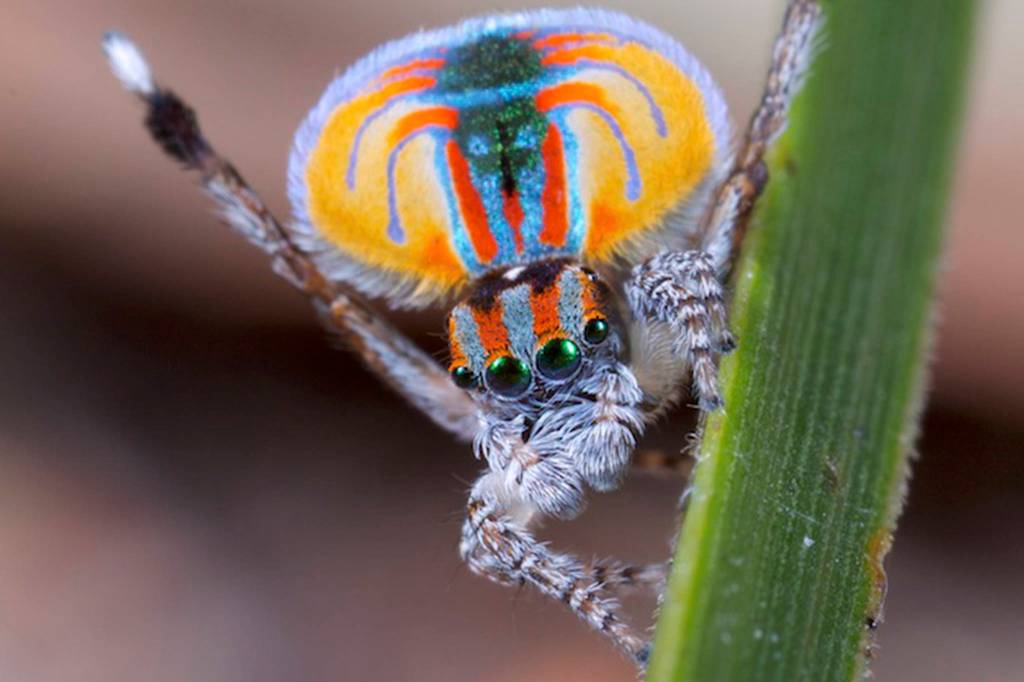
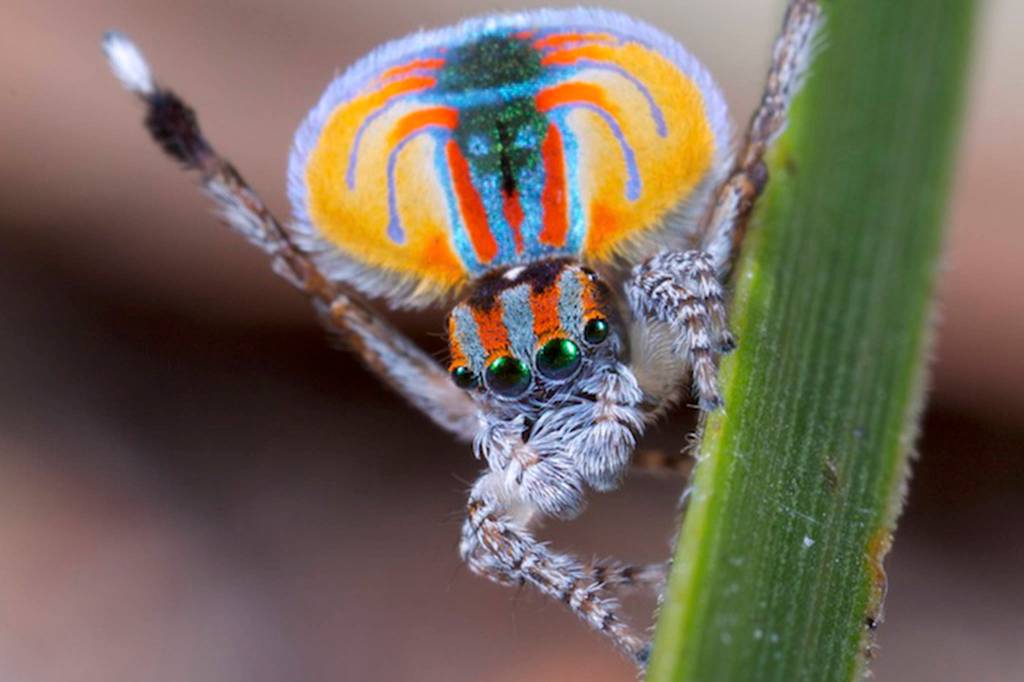
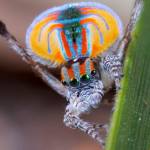
“Peacock spiders” (many species in the genus Maratus) live in Australia.
The displays of courting males are so showy that they suggested a similarity to peacocks but in miniature because these spiders are just a few millimeters long. A courting male approaches a female, waving his fluffy pedipalps and his third pair of legs, which may be decorated with fringes and patterns. He can accompany his approach with vibratory signals. Some have colorful faces, and pedipalps are often white but may have patterns. Males of many species have flamboyantly multi-colored, even partly iridescent, abdomens with flaps on the side, which can be extended, like a fan, to make the color display larger. The entire abdomen is then raised so that it is visible to a facing female over the male’s head. A male then fan-dances with his expanded abdomen, sidling back and forth in front of the female while showing the fan and waving his third legs. The colors on the fan are produced by modified scales whose structure determines the color. In some cases, the showy abdomen has a fringed border or feathery extensions at the end. To fully appreciate these gaudy little fellows, look online and watch the videos.
It’s a sure bet that ongoing research will try to determine what aspects of the males’ displays are most effective in their mating success. The cost of failure is sometimes high: If a female is seriously offended by a male’s advances, she might eat him.
• Mary F. Willson is a retired professor of ecology. “On The Trails” is a weekly column that appears every Wednesday.