Drops in Alaska’s student test scores and education funding follow similar paths past 20 years, study claims
Published 9:30 pm Tuesday, December 17, 2024





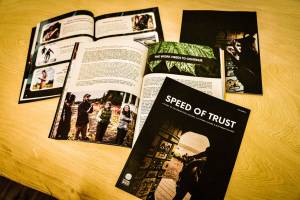
A decline in Alaska’s student test scores during the past two decades, including fourth graders now being a year behind their 2007 peers in reading and math, mirrors a decline in inflation-adjusted per-pupil state funding, according to a study published this week by a member of the NAACP Anchorage Education Committee.
The study also notes student-to-teacher ratios are rising as real-dollar funding for schools drops. Mike Bronson, author of the study titled “How legislators short-changed students out of reading and math instruction,” acknowledges funding declines aren’t necessarily the direct and/or only cause of the measured drop in test scores and rise in class sizes.
However, the findings do reflect claims some Alaska education advocates have made for years about the erosive effect inflation and is having on state schools as per-student funding fails to keep pace. The issue is again expected to be a focal point during the coming legislative session, with Democratic-led bipartisan majorities in both chambers seeking more per-student funding while Republican Gov. Mike Dunleavy has nixed an increase in his proposed budget.
“I do expect that if people see it and understand it they may change the debate a little bit for the better,” Bronson said in an interview Wednesday, when asked what his study can add to what’s been a years-long debate fueled by plenty of other reports. “And the thinking is that in spite of some of the efforts on the part of legislators to improve the (Base Student Allocation) most folks are still out in the woods. They don’t quite understand or they’re uncertain about the relationship between the BSA and outcomes…What this study does is it sharpens that debate.”
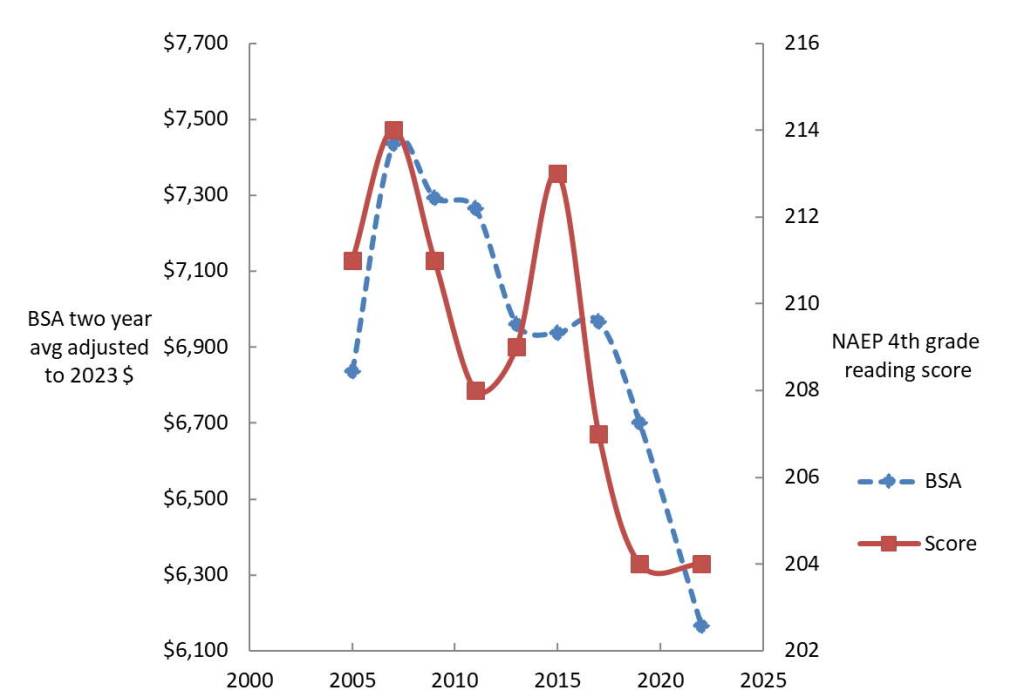
Bronson’s study notes the BSA peaked in 2006 and 2007 at more than $7,400 in inflation-adjusted dollars for 2023, and declined on a mostly steady path to about $6,150 in 2023. The statutory BSA is $5,960 with a one-time increase of $680 in effect for the current fiscal year that started July 1, which is omitted from the governor’s budget for the following year.
“Fourth graders’ math and reading proficiency fell one full year of learning as the Legislature reduced its real-dollar base student allocation to schools,” a summary of the study notes. “At the same time, eighth graders fell behind by more than a year of math learning and by almost a year of reading learning.”
Furthermore, “as the state lost many teachers but not many students in that period, the pupil-to-teacher ratio, an index of class size, increased more than 20 percent.”
Charts included by Bronson in the study that show largely similar trendlines in inflation-adjusted funding and test scores are somewhat misleading since the relative shift in numbers are different. A chart at the top of the report of fourth-grade reading, for instance, shows while inflation-adjusted funding went from a peak of about $7,450 in 2007 to $6,300 in 2023, test scores dropped from 214 to 204 during this period. Bronson states a 10-point difference in scores equates to one year of learning.
Standardized test results released in August by the state for the 2023-24 school year show 31.8% of students scored proficient or better in English, 32.5% in math and 36.9% in science, while in Juneau those respective percentages were 33.35%, 29.05% and 39.78%. Relatively flat state funding for the past decade was largely blamed for the results in a joint statement by the Alaska Council of School Administrators (ACSA) and Association of Alaska School Boards (AASB).
Yet problems with test scores and large class sizes go beyond Alaska.
Test scores have dropped nationwide and “are now at their lowest point since 1990, while reading scores have hit their lowest level since 2004,” according to a Scripps News report updated in July of this year. While average class sizes have remained relatively level nationally for the past two decades, a teacher shortage is recent years is making the issue a growing concern, according to the National Education Association.
Bronson, in response to the national test score findings, stated “Alaska scores started dropping earlier than nationwide scores started dropping, and they’ve generally dropped more steeply than national scores.” The congressionally-mandated National Assessment of Educational Progress shows Alaska’s scores for fourth- and eighth-grade students in reading and math generally dropping more than the national rate between 2002 and 2019, with data afterward more variable in the wake of the COVID-19 pandemic.
Dunleavy, when releasing his budget, said he’s willing to consider a permanent education funding increase similar to the temporary one in place this year if the Legislature approves other policy goals of his such as more support for charter and correspondence schools.
Bronson, in his study, notes correspondence schools have grown over the years and now represent about 17% of students in Alaska, but they are not factored into his study because only 15 percent of students in grades 3-10 took the standardized tests. He notes “among those 1,700 correspondence students who took the state tests, 54 percent scored below the English language arts standard and 64 percent scored below the math standard,” and that “Overall, the data do not suggest that correspondence students’ reading and math proficiency differs much from students in brick-and-mortar classrooms.”
Rep. Andi Story, a Juneau Democrat who will co-chair the House Education Committee during the coming legislative session, said such limited participation by correspondence schools means a direct comparison with traditional schools isn’t practical.
“If you’re testing 90% of the neighborhood schools, but 10% to 15% of the correspondence schools it’s just not enough to know how they’re doing,” she said.
Story said the impacts on schools due to lower inflation-adjusted education funding are well-established including larger class sizes and students struggling in learning areas such as reading. She also noted the state switched to a new standardized testing method in 2022, but it’s too soon to tell if that and/or one-time funding increases during the past two years are altering the trend line on test scores since it usually takes about three years of full results to see indicators.
Other factors also play a role, Story said, referring to a 2019 legislative study conducted by a former Anchorage School District finance director that among other things notes “test scores reflect poverty/affluence” of households and neighborhoods. The study also asserts districts with high teacher turnover and unstable funding have lower proficiency scores, and the longer students stay in a school system the better their test scores.
“We don’t have a lot of preschools in the state. We don’t have a lot of early literacy,” Story said. She said the COVID-19 pandemic disrupted efforts to change that situation, but now “we’re building back on that.”
Deena Bishop, commissioner of the Alaska Department of Education and Early Development, did not respond to inquires from the Empire about Bronson’s study Wednesday.
Story said she doesn’t know yet specifically what policies Dunleavy will seek in exchange for a permanent increase in per-student funding, but “I’m very much looking forward to that conversation.”
“It is so important that we work together — the governor, the Senate and the House,” she said. “We are at a critical juncture, and we need to find a positive way to move forward where we get that certainty and early funding, no matter what level it is permanent. I think the governor realizes it’s important that it be permanent and we just have to decide on the right amount, and we need to do that as soon as possible in the session, and have his certainty that he will sign that bill at budget time in May and June.”
Given that’s already the baseline for the discussions during this coming session, what can the findings in Bronson’s study add to the debate?
“Lots of times the more you hear something the more it sinks in, the more you pay attention to it,” Story said. “And certainly it’s been building and building and building the shaky ground that our schools are on. And so certainly more information about that I think is helpful.”
• Contact Mark Sabbatini at mark.sabbatini@juneauempire.com or (907) 957-2306.