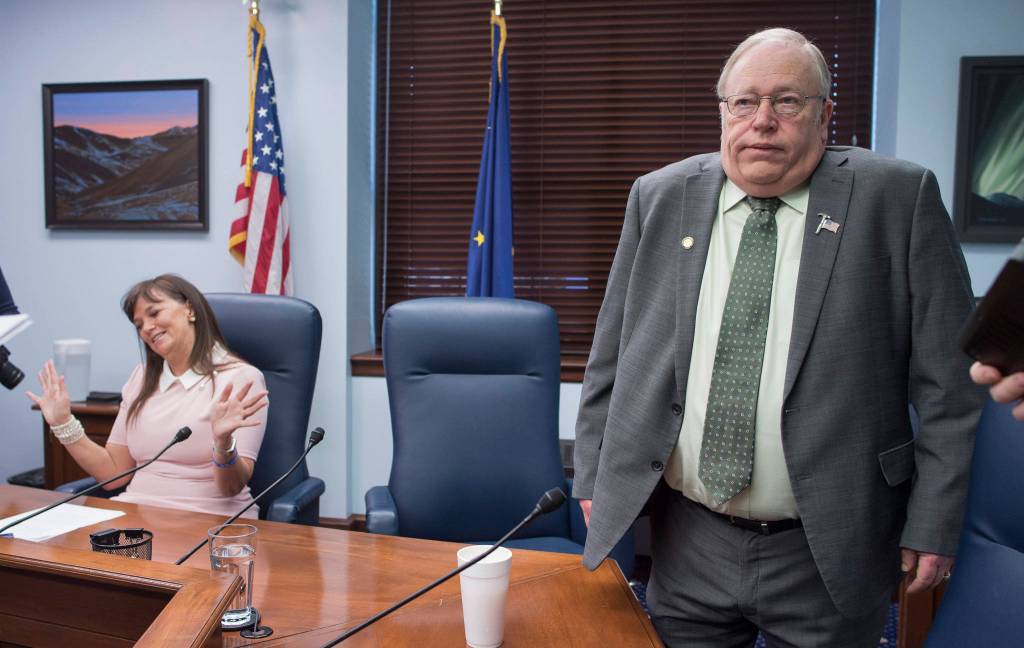
House Majority Leader Charisse Millett, R-Anchorage, left, and former Speaker of the House Rep. Mike Chenault, R-Nikiski, react to reporters questions about the state’s budget during a press conference at the Capitol on Thursday, March 29, 2018. (Michael Penn | Juneau Empire)

House Majority Leader Charisse Millett, R-Anchorage, left, and former Speaker of the House Rep. Mike Chenault, R-Nikiski, react to reporters questions about the state’s budget during a press conference at the Capitol on Thursday, March 29, 2018. (Michael Penn | Juneau Empire)

Alaska state budget remains stalemated in House of Representatives

Four days after narrowly approving a budget amendment that boosts the Alaska Permanent Fund Dividend, the Alaska House of Representatives remains without the votes to advance the state’s operating budget.

The deadlock is expected to continue into next week as lawmakers leave the Capitol for the Easter weekend. At the end of Thursday’s regular floor session, House Majority Leader Chris Tuck, D-Anchorage, adjourned the House until Friday morning.

Speaking in a press conference Thursday morning, House Minority Leader Charisse Millett, R-Anchorage, said the 18-member Republican House Minority is unwilling, thus far, to support the budget.

“For us, right now, the budget is too large for our members to vote for. It doesn’t take into account our ideas,” she said.

House Minority Whip Mike Chenault, R-Nikiski, said the House Majority’s leadership has reached out to members of the minority, but only limited conversations have taken place about getting minority support for the budget.

Those conversations started Tuesday, one day after a deeply divided House voted 21-19 to boost the Alaska Permanent Fund Dividend by restoring the traditional formula.

That increased the expected dividend from $1,250 to about $2,700. (That amount must be confirmed by the Senate and the governor.)

Among the 21 lawmakers voting “yes” were 11 minority members and 10 majority members. (Twenty-one votes is the bare minimum majority in the 40-person House.)

While members of the minority might be willing to approve more spending on dividends, they’re not willing to support more spending on government services, such as transportation, education, schools or health care.

Chenault and Millett pointed out that the budget proposal being considered by the House is larger than the one approved by lawmakers last year.

Meanwhile, the ranks of the House Majority remain divided because the money to pay for the dividend increase will come out of the Permanent Fund, and lawmakers are also looking to pay for government expenses from the fund.

The more money used from the fund on the dividend, the less money available for other things, unless the Legislature approves a new tax — something the Alaska Senate Majority has rejected.

“We were thinking there might be consensus today on a House fiscal plan, but there still isn’t,” said nonpartisan Legislative Finance Director David Teal in a Thursday-afternoon hearing of the House State Affairs Committee.

Last year, when the Legislature failed to agree upon an operating budget until late June, the House passed the state operating budget to the Senate for consideration on March 24. Things are moving even more slowly this year.

Asked whether trouble now could mean smoother votes later in the session, Chenault and Millett were divided.

Millett said unequivocally “yes,” that compromise now with the minority would ease votes later on in the session.

Critically, while passing a proposed budget requires 21 votes, actually paying for it with the Constitutional Budget Reserve (as is expected this year) requires 30 votes. That will require minority support in the House.

Compromise now will make that later compromise easier, she said.

Chenault disagreed. The Senate must still put its stamp on the budget, and there’s no telling if something acceptable today will be acceptable in another month.

“Things can change,” he said.


• Contact reporter James Brooks at jbrooks@juneauempire.com or 523-2258.

More in News

Members of Juneau Education Association and supporters of the union dress in green at the Board of Education Meeting on Oct. 28, 2025. (Mari Kanagy/Juneau Empire)
Teacher’s union speaks on lapsed contract as board members shuffle

Juneau Educators Association’s contract expired at the end of July.

“Tide Pools” is part of the “Landscapes of Southeast Alaska” exhibit by Johanna Griggs, presented by Juneau Arts & Humanities Council. The exhibit will open at the Juneau Arts and Culture Center on Friday, Nov. 7 2025. (courtesy Juneau Arts and Humanities Council)
November’s First Friday: Here’s what to see

Juneau Arts & Humanities Council announces community events at attend Nov. 7.

One of the houses on Telephone Hill stands vacant on Wednesday, Nov. 5. A lawsuit filed against the city Friday seeks to reverse the eviction of residents and halt demolition of homes on the hill. (Mari Kanagy/Juneau Empire)
Telephone Hill residents file lawsuit against city to stop evictions and demolition

The city says legal action is “without factual or legal support.”

“Hair ice” grows from the forest floor in Fairbanks, Alaska. Photo courtesy of Ned Rozell
‘Hair ice’ enlivens an extended fall in Interior Alaska

Just when you thought you’d seen everything in the boreal forest, a… Continue reading

Goldbelt Inc. illustrates a potential cruise ship port and development along the coast of west Douglas Island. (Port of Tomorrow MG image)
Assembly approves one step in Douglas cruise port plan, but pauses next move

Goldbelt’s “new cultural cruise destination” in west Douglas is still years out.

Kelsey Ciugun Wallace, president of the Alaska Native Heritage Center, looks over a collection of frozen sockeye salmon on Oct. 30, 2025. The salmon was donated from the Copper River basin and is part of the collection of traditional Native foods donated for the Yukon-Kuskokwim residents displaced by Typhoon Halong. The salmon and other foods have been stored in a large freezer trailer at the heritage center, pending distribution to families and organizations.
Alaska typhoon victims’ losses of traditional foods go beyond dollar values

A statewide effort to replace lost subsistence harvests is part of the system of aid that organizations are trying to tailor to the needs of Indigenous rural Alaskans

Gov. Mike Dunleavy discusses his new proposed omnibus education legislation at a news conference on Jan. 31, 2025. (Photo by Corinne Smith/Alaska Beacon)
Alaska declares disaster over federal food aid failure, diverts $10 million for temporary help

Following a request by state legislators and similar action by other states,… Continue reading

Yuxgitisiy George Holly and Lorrie Gax.áan.sán Heagy (center left and right) stand alongside Lieutenant Governor Nancy Dahlstrom (left) and other honorees at the Governor’s Arts and Humanities Award ceremony in Anchorage on Oct. 28, 2025. Holly won the Margaret Nick Cooke Award for Alaska Native Arts and Languages, and Heagy won the award for Individual Artist. (photo courtesy of Yuxgitisiy George Holly)
Two Juneau educators win Governor’s arts awards

Holly and Heagy turn music and dance into Lingít language learning, earning statewide arts awards.

Most Read