Governor candidates meet in Juneau debate
Published 11:19 am Thursday, September 6, 2018
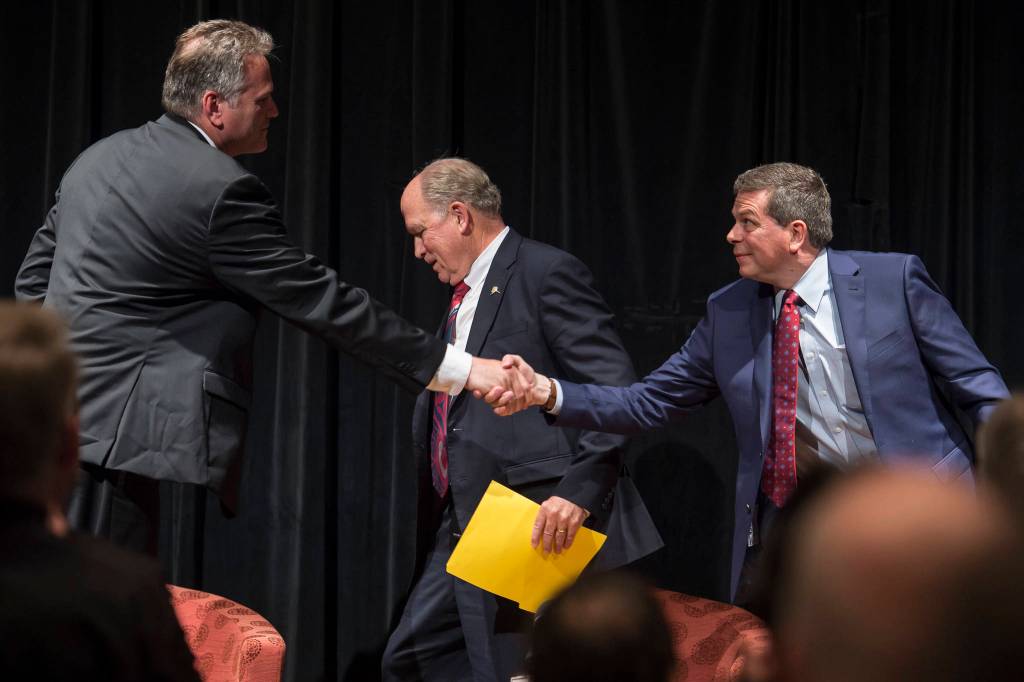
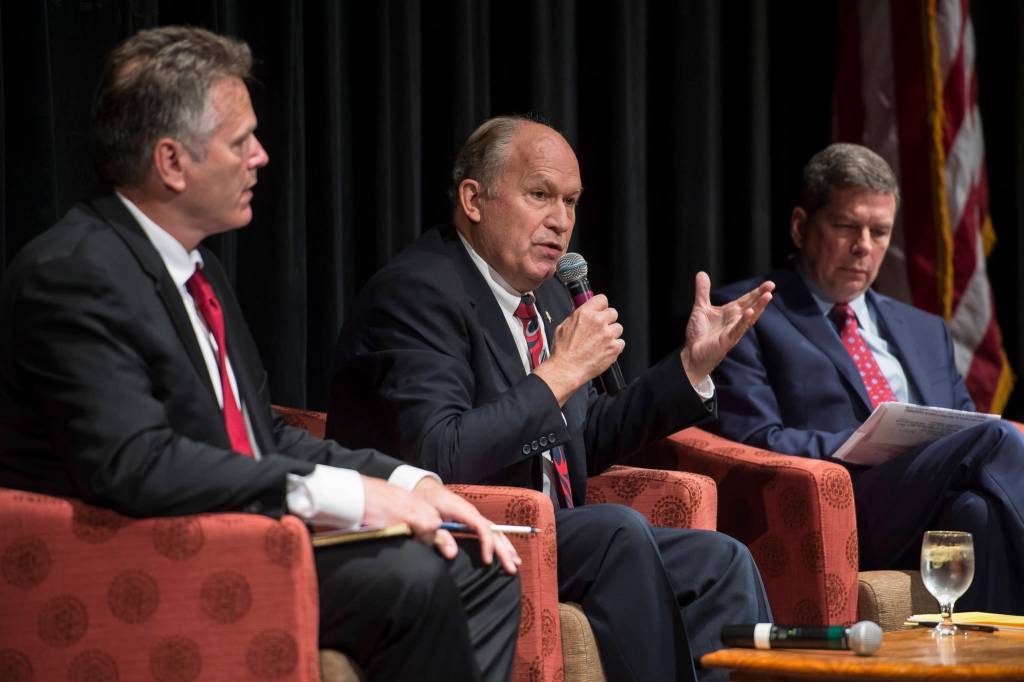
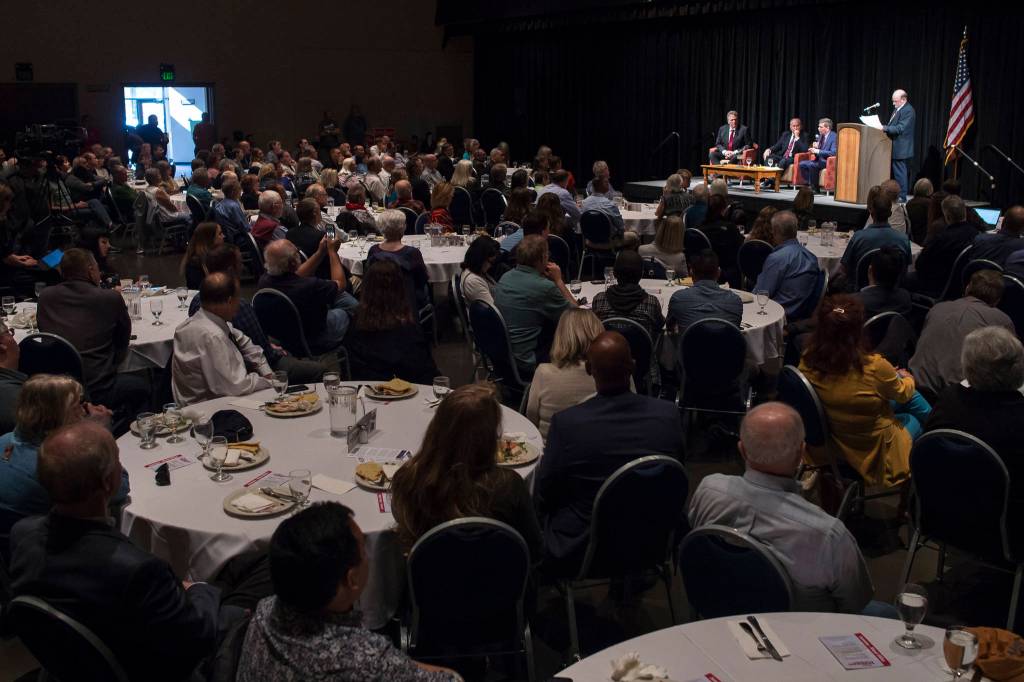
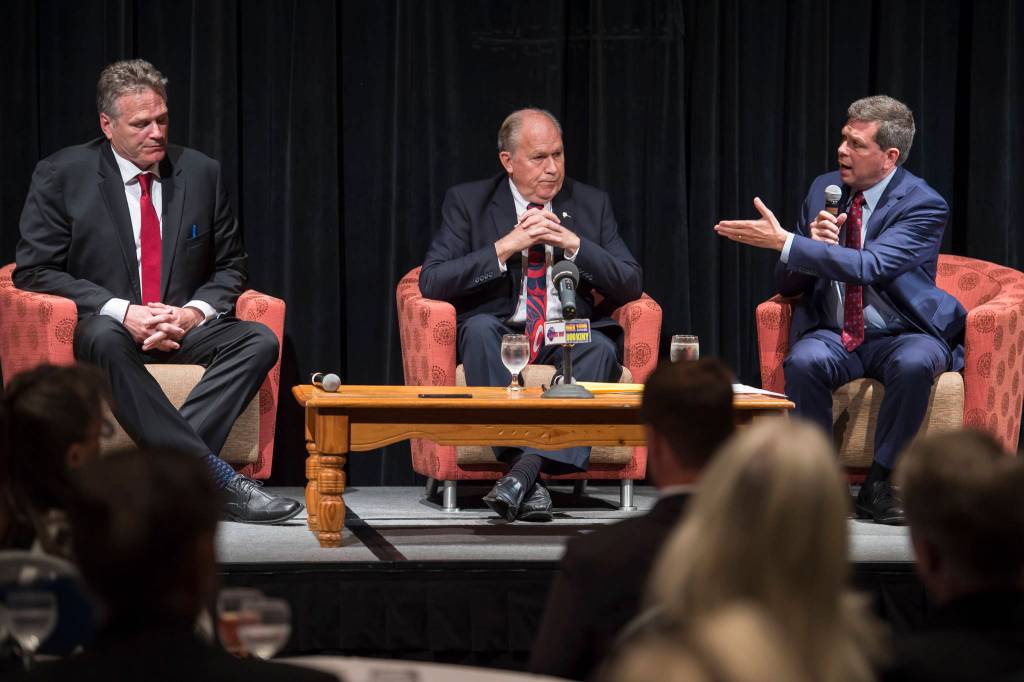
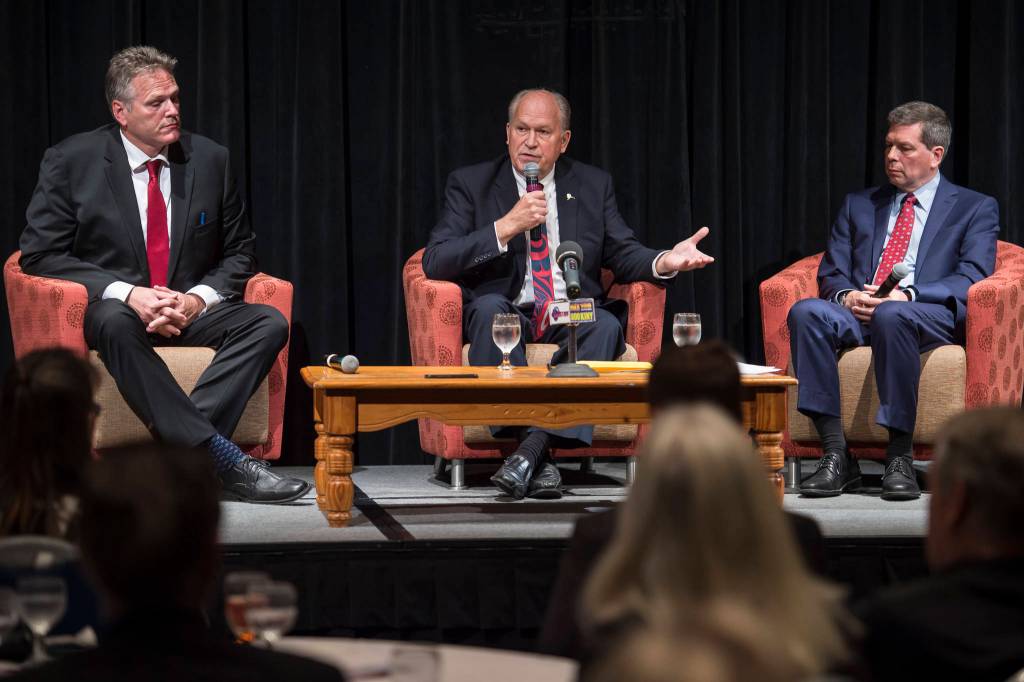


Alaska’s three leading candidates for governor met on stage Thursday for the first time since the three-way race became official.
In an hourlong forum hosted at Centennial Hall by the Juneau Chamber of Commerce and moderated by KINY-AM reporter emeritus Pete Carran, Republican candidate Mike Dunleavy, independent incumbent Bill Walker and Democratic candidate Mark Begich answered questions and occasionally punctured each other with rhetorical barbs.
“Welcome to Alaska’s most popular spectator sport, I would say: The spirited public debate,” Carran said before asking the first question.
The forum was narrowly focused: It didn’t address social issues, and its attention to economic issues was largely confined to the private sector.
On Juneau Access
Asked about construction of a road out of Juneau, Dunleavy garnered the largest round of applause when he said, “one of the first things I would do as governor is reactivate the road project.”
Walker, who canceled construction of the road in December 2016, responded that “my favorite road is it goes to another road,” not one that goes to “a new ferry terminal that hasn’t been built,” as the Juneau Access Project proposal would have done.
“We’ve got to fix our fiscal situation first, then talk about roads that go to roads,” Walker said.
“At this point, I’m not activating that road,” Begich said, then appeared to allude to the Alaska Marine Highway System. “I think there’s a better way to look at the whole transportation network in Southeast.”
Begich also pointed out that federal money intended for the project has now been diverted to other efforts, and finding a replacement might be difficult.
“If you reactivate the road, Sen. Dunleavy, it doesn’t mean it’s going to be built,” Begich said.
Ferry system remarks
Without a road, Juneau will be forced to rely on the Alaska Marine Highway System. Walker said he thinks the idea of an independent ferry authority will be “a step forward” for the agency.
The creation of such an authority, which is envisioned to operate like the state-owned Alaska Railroad, is the work of a reform committee operated by Southeast Conference. Its recommendations have yet to be implemented by the Legislature.
Begich said he doesn’t want to see the ferry system be treated as “second class” and thinks it should receive the same funding attention as the state’s roads and bridges.
“Major deferred maintenance is a problem,” he said.
Dunleavy said he wants to look for efficiencies and will treat it as part of the highway system but appeared to imply that he would encourage higher fares to pay for operating costs.
“Alaska has got to put its resources to work to raise the revenue to continue to pay for services,” he said. “We can’t continue to devolve into a situation where we’re going to take a dollar out of Bob’s pocket and give it to Sue.”
Budget fixes proposed
With regard to the state budget as a whole, Dunleavy said “the enemy of Alaska’s future is an uncontrolled operating budget that just keeps growing.”
He said the state must revise its constitutional spending limit lower and more tightly cap spending.
He compared the state’s 2006 and 2018 operating budgets, explaining that the latest budget is higher than it was 12 years ago.
Walker was quick to point out the flaw of that comparison: It omits a significant spending increase in the late 2000s and the spending cuts instituted by the Walker administration, which arrived to a “fiscal fire,” the incumbent said.
Despite almost $2 billion in budget cuts, the state still has a projected deficit of almost $700 million per year.
“I’ve yet to hear anyone on the stage talk about how we’re going to close the gap,” Walker said.
Begich said his proposal is to transfer most of the unprotected portion of the Alaska Permanent Fund into the constitutionally protected corpus. The investment earnings of that bolstered corpus would be divided 50/50, half to dividends and half to the state’s education budget.
That wouldn’t entirely eradicate the deficit, however.
“We do need revenues, there’s no question about it,” Begich said, referring to a tax.
Begich confronts Dunleavy
The candidates were granted a chance to ask questions of each other, and both Walker and Begich directed theirs at Dunleavy, who has led in three-way polls during the summer.
Dunleavy seemed to struggle answering Begich’s question, which asked how Dunleavy intends to erase the deficit while increasing the Permanent Fund Dividend. This year’s dividend is $1,600 per person, but under the traditional formula, it would have been nearly $3,000 — but cost the state nearly $800 million more.
Erasing the state’s deficit, balancing the budget and paying a full dividend would require budget cuts of about $1.5 billion — almost a third of the state’s entire budget.
“At some point, something is going to give,” Begich said.
Dunleavy said that if the budget “remained in the neighborhood of $4.3 billion” — requiring $200 million in cuts — and oil prices stayed high, and new oil entered the trans-Alaska pipeline system within the next two to seven years, then “we can service that (budget and dividend) for some time going forward with these new finds.”
“You can’t bank on the price of oil,” Begich said, adding that reliance on oil is how Alaska got into its current budget problem.
“Your plan does not have a long-term. It’s a short-term idea,” Begich said.
The Chamber crowd appeared to favor Dunleavy, who arrived early to the event and circulated throughout the room, shaking hands. Dunleavy campaign literature was provided at every table; there was none for Walker or Begich.
The three candidates sat in cushioned armchairs: Dunleavy at stage right, Walker in the middle, Begich at stage left. Carran said before the forum that the arrangement was made to accommodate left-handers, not a statement on the candidates’ political inclinations.
Dunleavy wore a black suit with a dark red tie. Walker wore a black suit with a formline design tie. Begich wore a navy blue suit with a red patterned tie, and a wristwatch with a leather band.
The Libertarian Party’s gubernatorial candidate, Billy Toien, was not invited to the event.
• Contact reporter James Brooks at jbrooks@juneauempire.com or 523-2258.