On The Trails: Some early summer observations
Published 10:30 pm Tuesday, July 8, 2025
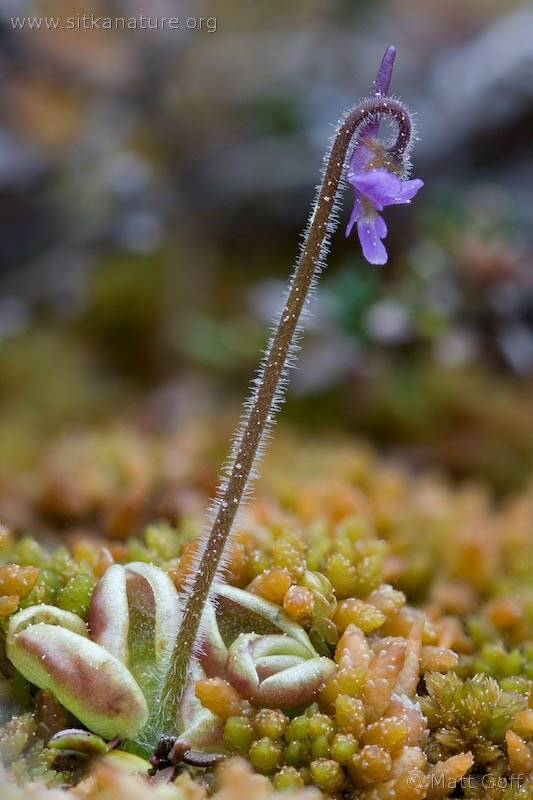
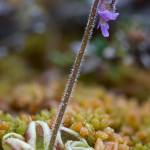
In a recent essay I mentioned our “discovery” of the hairy butterwort in a meadow on the Eaglecrest Road. A good photo would have been useful, since this small plant seems to be uncommon here. Luckily, a photo is now available. Note the hairy stem, the rolled, insectivorous leaves, and the little purple flower.
At the very end of June, with just one monster cruise ship in, a friend and I ventured up the tram in between rain showers. Not intending to go very far, we needed at least a taste of some upper elevations and the serenade of fox sparrows. Although summer hadn’t fully arrived up there, some of the flowers were blooming well. The best shows were narcissus anemones and violets, both yellow and deep purple. Narcissus anemones occur in northwestern North America and Eurasia. The flower has no true petals; the face of the flower is formed by colored sepals (which in most species occur behind the petals) that surround a crowd of stamens. It is reported to be self-fertile, the seeds dispersing on the wind.
Nestled in the trailside vegetation, we spotted a single little frog orchid in bloom, well below the main stand of that species that we often visit. This odd orchid is widely distributed in the northern hemisphere. It is pollinated by bees and other insects but can also self-pollinate. It is reported to form mycorrhizal associations with several kinds of fungi.
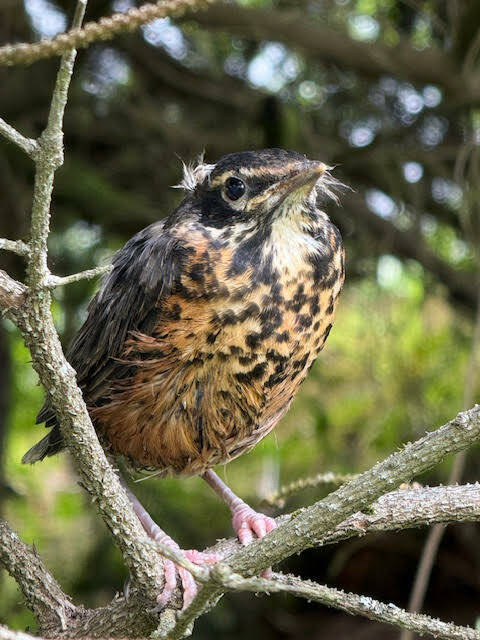
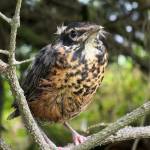
In one of the thickets, I think I heard a robin fussing. That reminded me of yesterday’s walk at Kingfisher Pond. Bird activity there was low, but as my companion and I circled the pond, a robin began to sound a vigorous alarm. Pretty soon we saw the reason for its concern — a young fledgling crouched in the trail. We crept carefully past the kid and hoped that the anxious parent would soon coax it off the trail. I’ve recently seen robin fledglings and juveniles at various stages of development in other locations. A friend shared with me a photo of a juvenile, with its irresistible raffish head plume — the last of the baby fuzz.
By late June along the Point Louisa trail, an understory plant sometimes called sweet cicely (Osmorhiza chilensis) becomes conspicuous, with its developing seeds on long branching stalks. Technically, those are fruits, with lots of maternal tissue around the enclosed seed. Two other species in the genus occur here too, but this one is the most evident. The elongate fruits have tiny barbs at the end and the engaging habit of sticking into fur and soft fabrics (watch your socks!), using critter transport as a means of seed dispersal. Osmorhiza belongs to the taxonomic family Apiaceae — the carrots, angelicas, lovage, et al. Among the local species of that family, Osmorhiza seems to be the only one that uses this method of seed dispersal.
A little farther along that trail, in more open habitats, lupines, yellow rocket (or rattle-pod), and white clover were blooming. I noted that bees seemed to be markedly less active on lupine than on the other two species, and I wondered why.
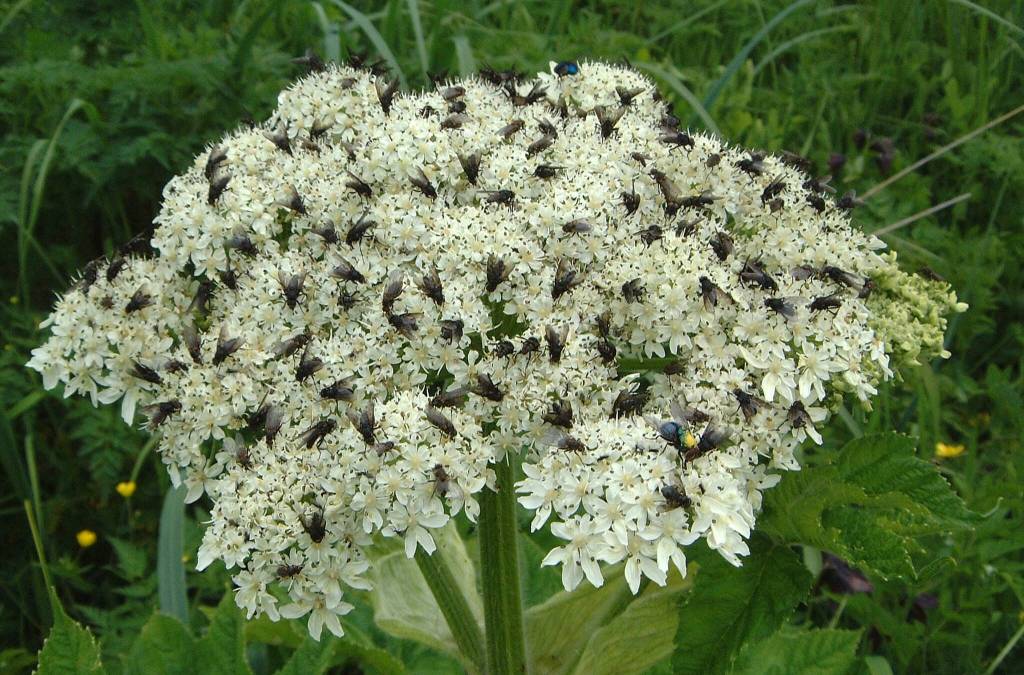
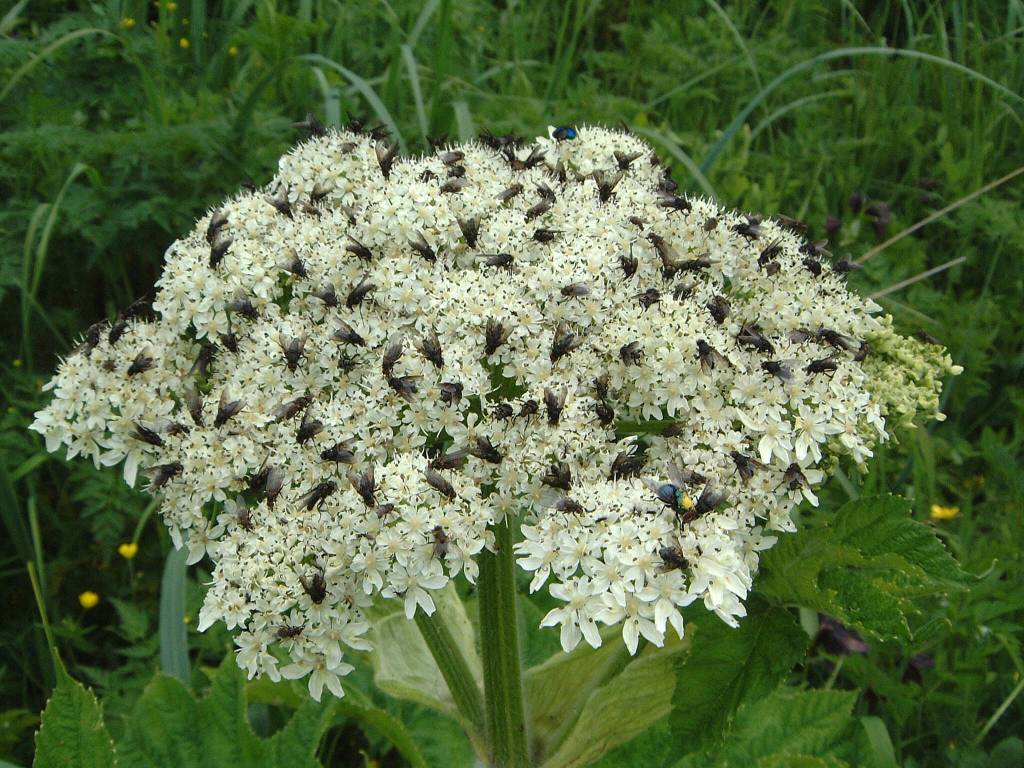
The last half of June and very early July were notable for (among other things) big displays of white flowers. In the open meadows the huge, flat inflorescences of cow parsnip dominated large areas. The flowers are pollinated by small insects that sometimes gather in crowds on the inflorescences.
By the second week of July, many of those inflorescences bear developing seeds. The many graceful little plumes of goatsbeard decorated open areas on some of the trails. The sexes are separate in this species. Inflorescences of males look quite fuzzy, due to the pollen-bearing stamens that stick out of each flower. Female inflorescences look less fuzzy. The inflorescences of both sexes are sometimes thronged by extremely tiny flies — almost invisibly small to our eyes — that crawl over and among the flowers.
Could some of them be those miserable no-see-ums that plague us as the females search for a blood meal? Might they contribute (along with other insects) to pollinating the tiny flowers?
• Mary F. Willson is a retired professor of ecology. “On The Trails” appears every Wednesday in the Juneau Empire.