OPINION: Ranked choice voting in Alaska and ‘Decoy Dan’
Published 12:03 pm Wednesday, July 15, 2026





When Ranked Choice Voting (RCV) was first pitched to Alaskans in 2020, sponsors promised “more choice, more voice and more power to Alaska voters.”
Since its enactment, RCV has mostly produced voter confusion and distrust and now, for the third election in a row, Alaska is making national news because of the preposterous “choices” RCV has given us.
Some of those choices have been doozies.
In Alaska’s first RCV election in June 2022, forty-eight candidates appeared on the special primary ballot to fill out the remainder of Congressman Don Young’s term. One of our choices was “Santa Claus” who netted 7,625 votes
In 2024, RCV gave us the choice of a New York Democrat who was serving a 20-year federal prison term. The convicted felon cruised through the RCV Primary and was one of four candidates on the November ballot. He won 3,558 first-choice votes. Way to go, Alaska!
In 2026, RCV has given us a dizzying selection of candidates and at least two more bizarre choices:
In the race for Governor of Alaska, 17 candidates will appear on the “jungle” primary ballot including former Republican and former Governor Bill Walker. Walker, as most people will remember, suspended his botched 2018 re-election campaign and has drawn the ire of many former supporters for injecting himself in the mix. This will be the fifth time Walker’s name will appear on a statewide ballot. The twisted RCV process combined with the weight of name recognition could easily propel the former failed governor to the general election ballot.
The irony of Bill Walker’s “independent” candidacy is that he likely lures left-of-center votes from Democrats and independent voters equally. This is surely a source of frustration for RCV supporters who are crying for new blood but can’t always control the monster they created.
However, it is this year’s U. S. Senate race which has created the most controversy and turned Alaska’s election system into a national laughingstock.
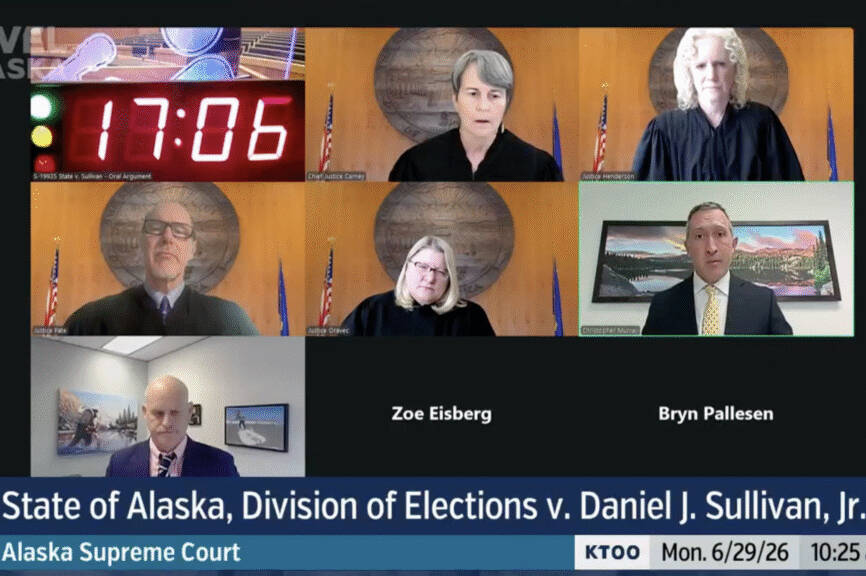
There are 14 candidates on Alaska’s RCV primary ballot for the U.S. Senate seat currently held by Republican Dan Sullivan. One of the candidates, Daniel J. Sullivan, since nicknamed “Decoy Dan” by the press, is a retired teacher from Petersburg. He shares a similar name as our incumbent Sen. Dan Sullivan.
Decoy Dan has never held elective office. He attempted to file his candidacy with a name he hadn’t historically used but more closely resembled his incumbent opponent’s name. His paperwork indicated he was a “Republican,” a party affiliation under which he had never registered.
Decoy Dan’s Declaration of Candidacy was handled by a Democratic operative, and his explanation for how his candidacy evolved is sketchy at best. He entered the race one day before the filing deadline.
While some Democrats have admitted that it’s obvious that Decoy Dan is not a “legitimate candidate” (in the non-legal sense), his legal team argued that even if he is a “sham candidate” he is still qualified under Alaska election laws. They point to previous no-name candidates who have run and were not subjected to this kind of scrutiny. However, they fail to mention this is the first time two Alaskan candidates running against each other have the same name.
It’s unfortunate that our election laws don’t prevent people from running when their motivation isn’t to get elected but to give an unfair advantage to another candidate on the ballot.
And who might that other candidate be? It’s obviously Democrat Mary Peltola, who still has not condemned the stunt nor explained how some of her campaign supporters were involved in it. Not surprisingly, she is also big supporter of jungle primaries and RCV which helped her win Alaska’s sole U. S. House seat in 2022.
Decoy Dan’s appearance on the ballot will surely sow confusion among voters. Which is exactly the point of this RCV-enabled copycat candidate scheme.
How does this increase voter confidence in our election process?
With RCV, there’s just no limit to how low party operatives and candidates can go to game the system and to manipulate the electorate.
It really is time to end the mess.
Vote YES on Ballot Measure 2 to repeal Ranked Choice Voting this November.
Win Gruening retired as the senior vice-president in charge of business banking for Key Bank in 2012. He was born and raised in Juneau and graduated from the U.S. Air Force Academy in 1970. He is active in community affairs as a 30-plus-year member of Juneau Downtown Rotary Club and has been involved in various local and statewide organizations.