
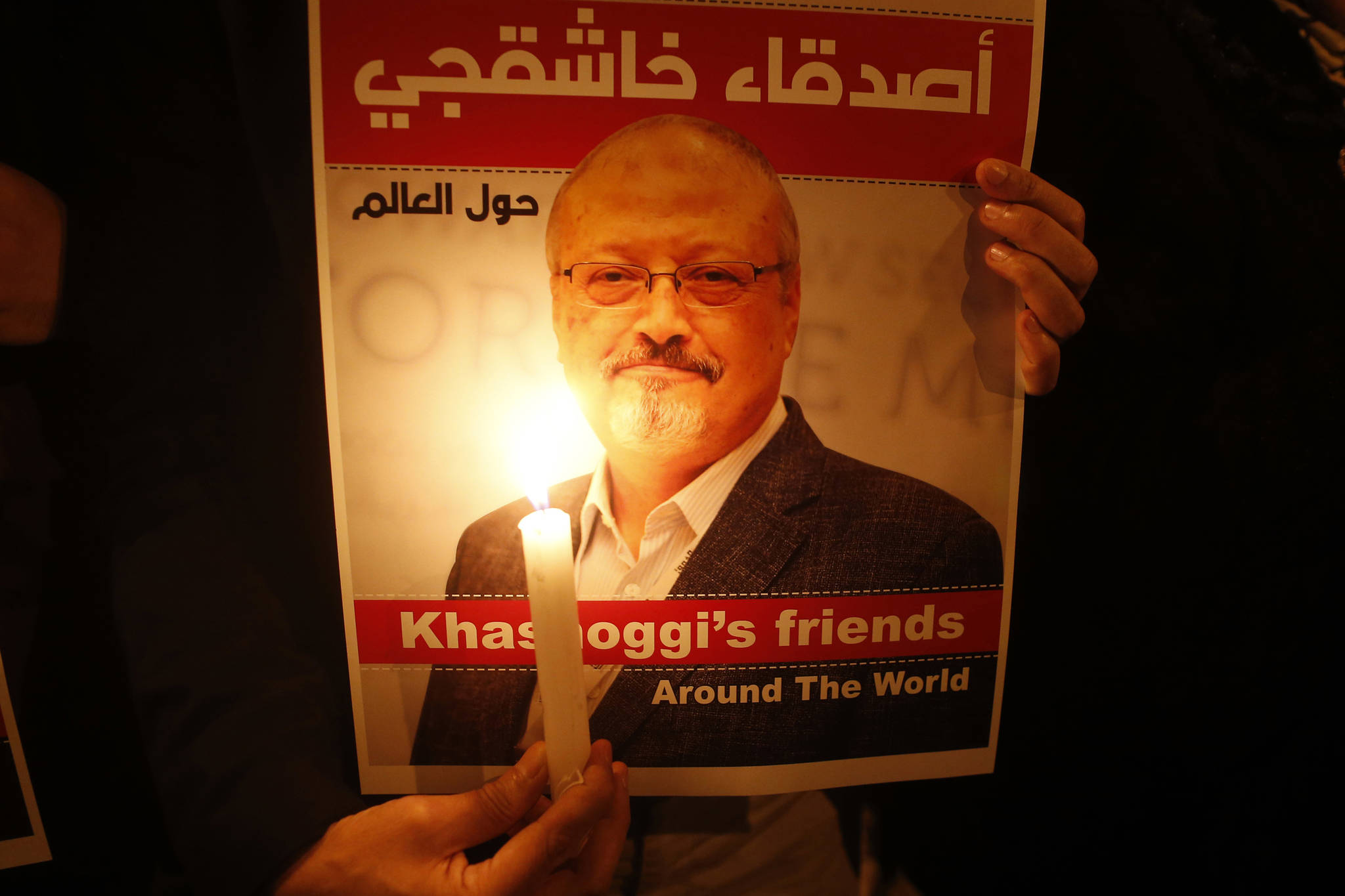
Activists, protesting the killing of Saudi journalist Jamal Khashoggi, hold a candlelight vigil outside Saudi Arabia’s consulate in Istanbul, Thursday, Oct. 25, 2018. The poster reads in Arabic:’ Khashoggi’s Friends Around the World’. A group of Arab and international public, political and media figures are establishing a global association called “Khashoggi’s Friends Around the World”; “to achieve justice for the freedom martyr”.(AP Photo/Lefteris Pitarakis)

Activists, protesting the killing of Saudi journalist Jamal Khashoggi, hold a candlelight vigil outside Saudi Arabia’s consulate in Istanbul, Thursday, Oct. 25, 2018. The poster reads in Arabic:’ Khashoggi’s Friends Around the World’. A group of Arab and international public, political and media figures are establishing a global association called “Khashoggi’s Friends Around the World”; “to achieve justice for the freedom martyr”.(AP Photo/Lefteris Pitarakis)

Opinion: A free press means freedom

The press is not “the enemy of the people.”

The First Amendment to the United States Constitution states, “Congress shall make no law … abridging the freedom of speech, or of the press ….” This basic tenet of life goes back centuries, and some may take it for granted, but it’s not something self-effecting, inviolable or guaranteed to last. Free speech and a free press will persist only if all commit to defend these institutions, and call out those who misguidedly, mistakenly or perniciously seek to undermine them.

Benjamin Franklin wrote, “freedom of speech is a principal pillar of a free government: when this support is taken away, the constitution of a free society is dissolved, and tyranny is erected on its ruins.” This may seem a drastic statement, but recent events make it worth considering.

The press is not “the enemy of the people.” Current trends underscore the urgency of embracing the free press as a good thing, even when stories in newspapers or online, on radio or television, don’t align with one’s personal or group world-view, or criticize a person or policy one supports.

Jamal Khashoggi was a Saudi Arabian citizen living in the United States until he was murdered in the consulate of his own government in Istanbul. Until his untimely death, he wrote a column for The Washington Post in which he commented on political developments in the powerful, rich Kingdom of Saudi Arabia.

Some Americans may wrongly think that what happens halfway around the world doesn’t matter. Saudi Arabia is not a democracy, nor a free or open society. It has no free press, and its residents are denied civil and social rights Americans enjoy as birthrights. Saudi Arabia has been a strong ally of the United States since the Cold War, at times with friction arising from American support for Israel. This alliance by no means prevents our nation from condemning outrageous, barbaric things like the premeditated assassination of Jamal Khashoggi to silence his reasonable criticisms.

Khashoggi went to the Saudi Consulate in Istanbul on Oct. 2 and hasn’t been seen since. After a few days, a growing clamor of international voices demanded to know what had happened. This led to an absurdly inconsistent string of statements and pseudo-explanations by the Saudi government. First it was claimed Khashoggi had left the consulate and walked away a free man.

Then it was said he had died in a fistfight, until acknowledgment his murder had been premeditated. Leaked information from the Turkish government’s investigation revealed a large team on a mission to destroy Khashoggi had traveled to Turkey to murder him and destroy the evidence.

Next a video emerged of a Saudi government functionary dressed in Khashoggi’s clothes with a fake beard, alongside alleged audio-recordings of his torture and killing. White House sources now say the de facto ruler of Saudi Arabia had described Khashoggi as a dangerous terrorist to senior American officials, while the updated Saudi government line is that his death remains a mysterious tragedy.

America’s free press is currently under attack as treasonous and deceitful in response to reporting that some don’t like because of its content. Just because a story is written that contain facts one dislikes doesn’t make it false, nor make its author disloyal or bad. Places where people can’t report the truth are often miserable dictatorships, like Venezuela. It is the height of childish immaturity to call the author of news that one dislikes a liar or a traitor. The mature, civilized response is to rebut others’ objectionable assertions with facts of one’s own, which does however require said facts to be objectively verifiable. Departing from this time-honored system of debating the news abandons the very essence of our democracy.

Certainly some media outlets and some individual journalists have biases, on both ends of the political spectrum. But for those at one end to call those at the other dishonest and deserving of punishment takes journalism to such a low level that it imperils its existence. And then what happened to Jamal Khashoggi in Turkey becomes alarmingly possible for reporters, or anyone else, here in the United States. We are all compelled and duty-bound to prevent this dreadful outcome from ever coming to pass.


• Benjamin Brown in a lifelong Alaskan, and an attorney, who lives in Juneau.


More in Opinion

Web
Have something to say?

Here’s how to add your voice to the conversation.

Northern sea ice, such as this surrounding the community of Kivalina, has declined dramatically in area and thickness over the last few decades. Photo courtesy Ned Rozell
20 years of Arctic report cards

Twenty years have passed since scientists released the first version of the… Continue reading

Dr. Karissa Niehoff
OPINION: Protecting the purpose

Why funding schools must include student activities.

A sign reading, "Help Save These Historic Homes" is posted in front of a residence on Telephone Hill on Friday Nov. 21, 2025. (Mari Kanagy / Juneau Empire)
OPINION: The Telephone Hill cost is staggering

The Assembly approved $5.5 million to raze Telephone Hill as part of… Continue reading

Win Gruening (courtesy)
OPINION: Eaglecrest’s opportunity to achieve financial independence, if the city allows it

It’s a well-known saying that “timing is everything.” Certainly, this applies to… Continue reading

Gov. Mike Dunleavy gestures during his State of the State address on Jan. 22, 2026. (Photo by Corinne Smith/Alaska Beacon)
OPINION: It’s time to end Alaska’s fiscal experiment

For decades, Alaska has operated under a fiscal and budgeting system unlike… Continue reading

Atticus Hempel stands in a row of his shared garden. (photo by Ari Romberg)
My Turn: What’s your burger worth?

Atticus Hempel reflects on gardening, fishing, hunting, and foraging for food for in Gustavus.

At the Elvey Building, home of UAF’s Geophysical Institute, Carl Benson, far right, and Val Scullion of the GI business office attend a 2014 retirement party with Glenn Shaw. Photo by Ned Rozell
Alaska Science Forum: Carl Benson embodied the far North

Carl Benson’s last winter on Earth featured 32 consecutive days during which… Continue reading

Van Abbott is a long-time resident of Alaska and California. He has held financial management positions in government and private organizations, and is now a full-time opinion writer. He served in the late nineteen-sixties in the Peace Corps as a teacher. (Contributed)
When lying becomes the only qualification

How truth lost its place in the Trump administration.

Jamie Kelter Davis/The New York Times
Masked federal agents arrive to help immigration agents detain immigrants and control protesters in Chicago, June 4, 2025. With the passage of President Trump’s domestic policy law, the Department of Homeland Security is poised to hire thousands of new Immigration and Customs Enforcement (ICE) agents, and double detention space.
OPINION: $85 billion and no answers

How ICE’s expansion threatens law, liberty, and accountability.

Yereth Rosen/Alaska Beacon
The entrance to the Alaska Gasline Development Corp.’s Anchorage office is seen on Aug. 11, 2023. The state-owned AGDC is pushing for a massive project that would ship natural gas south from the North Slope, liquefy it and send it on tankers from Cook Inlet to Asian markets. The AGDC proposal is among many that have been raised since the 1970s to try commercialize the North Slope’s stranded natural gas.
My Turn: Alaskans must proceed with caution on gasline legislation

Alaskans have watched a parade of natural gas pipeline proposals come and… Continue reading

Win Gruening (courtesy)
OPINION: Juneau Assembly members shift priorities in wish list to Legislature

OPINION: Juneau Assembly members shift priorities in wish list to Legislature