
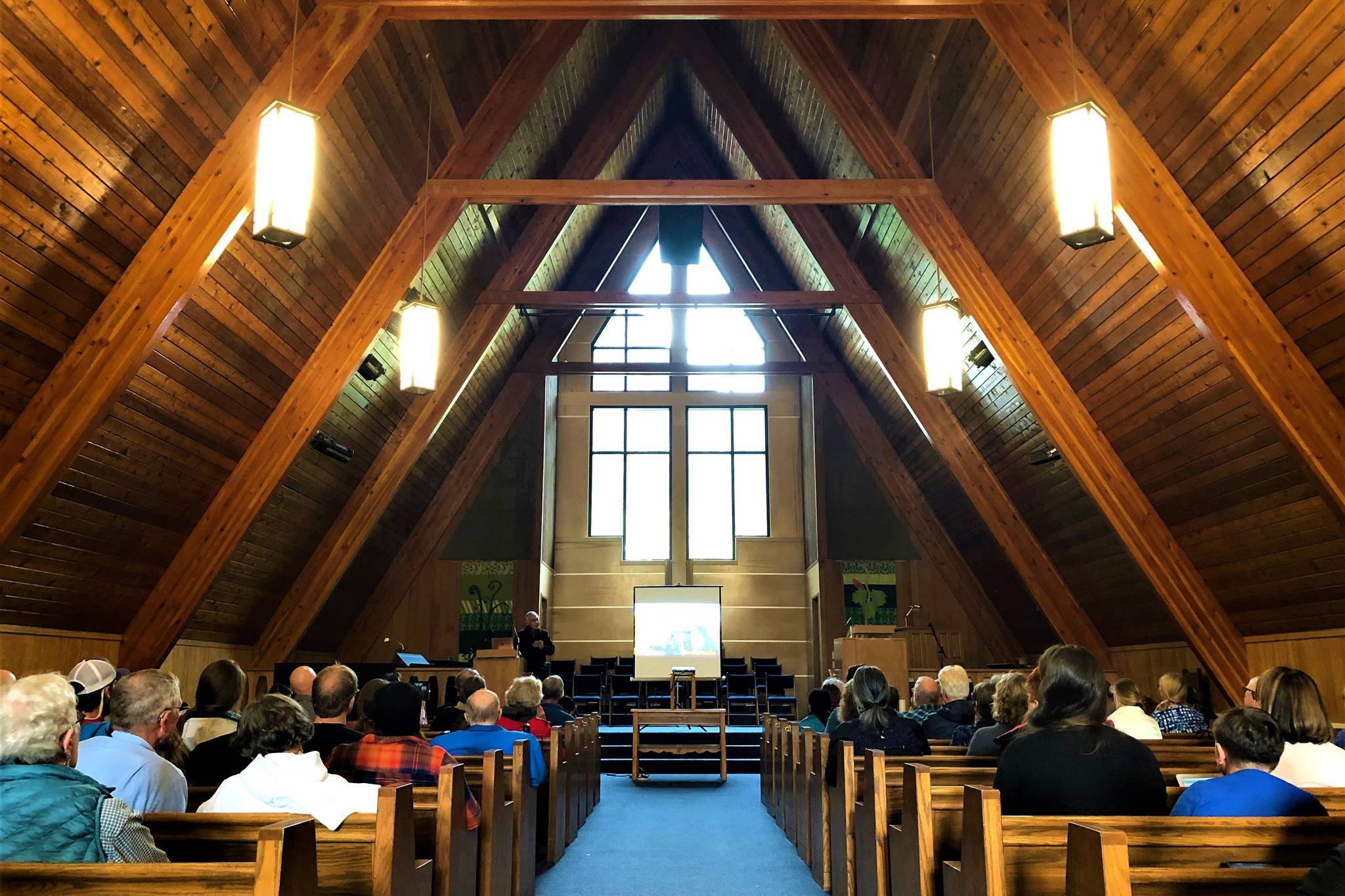
Five Alaska Native leaders shared their thoughts and experiences on climate change in Alaska and abroad beneath the vaulted ceilings of Northern Light United Church in downtown Juneau Thursday evening.
“In my life of 50 years, I have seen changes,” said Melanie Brown, a Yupik leader and commercial fisherman told the crowd.
Brown spent her summers in Bristol Bay where her mother is from and she returns there yearly to fish with her family.
“Things are shifting,” she said.
Brown said that the cyclical patterns of nature she’d observed growing up, which for years had remained fairly consistent, had begun to change.
“You can harvest blueberries in July, now,” she said, something she attributed to the warmer weather.
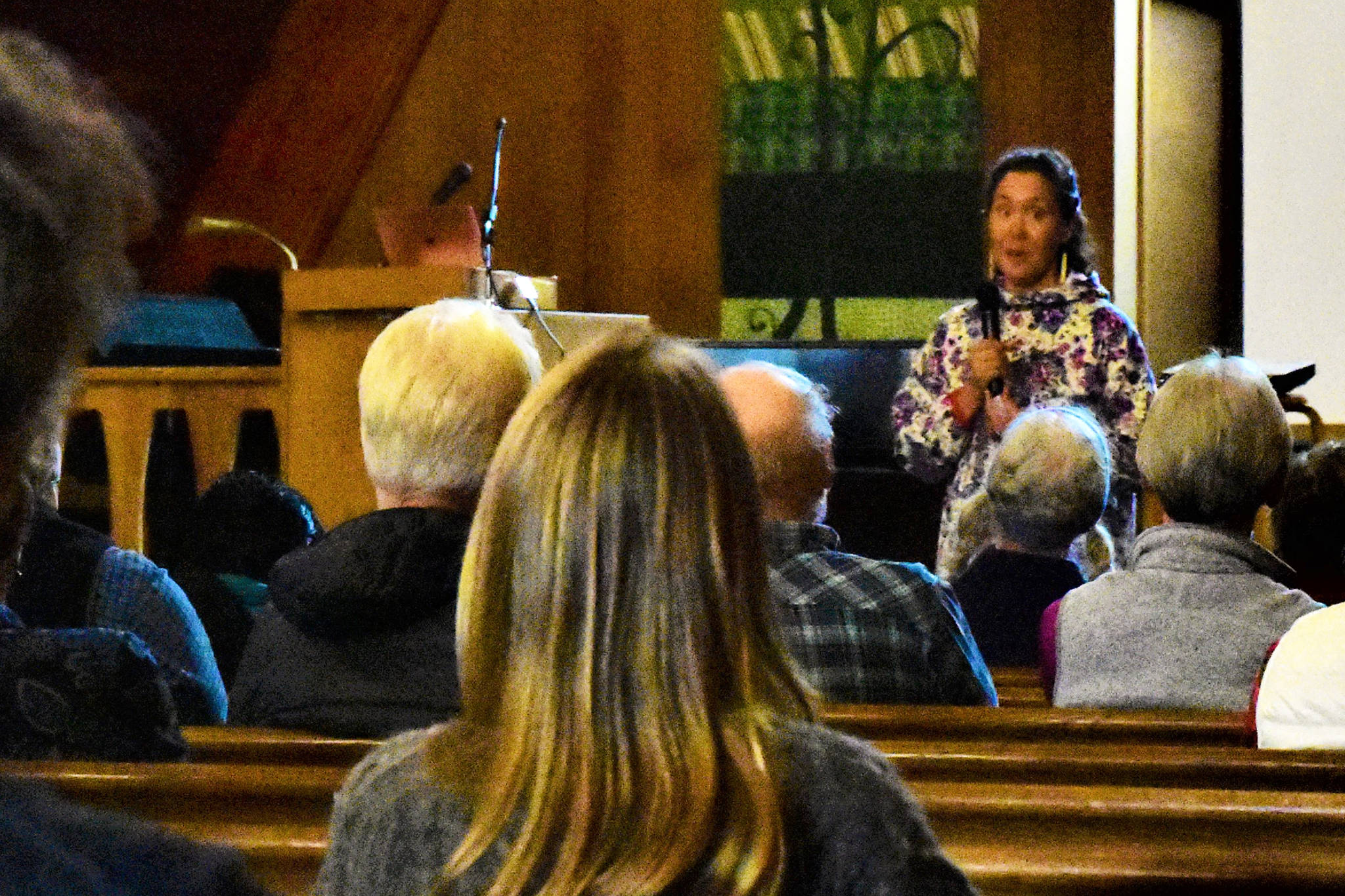
Melanie Brown speaks at Northern Light United Church in Juneau during the “Climate Change Through the Eyes of Alaska Natives,” forum on Sept. 12, 2019. (Peter Segall | Juneau Empire)
This July was Alaska’s hottest on record, according to the National Oceanic and Atmospheric Administration.
In a similar vein, Heather Evoy, a Tsimshian and Tlingit leader from Ketchikan, talked about how one of her favorite childhood memories was collecting shellfish with her grandmother.
But due to ocean acidification, this was something she worried she wasn’t going to be able to share with her 9-year-old son.
Lower pH levels in ocean water make it difficult for shellfish to properly form their shells, an issue which could have profound implications on Alaska’s seafood industry, according to the Alaska Ocean Acidification Network.
Each of the five speakers shared how they had seen the environment change in Alaska throughout their lives, often in ways which were threatening to traditional Native practices. The speakers who addressed the audience were, Rev. Charles Brower, Brown, Evoy, David Katzeek and Ilarion “Larry” Merculieff.
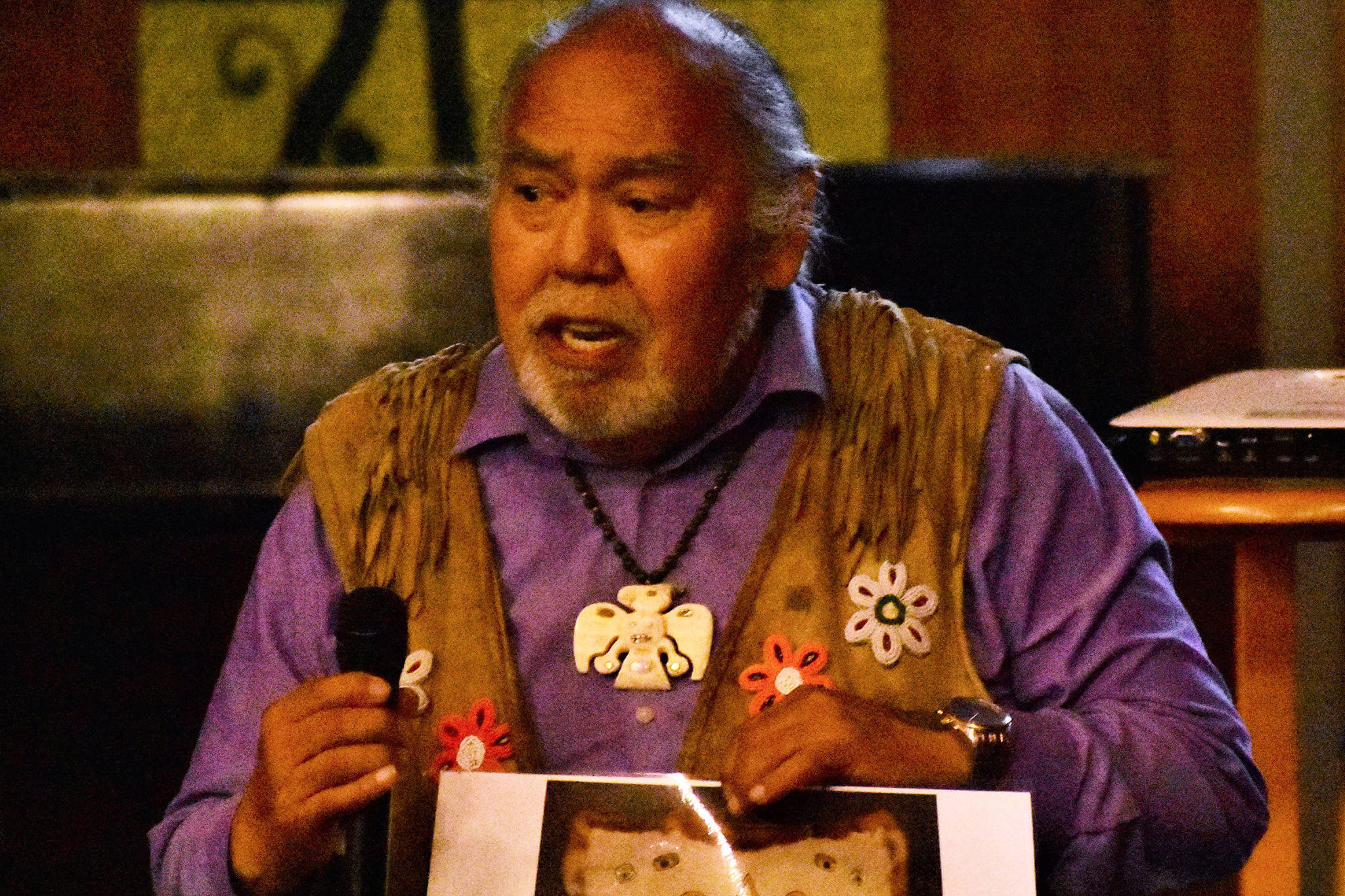
Rev. Charles Bower speaks at Northern Light United Church in Juneau during the “Climate Change Through the Eyes of Alaska Natives,” forum on Sept. 12, 2019. (Peter Segall | Juneau Empire)
Brower, an Inupiaq elder from Barrow and professional whaler, showed the audience pictures of 12-foot deep holes dug into the ground traditionally used for food storage.
“Now you can find water at the bottom of some of the pits,” he said. “If someone hadn’t come to check on the food it would have spoiled.”
The speakers were brought together by Alaska Interfaith Power and Light (AIPL), the local affiliate of an a environmentally focused religious nonprofit based in Oakland, California.
AIPL has been hosting a number of climate change-themed events in Juneau over the week, as have a number of other environmental organizations.
The week of activism is meant to coincide with the International Forum of Sovereign Wealth Funds taking place this week at Centennial Hall. That forum is being hosted this year by the Alaska Permanent Fund Corporation. Sovereign wealth funds are state-owned investment funds similar to the Alaska Permanent Fund. Like Alaska, many of those nation’s funds have significant investments in fossil fuels.
[Gov says warming Arctic could be good for Alaska]
Katzeek, who teaches Tlingit language and culture to students in the Juneau school district as well as at the University of Alaska Southeast, began his speech in Lingít, the Tlingit language, before switching to English.
“What you’re hearing from me is not any kind of special wisdom because I’ve been here,” David Katzeek said “It’s what my grandparents told me.”
He told the crowd that climate change was the result of egotistical thinking on the part of those in society who felt that they owned and had the right to do what they pleased with the planet.
“All the stuff that’s happening out there is the result of egotistical thinking, regardless of the color of your skin, the language you speak. It has its consequences,” Katzeek said.
Last to speak was Ilarion “Larry” Merculieff. Merculieff was the first Alaska Native commissioner of the Alaska Department of Commerce and Economic Development. He has served, either currently or previously, in a leadership capacity in a number of other organizations.
Merculieff said that in his Unangan culture, people didn’t view themselves as apart or distinct from the natural world. They didn’t consider themselves any higher or lower than any other animal. It was when people started to see themselves as above animals that “they lost their way,” he said.
“Mother Earth’s life-support systems are coming to the edge, we’ve got very little time left,” Merculieff said. “This is the generation that’s going to decide if human beings are going to be here. That’s quite a responsibility.”
Check out the Empire’s live coverage here.
• Contact reporter Peter Segall at 523-2228 or psegall@juneauempire.com.
