
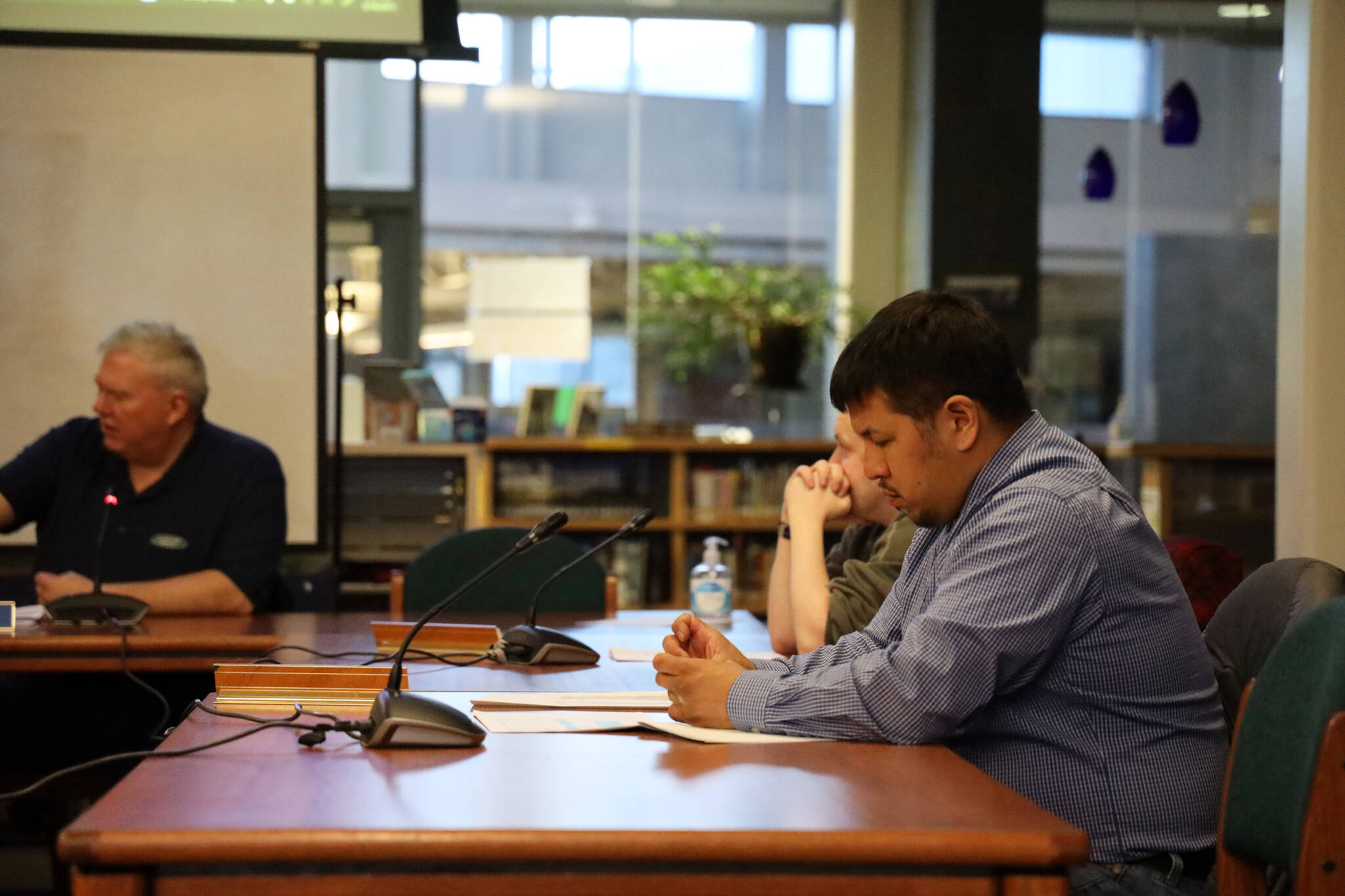
The Juneau School Board is banking on the state to increase the base student allocation — the amount per student that school districts receive in state funding — by $430 and finalized its upcoming $96.2 million budget at its Tuesday night meeting to reflect that.
However, even after agreeing to pass the budget, board members and district administrators expressed near-certainty that the district’s actual spending plan may differ drastically from what was decided on Tuesday night.
“This is all working on assumptions, and if we don’t end up passing a BSA and having it signed into law or overturning a veto, all of this means almost nothing,” said Emil Mackey, board vice president. “But, with the information we have today, it’s still important that we prioritize our true priorities and values.”
Overall, the district — along with most other districts across the state — has been facing growing financial restraints in recent years due in part to the BSA remaining essentially unchanged since 2017, all while costs continue to go up, enrollment in Juneau continues to decline and funding aids like the Elementary and Secondary School Emergency Relief Fund, a COVID-era funding source that provided $1.6 million in funding for this budget, near expiration.
Going into this budget process, the district was facing a $4.7 million deficit which had to be resolved and balanced.
Here are key takeaways for what the budget looks like — for now.
— It’s built around an anticipated BSA increase of $430
A $430 BSA increase would equate to around $3.3 million more dollars to be allocated to the district.
The district’s decision to land on an expected $430 increase — a total BSA of $6,360 — is considered to be a modest guess compared to some of the more dramatic increases being proposed by lawmakers like the senate majority which is pushing for a $1000 increase (17%) and the House Minority which is pushing for an even more ambitious $1,250 increase (21%.)
On the other hand, Gov. Mike Dunleavy, a Republican, has outlined an increased BSA of $30 included in his proposed budget.
If the Legislature fails to push the BSA up to the district’s $430 assumption, the district would still be able to revise the budget in the coming months in an attempt to resolve the shortfall, but the revisions could require millions of dollars to be cut.
The budget finalized Tuesday night has a $1.1 million fund balance remaining, an amount that fulfills the board’s policy to maintain a fund balance minimum of 1.5% of the year’s expenditures and outgoing transfers. That amount could potentially be used to ease some of the shortfalls if one were to occur.
The budget decided on Tuesday now goes to city officials for approval. The district won’t have a clearer picture of the BSA until later this spring. The budget, whether it is changed or remains the same, will be implemented starting July 1.
— It prioritizes maintaining the current teacher-pupil ratio
Throughout the entire budget-making process, which has been ongoing since November, board members have expressed a priority to either maintain or lower the number of students per teacher in each classroom across the district, a calculation commonly referred to as the teacher-pupil ratio, or PTR.
On Tuesday night, the board made the decision to move forward with that priority and budgeted to maintain all current PTR ratios across the district, with one exception: fourth and fifth grades will have their ratio reduced from 28 students per teacher to 26 students per teacher.
— It expects a small increase in enrollment
The district expects a slight enrollment increase of 12 students for a total of 4,240 students across the district.
Even with this year’s projected increase, however, the district’s enrollment in the coming years is not projected to head in the same direction. According to future enrollment projections, the district is estimated to see its current enrollment number decline by more than 1,000 students by 2032.
[A schooling in subtraction: Report projects drop in Juneau’s student enrollment over next 10 years]
— It cuts a handful of positions
Positions cut included six elementary school library assistant positions, along with removing a currently vacant position that was a part of the STEAM science, technology, engineering program.
— It relies on city support
The budget also relies on the City and Borough of Juneau to fund the district to the maximum amount it is allowed to contribute.
“We’d been doing it pretty much forever,” said City Manager Rorie Watt. “Juneau has historically always funded schools to the cap — it’s pretty normal.”
Last year, that amount was around $28.4 million, and according to Watt, this year’s amount is expected to be that plus an additional $2.5 million, an amount added to reflect the increased full and true value of properties in the city which the cap is based on.
The budget is also banking on the city to fund out-of-cap funding requested by the district, which is an additional $2.5 million request.
• Contact reporter Clarise Larson at clarise.larson@juneauempire.com or (651)-528-1807. Follow her on Twitter at @clariselarson.
