
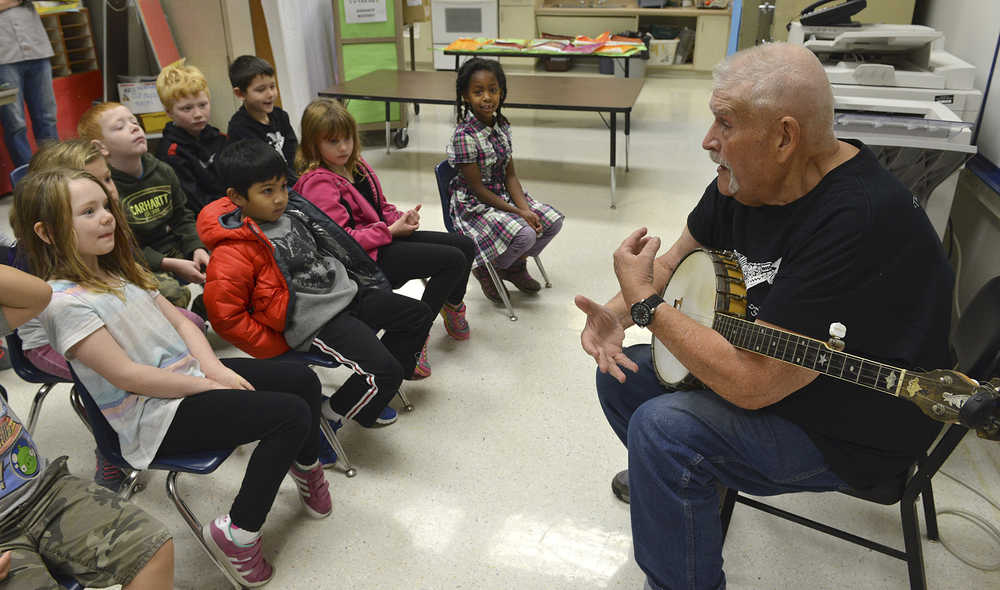
SITKA — “You’re in good voice today!”
It may be one of the best compliments that chanteyman Don Sineti can give out after he invites audiences to join him for choruses of “Barett’s Privateers” or “Rolling Down to Old Maui” or even a couple of verses of “This Land is Your Land.”
Sineti performed a family concert at one of the final events in Sitka’s annual WhaleFest. The concert was a combination of traditional songs, sea chanteys, songs of the sea as well as folk songs.
“Songs that people can join in on, and that kids will like,” Sineti said.
At his concerts, Sineti also provides some background about seafaring traditions and answers questions.
Sineti has been performing and giving talks at the elementary schools, preschools, the Pioneers Home, Swan Lake Senior Center and the Sitka Rotary Club meeting. He also led the squid dissection lesson with students at Keet Gooshi Heen Elementary.
Sineti first came to Sitka in 1998 for the second year of WhaleFest, and has returned every year but one since then.
His home base is Mystic Seaport, the Museum of the America and the Sea, in Connecticut, where he works in the Department of Interpretation specializing in sea chanteys. He also performs at schools, pubs, retirement centers, “kind of a wide number of venues.”
Music has been a part of Sineti’s life since he was young. He played clarinet in the high school band, but got involved in the folk music scene when it was becoming popular.
“When (folk music) came out, I just loved it,” he said. Some of the folk songs popularized, and “modernized,” by the Kingston Trio and groups like it were songs of the sea and chanteys.
As he was becoming more interested in folk music, he met Stan Hugill, the last living chanteyman who worked on a major ocean sailing vessel at the end of the age of sailing.
“I met him at a yearly sea music festival, which he came to every year until he passed,” Sineti said.
Sineti said he was performing folk songs at the festival in Mystic 24 years ago when he drew Hugill’s attention.
Hugill said he didn’t know what Sineti was doing for a living, but said, “whatever you’re doing you’ve got to stop doing it, and work here full time.”
“He felt I had the perfect voice for singing sea chanteys. Clarity and volume is more important than tonal beauty,” Sineti said.
“Take that as a compliment,” said Dave Moore, who was accompanying Sineti on his school visits. Moore, a former commanding officer of Coast Guard Air Station Sitka, can attest to the value of the chanteyman from his experience as a cadet at the U.S. Coast Guard Academy at New London, Connecticut.
Sineti said there’s a difference between chanteys — which are always sung a cappella — and traditional songs of the sea. Part of the training at the academy includes working as crew aboard the academy’s tall ship, the sailing barque Eagle.
“I was a fresh Iowa farm boy on the sea, we did a number of courses on the Eagle,” Moore said. “On the second or third cruise we had a chanteyman. The first time we set sail he started making noise, and we were thinking, ‘Stop that music! We’re trying to work.’ But at the end of the cruise, if the chantyman wasn’t there we weren’t hauling on the lines – the chanteyman was that important. We loved the chanteyman.”
And that’s the purpose of the chanteyman, said Sineti, who loves telling audiences that on a sailing ship one chanteyman is said to be worth 10 other men.
Sineti explained that the difference between chanteys and songs of the sea is that chanteys are strictly working songs, which you don’t sing unless you’re working, with specific songs paced to each particular activity, such as raising the anchor or hoisting sails. They’re always sung without any instrumental accompaniment.
Songs of the sea are ballads, and they cover a wide range of subjects, he said.
“Battles, the relationships with people in the harbor … it was a wide brush they painted with,” Sineti said. “Popular songs of the era — minstrel songs — songs from other lands, from the people on board the vessels: Afro-Cuban, Afro-American, Native American, Hawaiian.”
Sineti knows hundreds of tunes, and varies his Sitka show every year. One thing that doesn’t change is the multitude of opportunities for the audience to join in.
