
By Mary F. Willson
A visit to the lower reaches of the Herbert and Eagle rivers usually turns up something of interest.
A recent warm spell meant that looking for critter tracks in snow would be a vain endeavor. However, the sands were well-decorated by several animals.
Deer tracks old and new went every-which-way. One trackway went right to the last bit of sand and disappeared, so that deer probably swam the river. Maybe it took advantage of the current to arrive at some point well downstream. There were mink tracks and a good print of a small otter. Beavers had trekked back and forth over the sand bar, one of them recently toting a twiggy branch that left a well-defined pattern. Local beavers had a big cache of small branches for feeding little, growing kits through the winter.

A likely orphaned black bear cub forages for roots near a popular recreation area in Juneau. (Courtesy Photo / Denise Carroll)
Perching on a convenient log and pulling a snack from a backpack had the often-predictable result of attracting a black-feathered opportunist. This raven was obviously an experienced moocher and stood expectantly less than fifteen feet away. So the snack was shared. As experienced as that bird was, it approached tidbits tossed only three feet away with the characteristic sideways hops, ready for a quick dash to safety if needed. Just as the supply of snacks ran out, another raven came in and missed the fun.
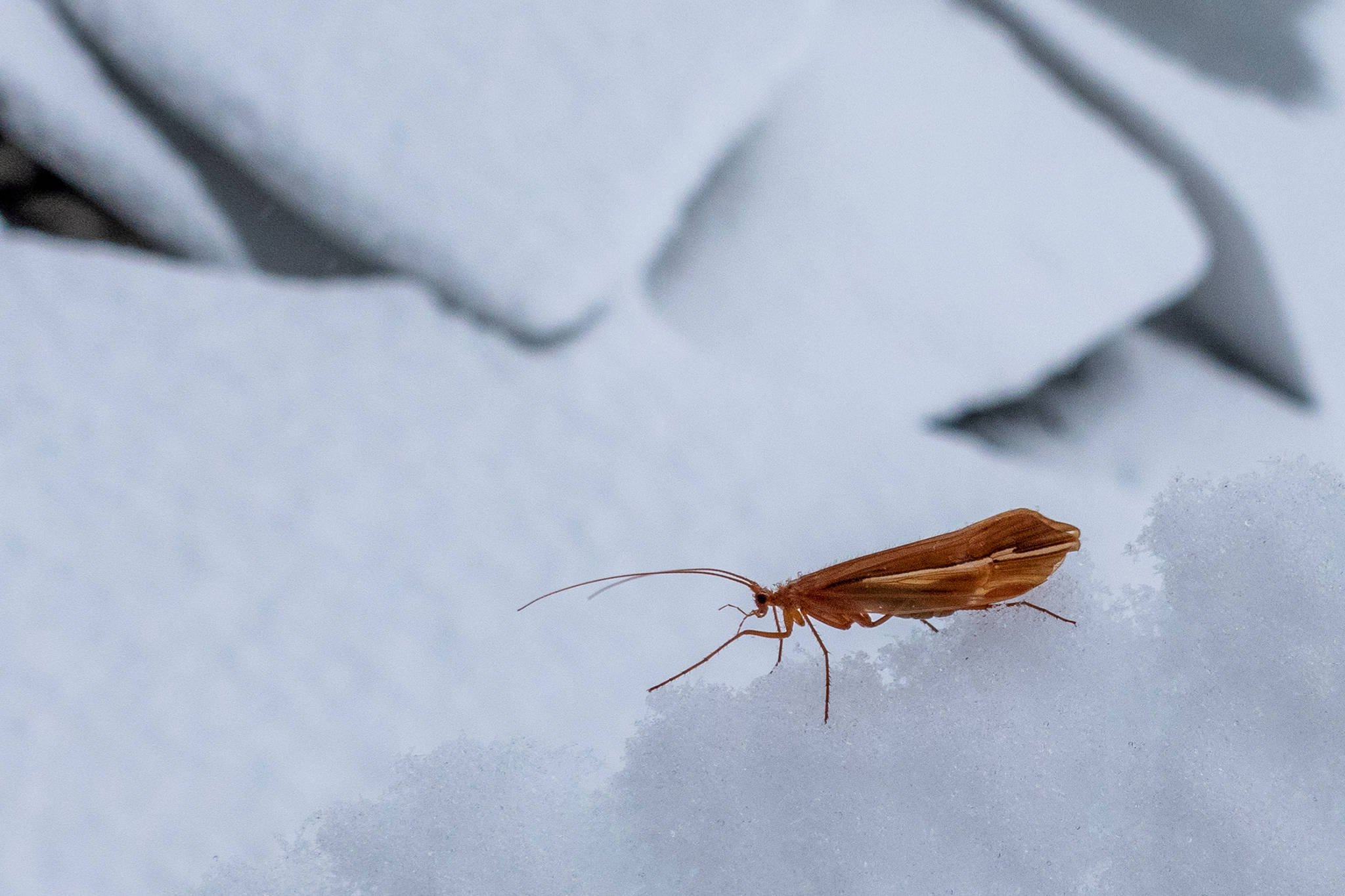
The west side of Mendenhall Lake caught the brunt of some very strong winds in early December, piling up big plates of broken ice. I went back out there a week later, when a light snowfall had brightened everything. The ice plates were still there, but this time one of them featured the only wildlife seen on that walk: a caddisfly. One of the big chunks of ice was tilted up, and the critter was walking down the steep edge. As it did, a small bit of ice broke off below its feet — I like to think that the insect kicked it off. Someone said it looks like the critter is climbing down its own Denali.
This caddisfly has a name (probably Psychoglypha subborealis) and a nickname (snow sedge). It is winter-active: both males and females have been found at times of very cold temperatures—as low as minus twenty or thirty degrees Centigrade, having emerged from their freshwater larval stage in the fall. When they emerge, they are adult in form but sexually immature. They mature gradually during winter, using up stored body fat in the process and females developing their eggs. They mate and lay eggs (in open fresh water) in early spring, and then apparently die, after a life span of roughly six months.
This caddisfly is not unique among insects in having a life history involving winter activity, but there are not many spend an entire phase of their life history in winter. I wonder about the ecological pressures that led to the evolution of such an unusual habit. Certain kinds of stoneflies customarily emerge, as adults, from fresh water streams in late winter, as soon as the streams aren’t completely covered with ice. Temperatures are often below freezing, but these winter stoneflies have ways to cope with the cold. They are interested in mating at that time, maybe getting a head start for their larvae in the streams?
[Twice-told tales —Juneau style]
On a group hike to Crow Point and Boy Scout beach in mid-December, when there was nice, fresh snow on the ground, I found some mouse tracks, a vole highway between grass clumps and some wanderings, and a set of squirrel tracks. Weasel tracks were all over the place—maybe hunting was not-so-good and lots of searching was needed? Or are there lots of weasels out there? We watched a small black bear cub in the tall grass, where it was digging persistently for some time, apparently finding edible roots. There have been reports of an orphaned cub in this area (and elsewhere), and this one was all alone. However, it seemed to be fending for itself reasonably well, and although it was not very chubby, we hoped it could eventually hibernate successfully.
Thanks to John Hudson for caddisfly info.
• Mary F. Willson is a retired professor of ecology.“On The Trails” is a weekly column that appears in the Juneau Empire every Wednesday.
