
By Mary F. Willson
For the Juneau Empire
Many kinds of bird regularly forage for prey underwater.
These birds have a variety of ways of doing so and adaptations to match. Life in the water is very different from life in the air.
The first hurdle to overcome is simply getting there. Some species start from the water surface. A few are able to just sink below the surface by decreasing their buoyancy: small grebes and anhingas do this by compressing the plumage (thus pushing air out) and exhaling. Others tuck their heads and kick with their webbed or lobed feet (e.g., mergansers, goldeneyes, buffleheads, most cormorants, loons, and some grebes) or flip their wings (murres, long-tailed ducks, dippers). Those that surface-dive a lot (e.g., loons) typically have legs set well back on the body, making them awkward on land.
Another way to get underwater is from above the surface.
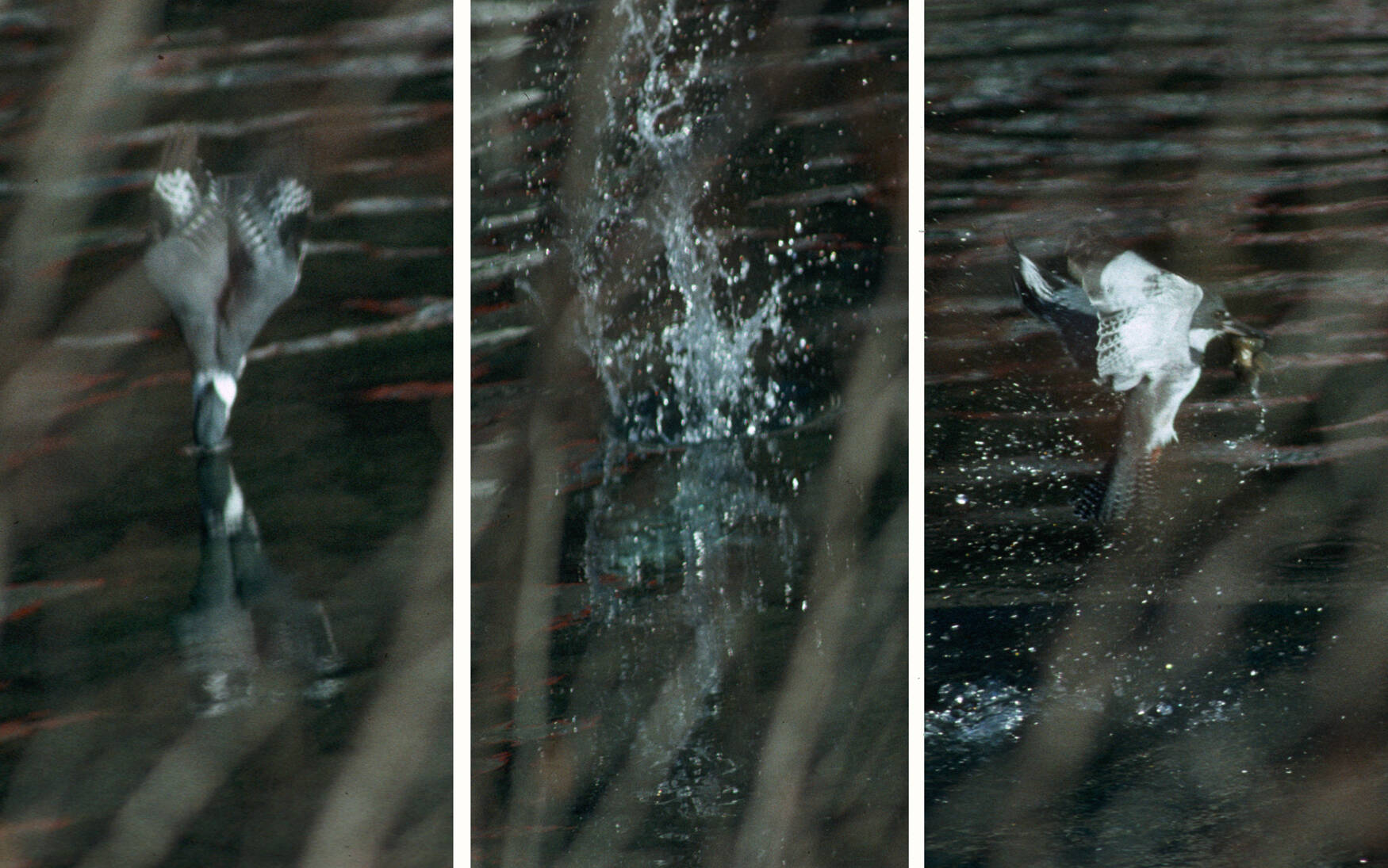
Dippers often dive into a stream from a rock or low-hanging branches not far from the water surface. Kingfishers may plunge from several meters above the surface, folding the wings closer to the sides. Brown pelicans can dive from a height of twenty meters, extending the neck and angling the wings back, making a more streamlined shape. The grand champion divers may be seabirds called gannets and boobies; they can start a dive from almost a hundred meters up, turning the body into a sleek dart, with the neck well-extended and the wings held back close to the body. The dives can reach a speed of sixty mph; to protect the bird from the resulting high impact, the skull is reinforced and subcutaneous air sacs on the chest and sides cushion the jolt.
Pelicans Rob Boobies from Bob Armstrong on Vimeo.
Most of these dives are quite shallow, but some species are adapted for deeper ventures, with heavier, stronger bones than other birds, to resist water pressure and decrease floatation. Gannets are quite deep divers, sometimes going on down to twenty meters. Loons may dive as deep as seventy-five meters and some of the murres and their relatives go down over a hundred meters; the common murre is said to be the deepest diver (sometimes down to 180 meters) in Alaska. Penguins often launch from ice-ledges; small ones make fairly shallow dives, but the emperor penguin can dive down more than five hundred meters!
The second hurdle to underwater foraging is locomotion in a medium that is denser than air. Most aquatic birds have webbed feet, often set far back on the body for good propulsion and steering; grebes have broadly lobed toes instead. But fancy feet are not always sufficient—some of these birds use their wings to swim in pursuit of prey. Gannets and cormorants can wing-it underwater; murres and puffins have narrow, stiff wings adapted to underwater ‘flight’ (without forsaking aerial flight); penguins swim with their flipper-like wings (and cannot fly) and steer with their webbed feet (some of them are very fast swimmers, clocked at over twenty mph).
Kingfishers and dippers don’t have webbed feet, so they have their own ways of moving in water. Kingfishers seem to rise buoyantly to the surface after a dive, wing-fluttering as they lift back into the air. Dippers have strong toes for clinging to rocks and walking even in fast currents, and they swim with their wings for short distances in pursuit of prey; they are the only songbird known to do so and do not have the same adaptions of bones and wings as other, more aquatic, birds do.
Plumages of birds that forage underwater are generally dense and well-waterproofed with oils from the preen gland. Penguin plumage has unusually many tiny filaments that hold air bubbles; when the bird swims, the bubbles are released, which decreases the density of water around the body, allowing faster swimming. Birds that decrease buoyancy by compressing the feathers might get a little of this effect, but penguin plumage can hold more bubbles and release them more gradually.
Diving birds hold their breath underwater, storing oxygen in their lungs. But they can also store extra oxygen in their muscles, in a compound called myoglobin—which, like hemoglobin, is a specialized protein with iron-containing compounds that hold oxygen. Species that engage in long dives and underwater pursuits have more myoglobin than those that spend shorter times without access to air. Emperor penguins can stay underwater for twelve minutes or more (for comparison, humans can normally manage to hold breath for less than two minutes).
• Mary F. Willson is a retired professor of ecology.
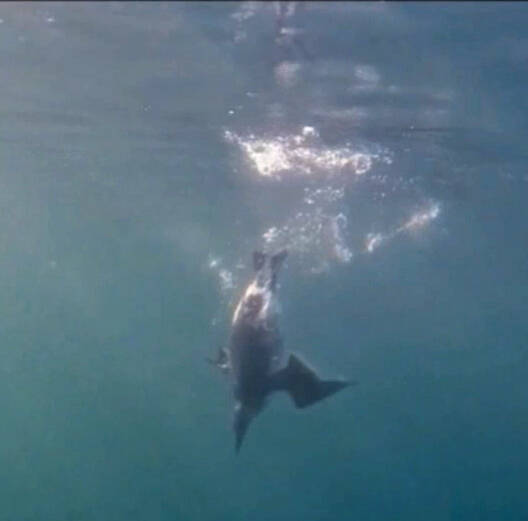
Common murres and their relatives use their wings to swim underwater. (Courtesy Photo / Bob Armstrong)
