
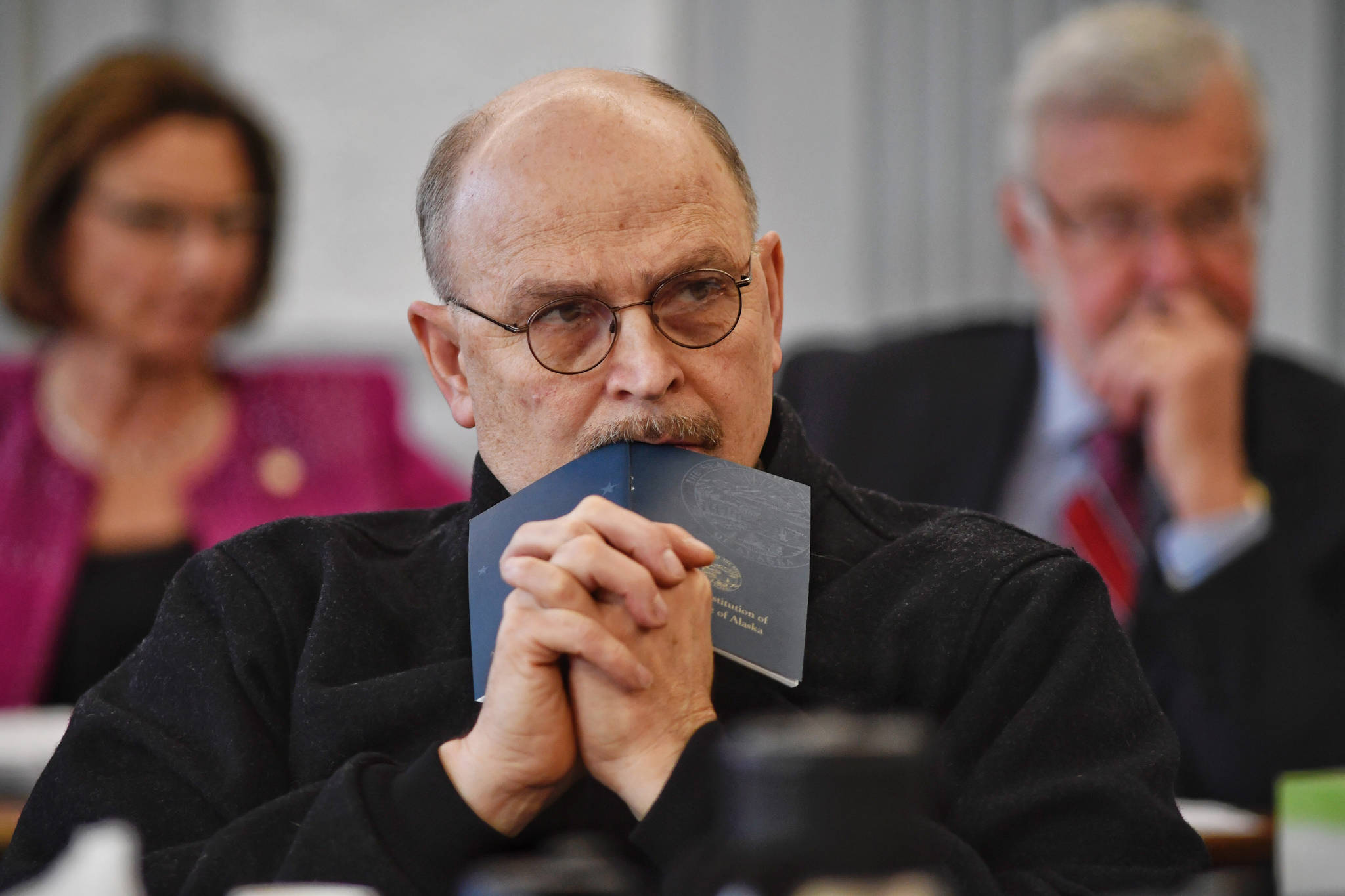
University of Alaska President Jim Johnsen made a case against Gov. Mike Dunleavy’s proposed budget cuts to the university, Tuesday, as the Senate Finance Committee continued to work its way through departmental budget presentations.
The committee met twice actually, once with Office of Management and Budget staff in the morning, and Johnsen made his presentation later in the afternoon.
“People vote with their feet,” Johnsen said on numerous occasions during his hour long presentation, referring to people leaving Alaska, which they have done in recent years. Johnsen believes these Dunleavy’s cuts would exacerbate the problem. He said history has shown that when staff at the university are cut, “enrollment follows.” Johnsen said this would be bad for Alaska.
“I’m not here to negotiate,” Johnsen said.
Johnsen said he was there to advocate for the Board of Regents’ budget requests.
Dunleavy’s budget proposal would cut $134 million from its the UA system’s current budget and eliminate upward of 1,300 jobs.
[Experts: State could lose tens of thousands of jobs if budget proposal goes through]
Johnsen said the University of Alaska Fairbanks is the world’s No. 1 Arctic research university and every dollar put into research at UAF provides a $6 return to the economy. He said there is no question Alaska would lose top researchers if these cuts are made because states such as Oregon and Washington are investing in research.
To illustrate the magnitude of proposed cuts to the UA system, Johnsen explained some options for meeting demands of Dunleavy’s budget proposal:
• Shuttering University of Alaska Southeast would save $25 million.
• Closing every community campus would save $38 million.
• Closing University of Alaska Anchorage would save $$120 million.
University of Alaska President Jim Johnsen gives a presentation about the impact proposed budget cuts would have on university funding, Tuesday, Feb. 19, 2019. (Kevin Baird | Juneau Empire)
UA could double its tuition to make up for the cut, though, Johnsen said.
In the morning, OMB Policy Director Mike Barnhill told the committee that state appropriations to UA comprise 40 percent of the university’s funding. He said UA operates on a much larger scale than of its overall funding than the average state university.
Barnhill pointed to Washington State University in Pullman, Washington, and Oregon State University in Corvallis, Oregon, which receive state appropriations that make up 20 and 16 percent of their respective funding totals.
Sen. Bill Wielechowski, D-Anchorage, said he believes this report may be an unfair comparison. He floated a few ideas as to why it may be more expensive for Alaska to keep its universities running. Operating costs are higher because of remote locations in Alaska. Wielechowski said it’s a common practice for alumni and locals to give generous gifts to universities, and that practice is non-existent in Alaska.
Johnsen responded to this issue later, saying schools like the University of Oregon, have alumni such as Phil Knight, the founder of Nike, who can bankroll the college.
“I would appreciate his interest in us, obviously,” Johnsen said.
Sen. Peter Micciche, R-Soldotna, asked the OMB team if the Dunleavy administration is willing to engage and figure out why Alaska is spending so much more money on its universities than other outside states in the Lower 48 spend on their own universities. OMB Director Donna Arduin says the administration is, and Barnhill’s research shows that.
Sen. Bill Wielechowski, D-Anchorage, said he believes this report may be an unfair comparison. He floated a few ideas as to why it may be more expensive for Alaska to keep its universities running. Operating costs, because of the remote location in Alaska are higher. Wielechowski said it’s a common practice for alumni and locals to give generous gifts to universities, and that practice is non-existent in Alaska.
At one point during the morning meeting, Sen. Bert Stedman, R-Sitka, told Barnhill to pick up the pace or the committee would be there “until August.” Steman’s dark humor elicited laughter from most in the room.
At the end of the morning meeting when the OMB staff filed out of the room, Stedman said, “I see OMB cleared out, didn’t take long,” and then chuckled.
The Senate Finance Committee will continue to receive budget presentations from the OMB the remainder of the week.
• Contact reporter Kevin Baird at 523-2258 or kbaird@juneauempire.com. Follow him on Twitter at @alaska_kev.
