
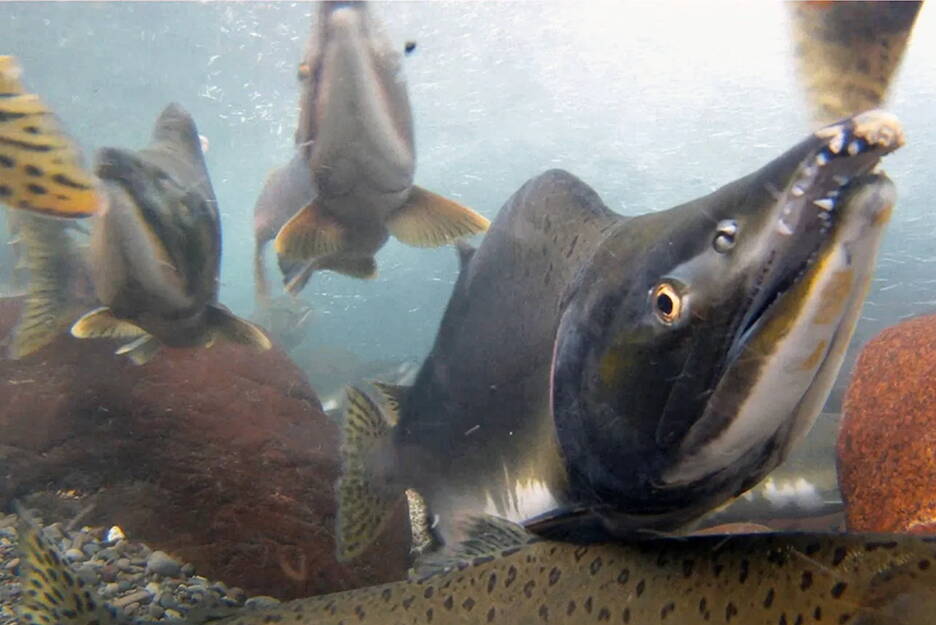
A new analysis of nearly 25,000 fish scales offers more evidence that the millions of pink salmon churned out by Alaska fish hatcheries could be harming wild sockeye salmon populations when they meet in the ocean, according to the scientists who authored the study.
The new peer-reviewed paper, published this week in the ICES Journal of Marine Science, analyzed growth rates that could be deduced from the fish scales, similar to trees’ yearly growth rings.
The paper was built on a unique aspect of the life cycle of pink salmon, which are primarily targeted by commercial fishermen: Their abundance is high in odd-numbered years, and lower in even-numbered years. Those booms and busts allowed authors Peter Rand and Gregory Ruggerone to tease out whether sockeye salmon — which are more highly valued by sport and personal use fishermen — were growing at lower rates during odd years, when pink salmon are more numerous.
Their analysis showed that was the case across the Gulf of Alaska — a dynamic that Rand and Ruggerone describe as a “zero-sum game” between the two species. It found that yearly growth of sockeye was depressed by as much as 17% at times when pink salmon abundance was high.
“This is the first time we’ve looked at populations across coastal Alaska, and we see the same signal in all of them,” Rand said in an interview. “It’s quite compelling.”
There’s been increasing debate in recent years about the impacts on other salmon species of growing populations of pink salmon, and Ruggerone last year published a review paper that documented what it called “consistent and strong” evidence of competition. The pinks have been benefiting from warming ocean waters and are also boosted by hatcheries around Alaska that raise them to bolster harvests by commercial fishermen.
The number of pinks returning annually from the North Pacific Ocean rose to nearly 800 million in 2021, up from 170 million in the early 1970s, with hatcheries contributing some 80 million fish each year, the authors wrote in their new study.
Some policymakers, Ruggerone said, have been holding out for more documentation of competition between hatchery pinks and wild salmon, and the new paper should serve as additional evidence, he added.
A spokesperson for the Alaska Department of Fish and Game, whose commissioner has said it’s an “open question” if there’s a relationship between hatchery-raised pinks and wild king salmon populations, said no one was available Thursday to comment on the new study.
• Nathaniel Herz welcomes tips at natherz@gmail.com or (907) 793-0312. This article was originally published in Northern Journal, a newsletter from Herz. Subscribe at this link. This article originally appeared online at alaskabeacon.com. Alaska Beacon, an affiliate of States Newsroom, is an independent, nonpartisan news organization focused on connecting Alaskans to their state government.
