
By Lisa Mascaro and Farnoush Amiri
Associated Press
WASHINGTON — The House 1/6 committee outlined on Tuesday Donald Trump’s relentless pressure to overturn the 2020 presidential election, aiming to show it led to widespread personal threats on the stewards of American democracy — election workers and local officials who fended off the defeated president’s efforts.
The panel investigating the Jan. 6, 2021, attack at the U.S. Capitol resumed with a focus on Trump’s efforts to undo Joe Biden’s victory in the most local way — by leaning on officials in key battleground states to reject ballots outright or to submit alternative electors for the final tally in Congress. The pressure was fueled by the defeated president’s false claims of voter fraud which, the panel says, led directly to the riot at the Capitol.
Chairman Bennie Thompson declared, “A handful of election officials in several key states stood between Donald Trump and the upending of American democracy.”
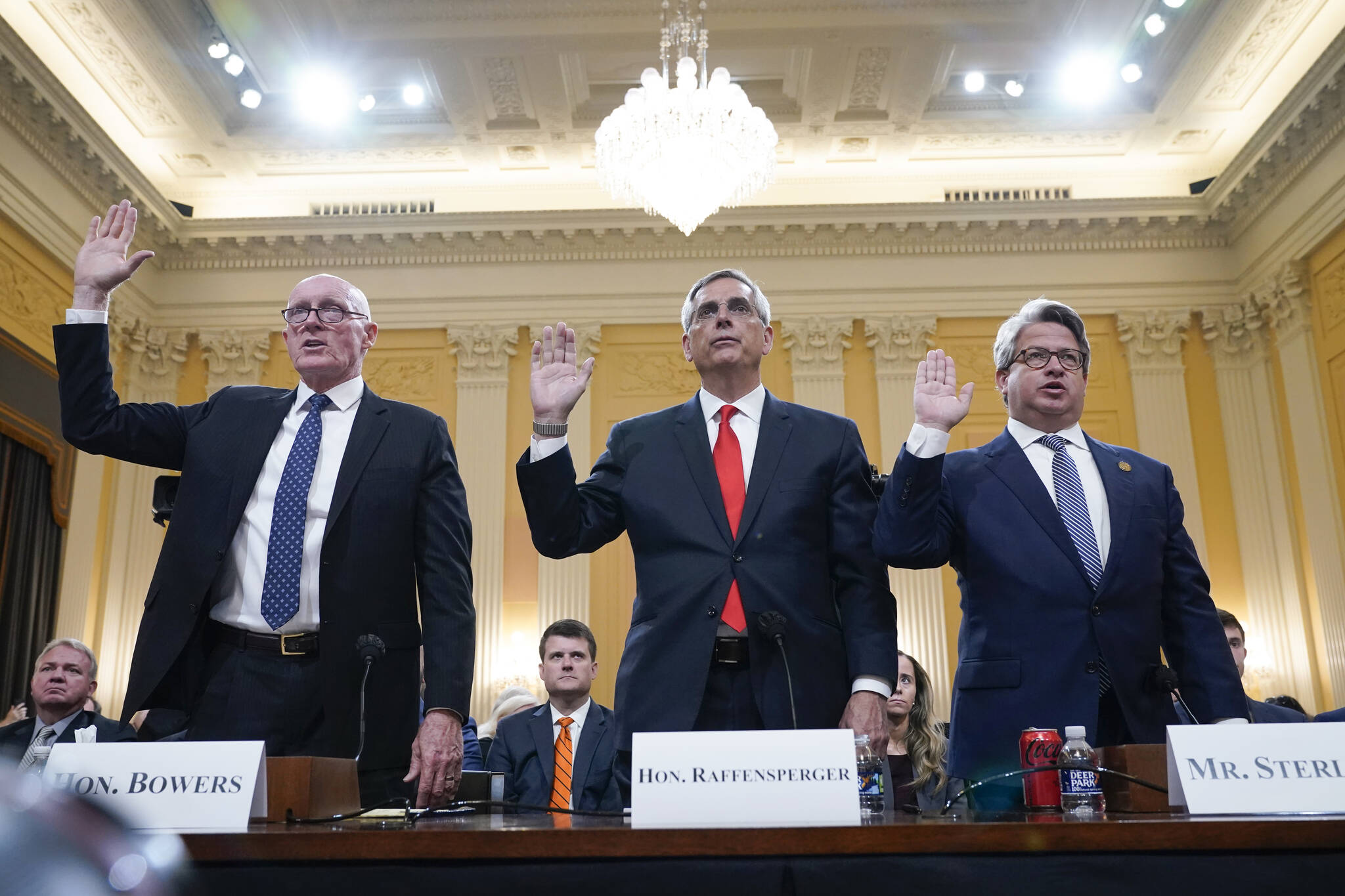
The hearing opened with chilling accounts of the barrage of verbal attacks facing state and local elected officials, including Arizona’s Republican House speaker Rusty Bowers who said he was subject to a “disturbing” smear campaign online, bull-horn protests at his home and a pistol-wielding man taunting his family and neighbors.
Bowers walked through an account of being called by Trump on a Sunday after returning from church when the defeated president laid out his proposal to have the state replace its electors for Joe Biden with those favoring Trump.
“I said, Look, you’re asking me to do something that is counter to my oath,” Bowers testified before the committee.
Bowers insisted on seeing Trump’s evidence of voter fraud, which he said Trump’s team never produced beyond vague allegations. He recalled Trump lawyer Rudy Giuliani at one point told him, “‘We’ve got lots of theories, we just don’t have the evidence.’”
Trump wanted Bowers to hold a hearing at the state Capitol, but the Republican leader said there was already a “circus” atmosphere over the election. The panel showed video footage of protesters at the Arizona state house including a key figure, the horned-hat wearing Jacob Chansley, who was later arrested at the Jan. 6, 2021 Capitol riot.
Trump nevertheless pressed the Arizona official, including in a follow-up call, suggesting he expected a better response from a fellow Republican.
But Bowers testified under oath that because of his faith, including a belief the U.S. Constitution is divinely inspired, what the president was asking him to do was “foreign to my very being.”
Republican Rep. Liz Cheney, the panel’s vice chair, embraced Bowers during a break in the hearing.
She implored Americans to pay attention to the evidence being presented, declaring, “Donald Trump didn’t care about the threats of violence. He did not condemn them, he made no effort to stop them.”
“We cannot let America become a nation of conspiracy theories and thug violence.”
The public hearing, the fourth by the panel this month, stemmed from its yearlong investigation into Trump’s unprecedented attempt to remain in power, a sprawling scheme that the chairman of the Jan. 6 committee has likened to an “attempted coup.”
Thompson, D-Miss., pointed to recent election disputes in New Mexico and said, “The danger hasn’t gone away. It’s corrupting our democratic institutions.”
Georgia Secretary of State Brad Raffensperger testified about Trump’s phone call asking him to “find 11,780” votes that could flip his state to prevent Biden’s election victory.
Raffensperger and his deputy Gabe Sterling were key witnesses, along with Wandrea “Shay” Moss, a former Georgia election worker who, with her mother, has said they faced such severe public harassment from Trump allies they felt unable to live normal lives.
While the committee cannot charge Trump with any crimes, the Justice Department is watching the panel’s work closely. Trump’s actions in Georgia are also the subject of a grand jury investigation, with the district attorney expected to announce findings this year.
Trump defended himself on social media, describing his phone call to Raffensperger as “perfect,” similar to the way he described his 2020 call with Ukraine President Volodomyr Zelenskyy that resulted in his first impeachment.
During the call, days before the Jan. 6 attack, Trump repeatedly cited disproven claims of fraud and raised the prospect of a “criminal offense” if Georgia officials did not change the state’s count. The state had counted its votes three times before certifying Biden’s win by a margin of 11,779.
The public testimony from Raffensperger came weeks after he appeared before a special grand jury in Georgia investigating whether Trump and others illegally tried to intervene in the state’s 2020 election, and after Raffensperger beat a Trump-backed challenger in last month’s primary election.
Sterling, Raffensperger’s chief operating officer, became a notable figure in Georgia’s long post-election counting, and recounting, of the presidential ballots, with his regular updates often broadcast live to a divided nation. At one point, the soft-spoken Republican implored Americans to tone down the heated rhetoric.
“Death threats, physical threats, intimidation — it’s too much, it’s not right,” he said.
Bowers also revealed a second phone call with Trump in December 2020 that he said was mainly small talk, although Trump also referenced their first conversation.
Moss, who had worked for the Fulton County elections department since 2012, and her mother, Ruby Freeman, a temporary election worker, filed a defamation lawsuit in December 2021. Moss claimed conservative outlet One America News Network and Giuliani falsely spread allegations that she and her mother engaged in ballot fraud during the election. The case against OAN has since been dismissed with a settlement.
The select committee also worked to untangle the elaborate “fake electors” scheme that sought to have representatives in as many as seven battlegrounds — Arizona, Georgia, Michigan, Pennsylvania, Wisconsin, Nevada and New Mexico — sign certificates falsely stating that Trump, not Biden, had won their states.
Conservative law professor John Eastman, a lawyer for Trump, pushed the fake electors in the weeks after the election. Trump and Eastman convened hundreds of electors on a call on Jan. 2, 2021, encouraging them to send alternative slates from their states where Trump’s team was claiming fraud.
The fake electors idea was designed to set up a challenge on Jan. 6, 2021, when Congress met in joint session, with Vice President Mike Pence presiding over what is typically a ceremonial role to accept the states’ vote tallies. But the effort collapsed, as Pence refused Trump’s repeated demands that he simply halt the certification of Biden’s win — a power he believed he did not possess in his purely ceremonial role.
At least 20 people in connection with the fake electors scheme were subpoenaed by the House panel. The committee says it will also show that it has gathered enough evidence through its more than 1,000 interviews and tens of thousands of documents to connect the varying efforts to overturn the election directly to Trump.
