
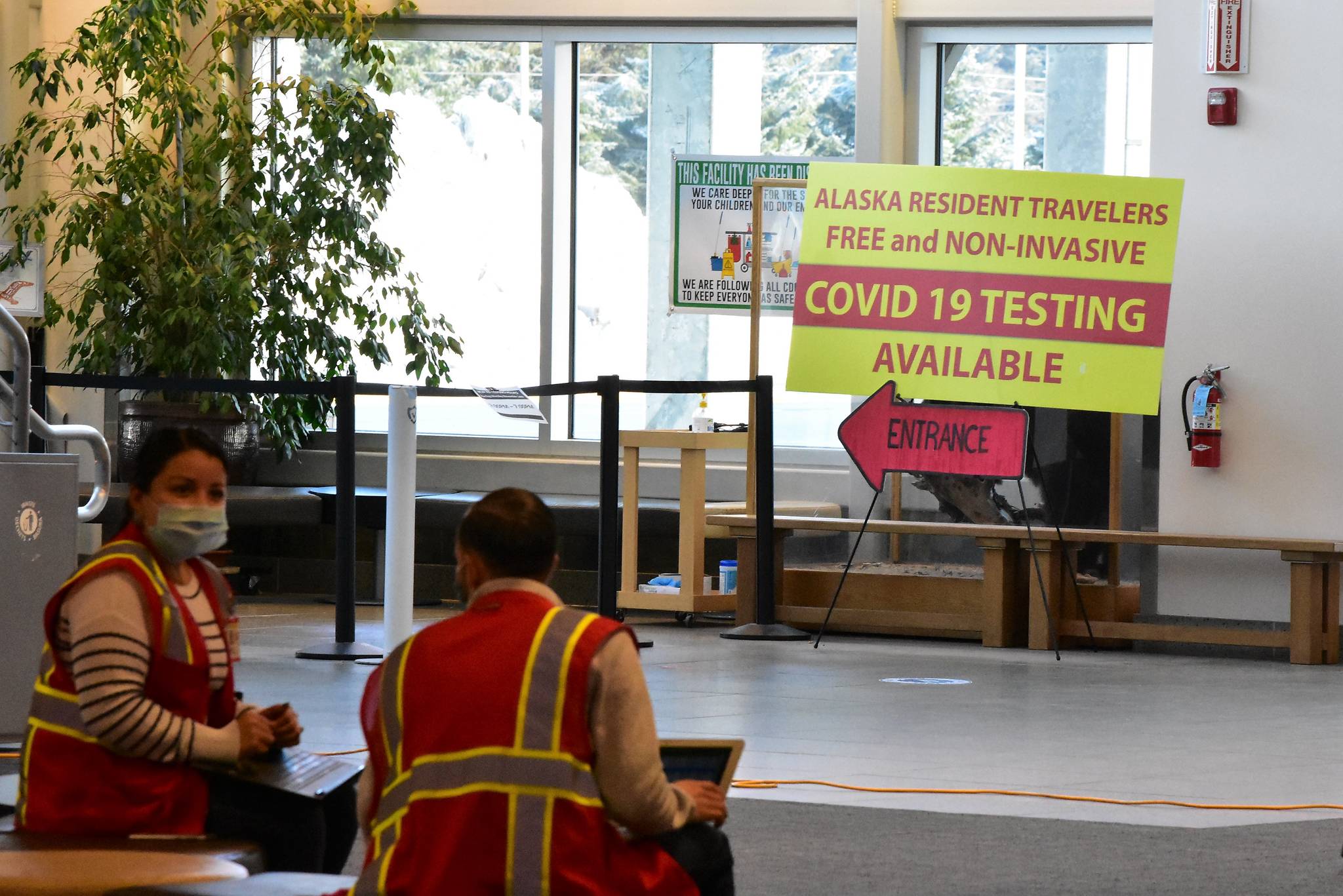
The City and Borough of Juneau will see little change under Gov. Mike Dunleavy’s new health orders, city officials said Tuesday, as the orders largely extended regulations already in place. Speaking during a community update, Emergency Operations Center incident commander Mila Cosgrove said the regulations regarding travel within the state were likely to affect the public most.
“There’s not a lot of change for our community,” Cosgrove said during the EOC’s weekly update. “We were already doing most of the things the governor asked us to do.”
Dunleavy issued the new health orders as part of his new disaster declaration that took effect Monday. The new health orders are mostly an extension of regulations laid out under the previous health mandates with some refinements. Legally the orders are no different from the mandates issued under the previous declaration, acting Attorney General Ed Sniffen said Monday, but the wording was changed so the new health orders weren’t confused with the past mandates.
Travelers coming to the state must still submit a travel plan including test results and a self-isolation plan, and airport testing will still be free for residents and $250 for nonresidents, according to the orders. Residents returning from out of state do not have to be tested, but must self-quarantine for 14 days following arrival in Alaska.
Residents traveling out of the state for less than 72 hours are not required to be tested or to self-quarantine, and must only self-monitor for symptoms of COVID-19, the orders say. Any traveler who can provide proof of a positive test within the past 90 days, who also can provide documentation of recovery from a medical provider and is asymptomatic at the time of travel may also forgo testing in order to enter the state, under the new regulations.
[Governor defends virus approach amid criticism]
While the state is not enacting any health measures more stringent than were already in place, the new emergency declaration allows municipalities to pass their own health regulations, so long as they don’t interfere with critical infrastructure such as the travel of essential personnel like health and law enforcement officials. Critical infrastructure employees are defined by the state and must have a letter from their employer showing compliance with state regulations, according to the health orders.
The health orders do provide special provisions for people traveling between communities on and off the state’s road system, including the Alaska Marine Highway. Under state travel orders, if a traveler from a community off the road system travels to a community connected to the system, the state requires that person get tested at least 72 hours before returning home.
People traveling between communities on and off the road system can receive tests for the purpose of traveling at the Juneau International Airport from 10-11:30 a.m. or 1:30-4 p.m. daily. Those seeking tests are asked to make an appointment online with the private laboratory contracted with the state to process tests from the airport.
Dunleavy has said his administration wants to support local communities implement their own strategies and find things that work in those communities. But that kind of approach has been criticized by health experts on both a national and state level. Speaking to reporters Tuesday, Dr. Anthony Fauci, the U.S. government’s top infectious disease expert, said the nation needed a uniform response rather than a “disjointed” state-by-state response, according to the New York Times.
A similar criticism of locally-focused health regulations in Alaska was voiced by Alaska Native Medical Center interim CEO Dr. Bob Onders during a news conference earlier this month. The state’s current patchwork legal framework wasn’t working, Onders told reporters, and a statewide mask mandate would establish a bare minimum of health standards across Alaska.
That news conference featured several health experts from around the state, including President and CEO of the Alaska State Hospital and Nursing Home Association Jared Kosin, who said his organization supported a statewide mask mandate. Health experts warned at that conference the state’s health care facilities were at risk of becoming overrun if stricter measures were not taken.
In a statement Monday, ASHNHA said that in the week ending Nov. 13, 530 health care workers could not report to work because they either tested positive for COVID-19 or had to self-quarantine due to potential exposure to the virus.
Announcing the new health orders Monday, Department of Health and Social Services Commissioner Adam Crum said the state’s recent increased messaging around the seriousness of the pandemic seemed to have made an impact. On Nov. 11, the governor used the state’s emergency messaging system to send a video to Alaskans’ phones, strongly urging them to take health precautions seriously. Crum said Monday DHSS had already received positive feedback from regional health officials saying the increased messaging had already made an impact.
ASHNHA’s statement said they supported the governor’s message but continued to support a statewide mask mandate.
CBJ reported five new coronavirus cases locally Tuesday and said in a news release a cluster among seven students in residence halls at the University of Alaska Southeast is remaining steady and students are in isolation. Statewide health officials reported 637 new cases and an additional death. The new death brings the total number of residents who died with COVID-19 to 99. There are 53 active cases in Juneau, according to CBJ.
People seeking tests for travel to and from communities off the road system can make an appointment for testing at the Juneau International Airport by going to juneau.fulgentgenetics.com.
• Contact reporter Peter Segall at psegall@juneauempire.com. Follow him on Twitter at @SegallJnuEmpire.
