
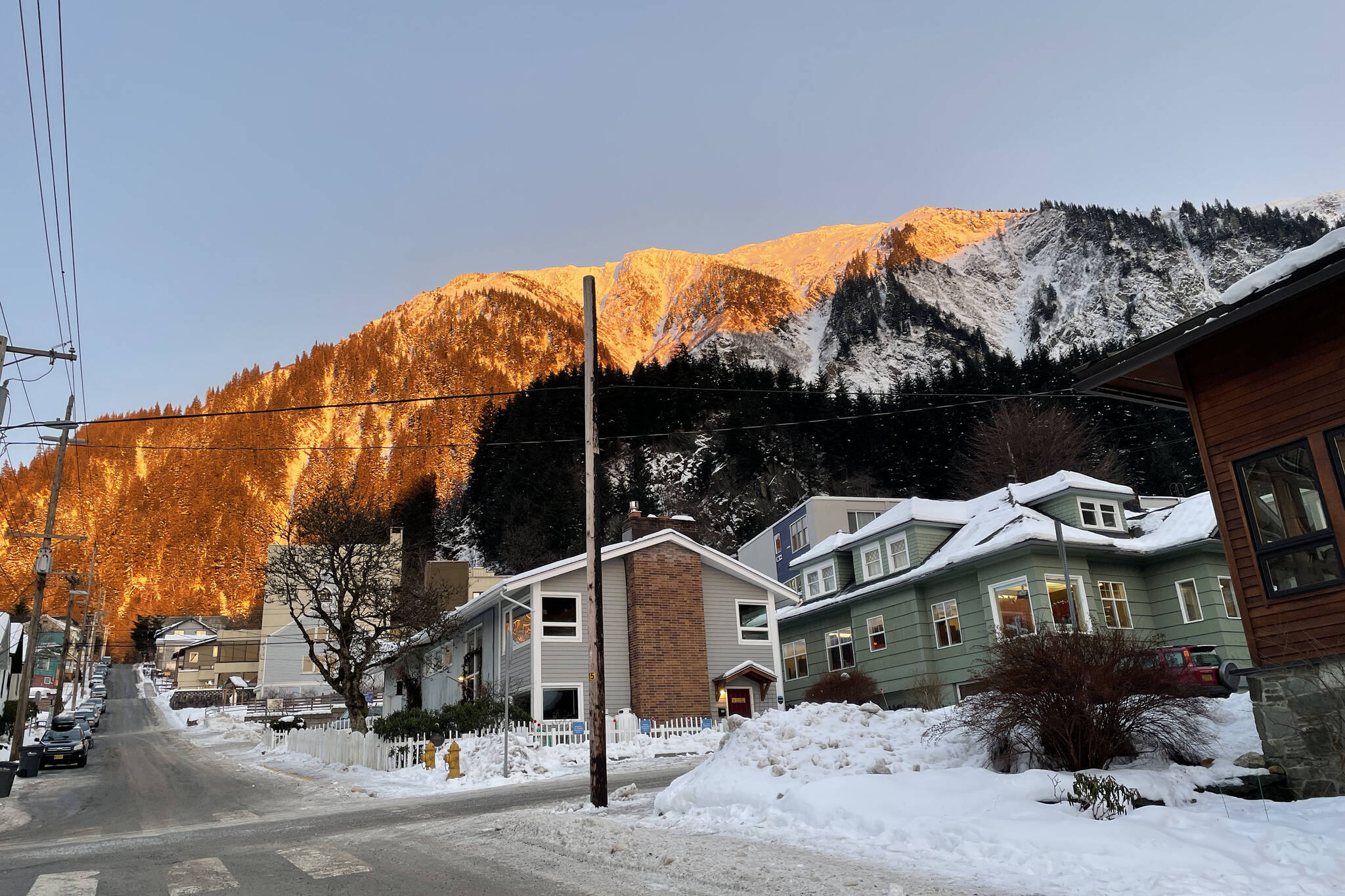
The sun rises over Juneau on Dec. 16, 2021. The solstice on Dec. 21 will mark the shortest day of the year as the northern hemisphere is at its furthest away from the sun. (Michael S. Lockett / Juneau Empire)

The sun rises over Juneau on Dec. 16, 2021. The solstice on Dec. 21 will mark the shortest day of the year as the northern hemisphere is at its furthest away from the sun. (Michael S. Lockett / Juneau Empire)

Dark night of the sol: Solstice means we’ll soon be gaining daylight

Solstice means we’ll soon be gaining daylight

As snow falls, Juneau is entering the shortest day of the year — and the turning point, as the days begin to gain more light.

Juneau will begin gaining 30 seconds of light a day, stretching to as much as 5 more minutes of light each day by the spring equinox, said Marie Drake Planetarium lecturer Steve Kocsis.

“The whole reason for the solstice is the tilt of the Earth’s axis,” Kocsis said in a phone interview. “The solstice is always seen as a turning point. It’s the longest night of the year.”

[Shopping aisle be home for Christmas]

The solstice will occur when the sun hits its very furthest point south, which occurs Tuesday morning for Alaska.

“It’s tomorrow Alaska time around 6:58 a.m.,” Kocsis said. “At Rio de Janeiro tomorrow, the sun will be directly overhead tomorrow at noon.”

Rio de Janeiro is located 22.9 degrees south, giving it nearly 12.5 hours of daylight on the solstice. By contrast, Kocsis said, Juneau will see sunrise at 8:45 a.m. and sunset at 3:10 p.m., giving Juneau fewer than 7 hours of daylight. It won’t get any darker here, pausing for one day tomorrow and then beginning to grow later.

“Solstice means standing still,” Kocsis said. “We’re at 58 degrees latitude. You go north, (the change in light per day) is more extreme, you go south, it’s less extreme.”

The word solstice itself comes from latin for sun, sol, and stit, which was part of the Latin verb sistere, meaning to stand still, creating the word solstitium, according to the Merriam-Webster Dictionary. English speakers later shortened it to solstice, Merriam-Webster said.

Juneau’s far northerly location means the sun will barely clear the horizon on the solstice. In Fairbanks, the sun will rise at 10:57 a.m. and set at 2:39 p.m. And in Utqiaġvik, the sun won’t rise at all, with its first sunrise of the new year on Jan. 22, 2022, according to the National Oceanic and Atmospheric Administration.

“It’s the southernmost point of the sun in the sky. It’ll be about 8 degrees above the horizon at local noon,” Kocsis said. “If you hold your fist out at arm’s length, that’s about 8 degrees.”

For those with a yen to learn more about the workings of the vast heavens and their dark halls full of bright burning stars, the planetarium is reopening for shows, including one before the new year, said Christina Della-Rosa, president of the board of the Marie Drake Planetarium.

“We’ve started restarting shows with just small audiences because of COVID,” Della-Rosa said in a phone interview.

Shows are free but do require guests to register ahead of time at MarieDrakePlanetarium.org, Della-Rosa said.

• Contact reporter Michael S. Lockett at 757-621-1197 or mlockett@juneauempire.com.

More in News

Brenda Schwartz-Yeager gestures to her artwork on display at Annie Kaill’s Gallery Gifts and Framing during the 2025 Gallery Walk on Friday, Dec. 5. (Mari Kanagy / Juneau Empire)
Alaska artist splashes nautical charts with sea life

Gallery Walk draws crowds to downtown studios and shops.

A totem pole, one of 13 on downtown’s Totem Pole Trail in Juneau, Alaska, Nov. 27, 2024. (Christopher S. Miller/The New York Times)
Downtown Juneau experiences its first significant city-level snow fall of the season as pictured on Saturday, Dec. 6, 2025. (Mari Kanagy / Juneau Empire)
Sub-zero temperatures to follow record snowfall in Juneau

The National Weather Service warns of dangerous wind chills as low as -15 degrees early this week.

A truck rumbles down a road at the Greens Creek mine. The mining industry offers some of Juneau’s highest paying jobs, according to Juneau Economic Development’s 2025 Economic Indicator’s Report. (Hecla Greens Creek Mine photo)
Juneau’s economic picture: Strong industries, shrinking population

JEDC’s 2025 Economic Indicators Report is out.

Map showing approximate location of a 7.0-magnitude earthquake on Saturday, Dec. 6, 2025. (Courtesy/Earthquakes Canada)
7.0-magnitude earthquake hits Yukon/Alaska border

Earthquake occurred about 55 miles from Yakutat

A commercial bowpicker is seen headed out of the Cordova harbor for a salmon fishing opener in June 2024 (Photo by Corinne Smith)
Planned fiber-optic cable will add backup for Alaska’s phone and high-speed internet network

The project is expected to bring more reliable connection to some isolated coastal communities.

Gustavus author Kim Heacox talked about the role of storytelling in communicating climate change to a group of about 100 people at <strong>Ḵ</strong>unéix<strong>̱</strong> Hídi Northern Light United Church on Wednesday, Dec. 3, 2025. (Mari Kanagy / Juneau Empire)
Author calls for climate storytelling in Juneau talk

Kim Heacox reflects on what we’ve long known and how we speak of it.

The Juneau road system ends at Cascade Point in Berners Bay, as shown in a May 2006 photo. (Michael Penn / Juneau Empire file)
State starts engineering for power at proposed Cascade Point ferry terminal

DOT says the contract for electrical planning is not a commitment to construct the terminal.

Most Read