
Clarification: This article has been updated to clarify that the Department of Homeland Security plans to start a new center of excellence.
For the U.S. Department of Homeland Security, which has a combination of public safety, emergency response and law-enforcement functions, climate change is creating new challenges for which old responses are no longer adequate, a top department official said on Tuesday.
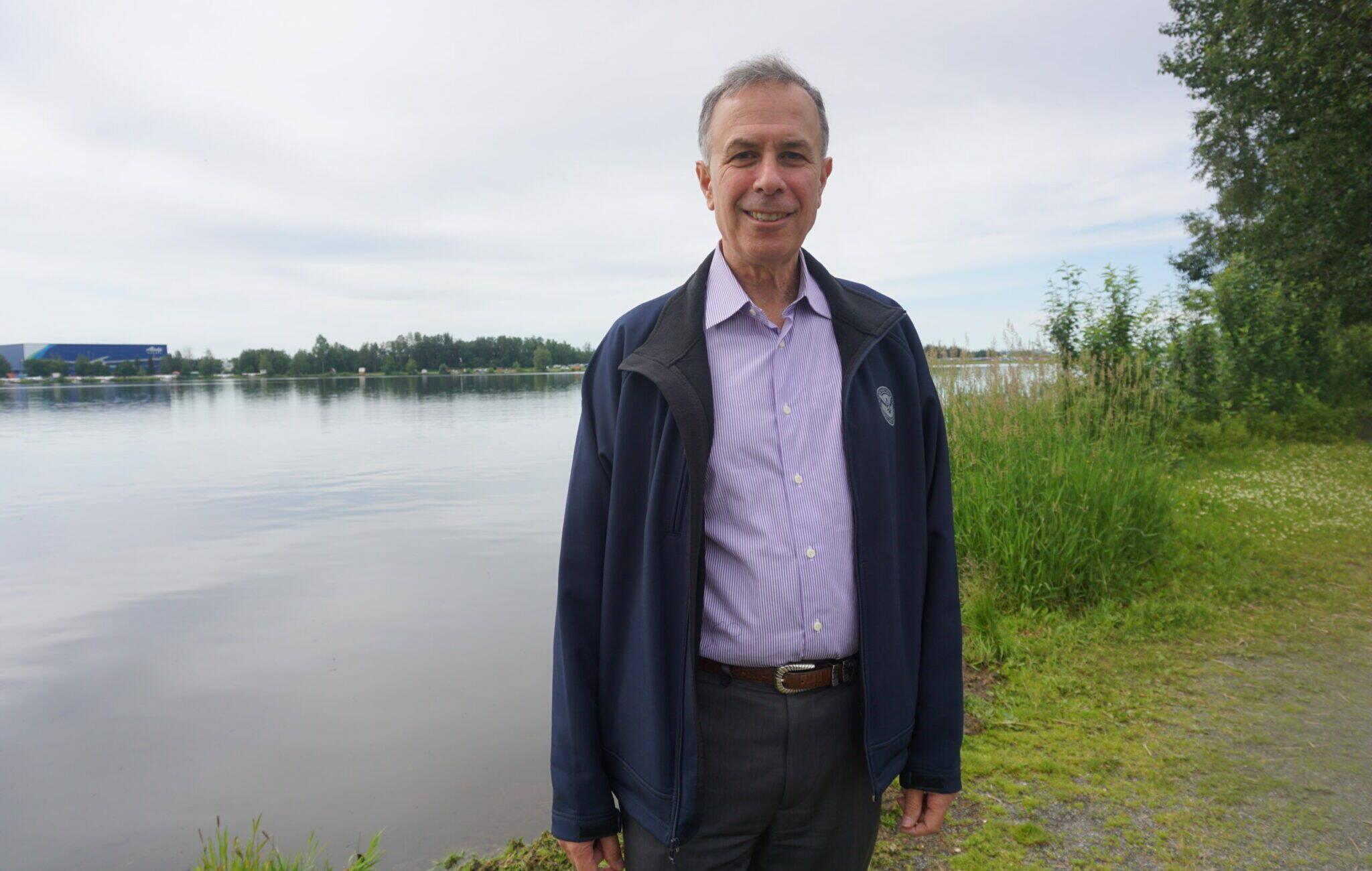
“I think we live in just a remarkable time, a time of unprecedented change for which we have no historical context for what is happening around us,” said Dimitri Kusnezov, a physicist and former Yale University professor and Department of Energy expert who was confirmed in 2022 as the Homeland Security undersecretary for science and technology.
The forces of climate change that are reducing ice cover and opening up the Arctic to more activity are making Alaska more important, said Kusnezov, who was in the midst of his first tour of the state.
To that end, the department plans to revitalize the Arctic Domain Awareness Center that has been based at the University of Alaska Anchorage, he said in a brief interview in Anchorage before he caught a flight to Fairbanks.
The center was established in 2014 as one of the department’s “centers of excellence” to research threats and challenges to the homeland, but its activity has been reduced. It is now considered to be in “emeritus” status, he said. Homeland Security is now planning to start a new center of excellence focused on Arctic homeland security, with an announcement expected this fall, he said.
The Arctic looms large as far as south as Juneau, which serves as the Alaska headquarters for the one of the best-known branches of the Department of Homeland Security, the U.S. Coast Guard, Kusnezov found during a stop there.
From what he heard in Juneau, the amount of time it takes to respond to Arctic emergencies or needs when personnel, equipment and other resources are located well south of the Arctic Circle is “a hard problem” for the Coast Guard, Kusnezov said.
The Coast Guard conducts seasonal Arctic operations every year, a program called Operation Arctic Shield that uses Kotzebue as its temporary base. But there is no permanent presence. That lack of permanent presence extends across the department, Kusnezov said.
“DHS does not have a lot of a physical footprint up north. And staging equipment or vessels for search and rescue, I think, is something that is a challenge for the future,” he said.
Aside from meeting with Coast Guard officials in Juneau on Monday, Kusnezov spent part of Tuesday meeting with Julie Kitka, the president of the Alaska Federation of Natives, who brought up Western Alaska’s experience with last fall’s Typhoon Merbok disaster, among other topics. He also toured the Ted Stevens Center for Arctic Security Studies on Joint Base Elmendorf-Richardson.
Kusnezov was scheduled to examine permafrost and the impact of its thaw in Fairbanks, a trip that includes a tour of the U.S. Army Corps of Engineers Permafrost Tunnel Research Facility, with further travel to Utqiagvik to learn about erosion, storm surges and other hazards there. A community meeting is scheduled in Utqiagvik to allow him to learn about public concerns.
For the Arctic and beyond, climate change is playing out in extreme events like huge wildfires, heat waves and floods, events that require the emergency actions for which the Department of Homeland Security, though its Federal Emergency Management Agency and other branches, is responsible.
“Every day we have events that are once-in-a-lifetime. And that’s a lot of lifetimes to live through in one season,” he said.
His job is to employ science and technology to help prepare for such emergencies, he said. While extreme events may not be preventable in the near term, they can be better predicted and tracked through science and technology, he said.
To learn about threats facing Alaska, Kusnezov’s visit was timed serendipitously.
On Saturday, just before his arrival, a magnitude 7.2 earthquake struck an area near the Alaska Peninsula community of Sand Point, triggering a tsunami warning and some brief evacuations in coastal towns. At the same time, Shishaldin Volcano in the Aleutian Islands has been erupting explosively since Saturday, including on Tuesday, when it sent an ash cloud up to 30,000 feet into the air, potentially reaching airspace used by commercial jetliners. The National Weather Service has issued advisories about Shishaldin to both pilots and mariners.
Kusnezov said he has been monitoring both situations and that they show the force of natural events.
“It’s a reminder that we’re not in control of our destiny in that sense. These things are going to happen and they’re going to surprise us,” he said.
• Yereth Rosen came to Alaska in 1987 to work for the Anchorage Times. She has reported for Reuters, for the Alaska Dispatch News, for Arctic Today and for other organizations. She covers environmental issues, energy, climate change, natural resources, economic and business news, health, science and Arctic concerns. This story originally appeared at alaskabeacon.com. Alaska Beacon, an affiliate of States Newsroom, is an independent, nonpartisan news organization focused on connecting Alaskans to their state government.
